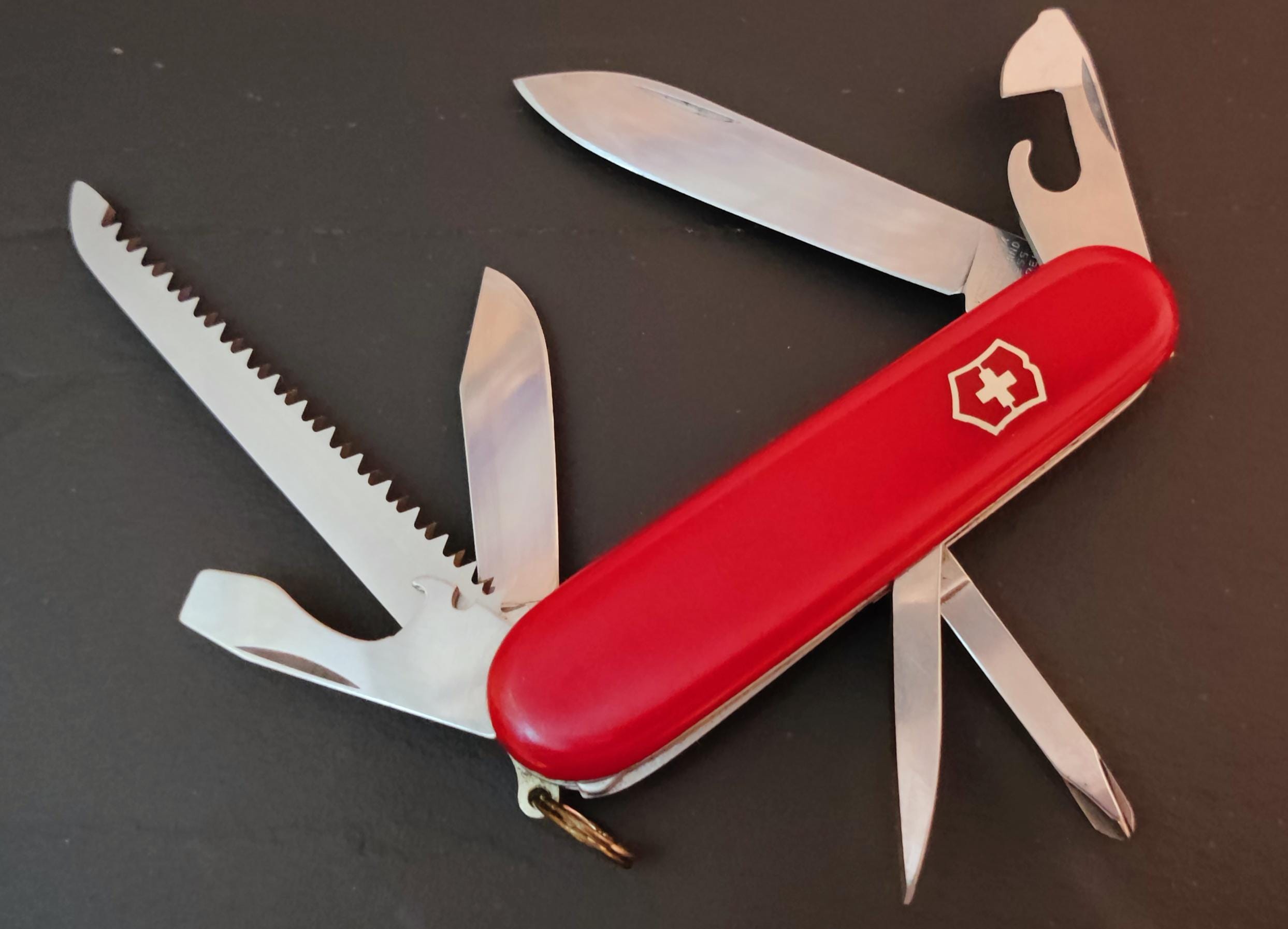
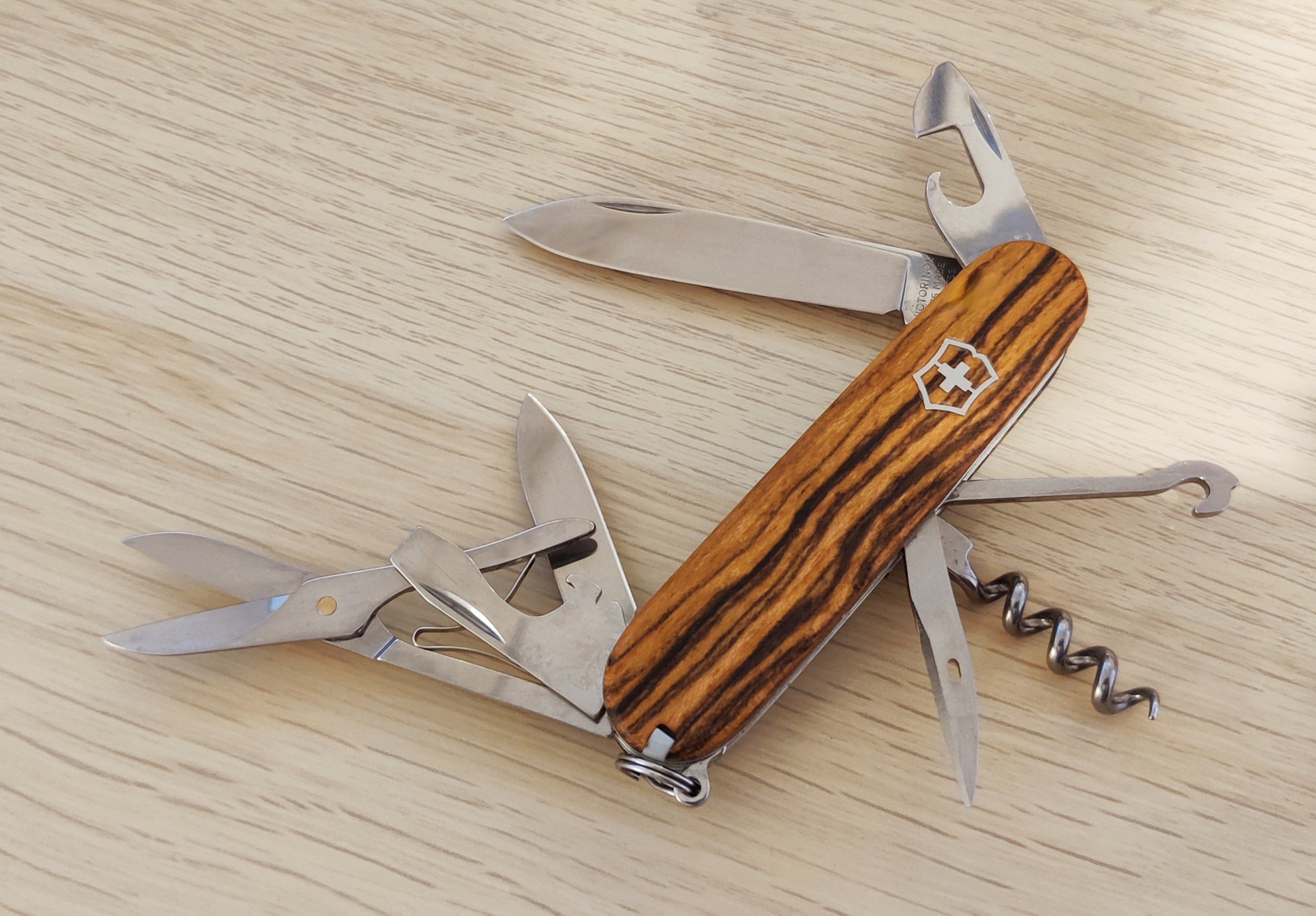
The 1973 Technical 4-Layer with the Ford T Identity
Introduction
Introduced in 1973, the Victorinox Grand Prix embodies the technical evolution of the Automobile lineage.
Built as a 4-layer Officer knife with a rear Phillips screwdriver, it positions itself as a mechanically oriented configuration within the newly structured 91 mm range of the 1970s.
Its identity is reinforced by the permanent Ford Model T metal inlay, carried throughout its entire production life.
The Grand Prix remains in the catalogue through the 1970s and 1980s before disappearing in the 1990s.
I. Technical Overview — The 4-Layer Technical Layout
- Closed length: 91 mm
- Introduced: 1973
- Discontinued: 1990s
- Architecture: 4 layers
- Orientation: Technical / automotive
Tool configuration

Grand Prix 1985
Large blade
Small blade
Scissors
Metal file
Can opener + small screwdriver
Bottle opener + large screwdriver + wire stripper
Back Layer Tools
Phillips screwdriver
Flat screwdriver (until the late 1980s)
Reamer / awl
Scale Tools
Toothpick
Tweezers
II. 1973 Context — The Technical Reset
The Grand Prix appears at a pivotal moment for the 91 mm range.

Grand Prix 1973

Catalogue 1973
Alongside the Mountaineer that had emerged slightly earlier in the early 1970s, it reflects Victorinox’s effort to modernize and rationalize its technical offerings after the Elinox era.

Mountaineer early 1970's & Grand Prix 1973
While older models like the Automobile continue briefly after 1973, the Grand Prix becomes the structurally coherent 4-layer technical reference of the mid-1970s.

Automobile 1973, Grand Prix 1973, Automobile Special (Grand Prix Junior) 1973
At the same time, the Automobile Special appears, replacing the inline technician screwdriver with a small blade — reinforcing the Grand Prix’s clearer mechanical positioning.
III. The Ford T Metal Inlay — Permanent Identity
Throughout its entire existence, the Grand Prix carries the Ford Model T metal inlay.

5 subtle variations of the inlay exist across production decades — differences in tone, finish, and execution — detailed in dedicated metal inlay studies.
👉1973 — A Turning Point for Victorinox Metal Inlays
👉Victorinox Catalogue Metal Inlay Models of the 1970s — From Nickel-Silver to Stainless Steel
👉Victorinox Regular Metal Inlays Models in the 1980s
Unlike transitional inlays that migrated between models, the Grand Prix remained permanently associated with the Ford T.

Ford T 1908
It defines the knife visually and thematically.

Early 1980's Catalogue

Late 1980's Catalogue
IV. Corporate Platform
The Grand Prix became a preferred base model for corporate and industrial editions.
Notable examples include:
- Brown Boveri
- ABB

Mid 1970's BBC Grand Prix & late 1980's ABB Grand Prix
Its technical toolset made it particularly suited for corporate gifts in mechanical and industrial sectors.
In some cases, the Ford T inlay or Victorinox Shield was replaced with company-specific inserts, strengthening its professional identity.

Grand Prix 1976-1978 K-Lines

Grand Prix 1983-1985 Rogers (holsters)
V. Late 1980s Structural Update
By the late 1980s, the Grand Prix undergoes a structural simplification:
- The rear flat screwdriver disappears
- The keyring becomes an option

Late 1980's Grand Prix

Grand Prix 1991
This marks the final evolution of the model before its disappearance in the 1990s.
The removal of the extra rear tool reflects Victorinox’s broader effort to streamline overlapping configurations.
Position within the 91 mm Range
The Grand Prix occupies a precise structural niche:
- A 4-layer technical configuration
- More mechanically oriented than file-only models
- Successor to the Cadillac philosophy
- A bridge between Elinox-era technical knives and the simplified 1990s lineup
It represents the rationalized industrial Officer knife of its generation.
Collector Perspective and Significance
The Grand Prix stands out because:
- It marks the 1973 technical restructuring
- It consistently carried the Ford T inlay
- It evolved structurally in the late 1980s
- It served extensively as a corporate platform
- It bridges two eras of Victorinox technical design
Early examples with the rear flat screwdriver and later simplified versions offer clear collecting distinctions.
Corporate inlay variants add another layer of interest.
Related Models
- 👉Automobile (8134m) – Earlier inline technician era
- 👉Automobile Special – Small blade alternative
- 👉Mountaineer – Contemporary 4-layer file model
- 👉Cadillac 5146m – Deluxe predecessor
Conclusion
The Victorinox Grand Prix represents the definitive 4-layer technical Officer knife of the post-1973 generation.
With its permanent Ford T identity and strong corporate presence, it carried forward the spirit of the Automobile lineage into a modernized structural framework.
Its disappearance in the 1990s marks the end of a visual identity technical branch within the 91 mm range — one that today remains highly appreciated by collectors.
This article is part of the SAKnife Archives, an independent collector-driven project dedicated to documenting Victorinox Swiss Army Knives. All photographs shown come from the SAKnife private collection unless otherwise noted. The historical and technical information presented here is based on period catalogues and expert collector databases. Additional material will be added as new information emerges.
Identify every Victorinox 91 mm configuration using the structural identification tree:
👉 🔎 Victorinox 91mm Identification Tree – Identify Your Swiss Army Knife by Toolset
Identify the production period of your Swiss Army Knife using the interactive visual tool based on tang stamps and tool evolution:
👉 ⌛ Swiss Army Knife Production Period Guide – Victorinox Interactive Tool Evolution
Explore the evolution of Victorinox 91 mm Swiss Army Knives and discover related model sheets in the historical timeline:
👉 📘 Swiss Army Knife History & 91 mm Model Evolution