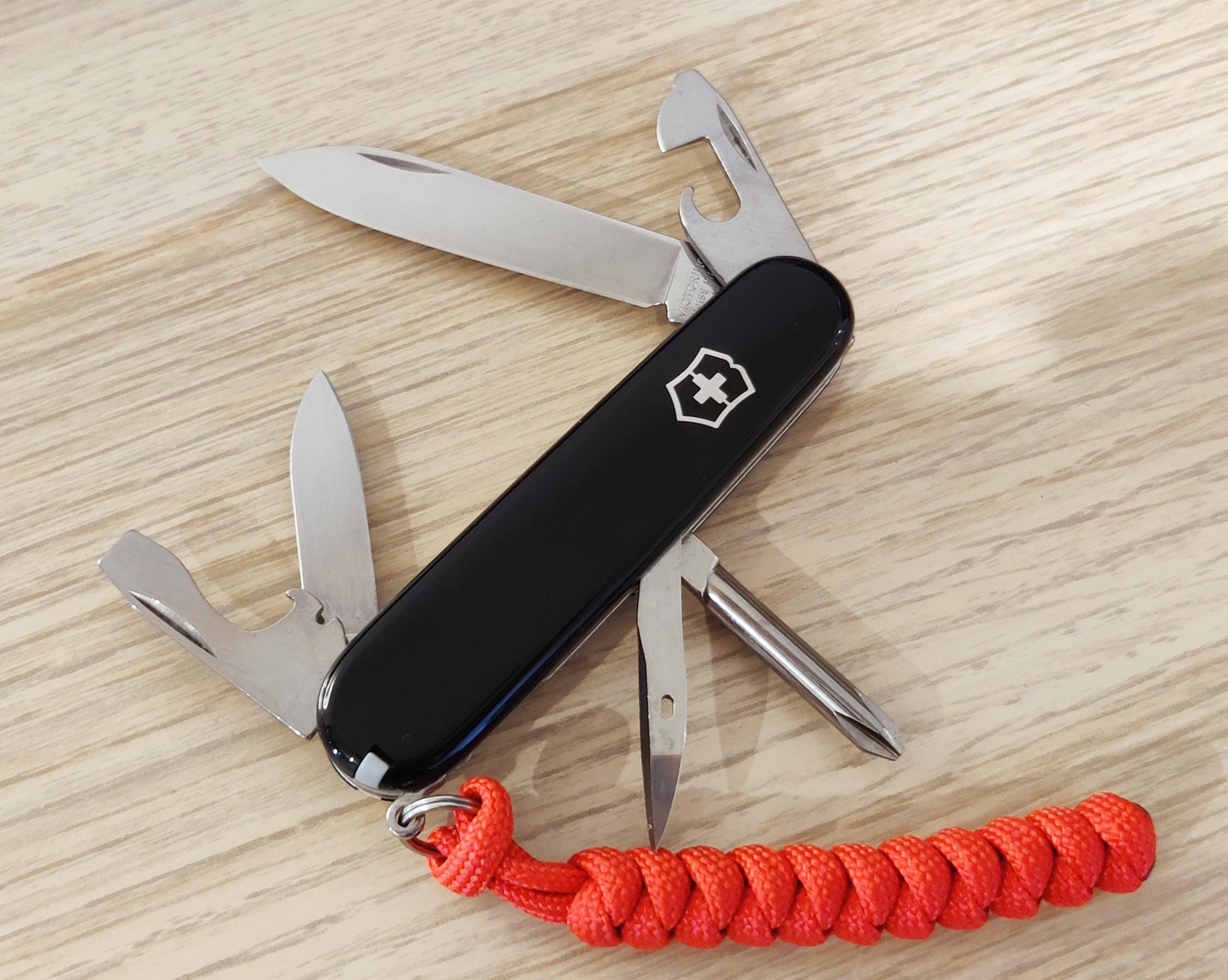
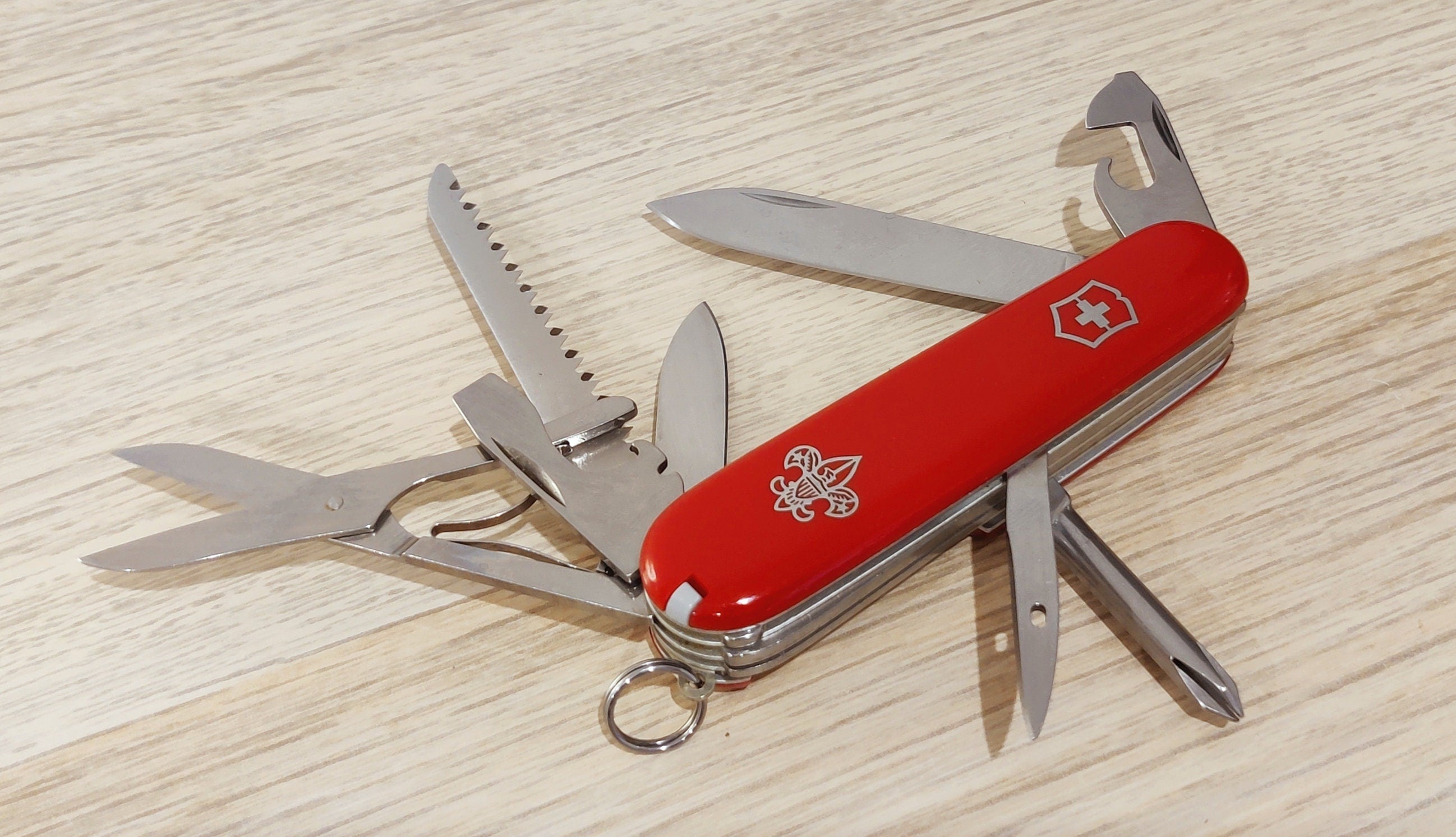
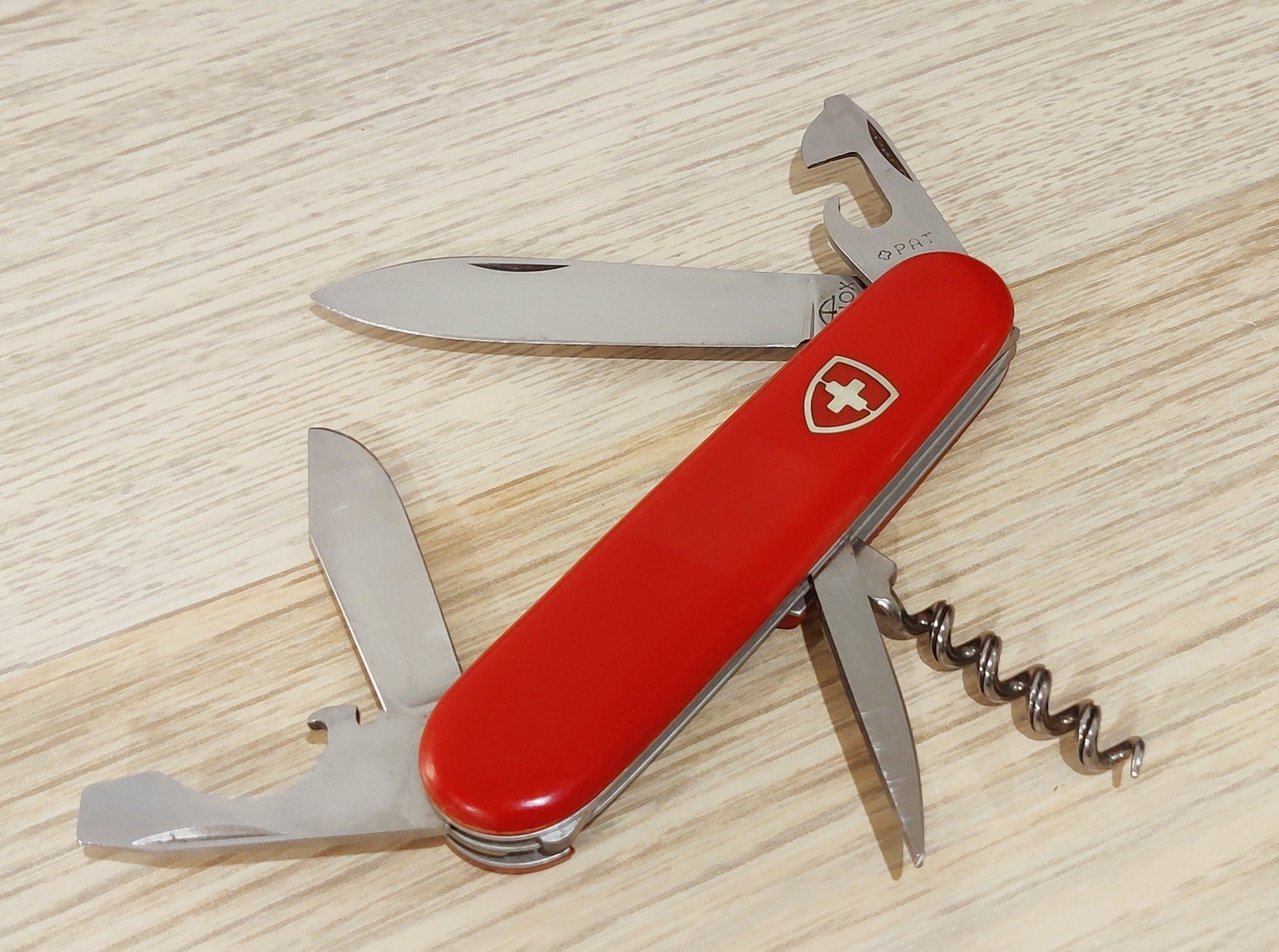
If you're wondering what year your Swiss Army Knife was made, this guide explains how to date a Swiss Army Knife step by step.
An interactive dating tool ⌛ is available below if you prefer to start directly with your knife.
Dating a Victorinox is rarely about a single detail.
A tang stamp gives a range.
Tool shapes narrow that range.
Model production windows refine it further.
The method is simple:
I. Observe the general shape
II. Check the tang stamp
III. Examine tool evolution
IV. Confirm the model
Together, these elements allow you to estimate the production period with reasonable precision.
If you don’t yet know your model, use the Identification Tree.
👉 🔎 Victorinox 91mm Identification Tree – Identify Your Swiss Army Knife by Toolset
If you want full chronological context, see the History section.
👉 📘 Swiss Army Knife History & 91 mm Model Evolution
Here, we focus specifically on dating — and on giving you a structured way to determine the age of your knife.
I. Observe the General Shape
Before opening the blade, your knife already provides clues.

First Can Opener
1897–1946
|

Lobster Claw Can Opener
1946–1951
|

Top Can Opener + Apparent Rivets
1951–1957
|

Hidden Rivets + Front Reamer
1957–1961
|

Plain Scale
1961–Today
|
At first glance, examine:
- Scales shape
- Front apparent reamer or hidden back awl
- Visible or hidden rivets
- Back Hook or not
These characteristics place the knife within a broad production phase. While they don’t give an exact year, they can eliminate entire decades immediately.
This first visual assessment is often underestimated — but it’s extremely useful.
⌛Interactive Swiss Army Knife Dating Tool
Let yourself be guided step by step.
Simply click on the feature that matches what you see on your knife — overall shape, tang stamp, most general tools details — Refine your selection until you can't go further and reach an estimated production range.
The system progressively narrows the timeline based on structural evolution and documented tool changes.
The interactive tool uses the major documented structural and tool changes to conservatively determine a restricted production window that applies across all Officer’s Knife configurations. The result reflects the period during which that combination of features did realistically existed.
For an even finer analysis, cross-reference your result with the detailed information in the Tools Evolution section below.
II. Victorinox Tang Stamp Evolution
The tang stamp is engraved at the base of the main blade.

refer to 🔗 Elsinox.com tang stamp diagram (latest version) .

It helps identify:
- Period
- Brand format
- A general production range
However, tang stamps usually indicate a span of years rather than a specific production year.
For example, a particular stamp may correspond to a 10–15 year window. To narrow that window further, additional evidence is required.
Tang stamp dating is a starting point — not the conclusion.
III. Examine Tool Evolution
Tool geometry evolves gradually over time, and these changes are often more precise than tang stamps.
Keep in mind that Victorinox often continued using older stock parts for several years after introducing a new design. Small overlaps are therefore normal.
Golden rule:
When dates appear to conflict, the youngest tool always prevails. The most recent component defines the earliest possible production date.
Main documented tools evolutions include:
- 🛠️ Openers design including (Lobster claw, PAT stamp can opener, modern virgin version...)
-
🛠️ Reamer/Awl shape
- Small blade shape (clip point vs drop point)
- 🛠️ Wood Saw Early vs modern teeth
The evolution of the Victorinox wood saw includes multiple subtle and transitional variations. For a detailed overview and documentation of these changes refer to the diagram below, thanks to 🔗 MiniChamp on Multitool.org .
- 🛠️ Phillips Square or round, file, can-key
The backside Phillips went through several subtle design variations over the years. For a detailed overview and documentation of these changes refer to the diagram below, thanks to 🔗 MiniChamp on Multitool.org .
-
🛠️ Fishscaler with ruler or not
The Fishscaler shows several variations over time, notably in ruler markings and bevel. For a detailed overview and documentation of these changes refer to the diagram below, thanks to 🔗 jazzbass on Multitool.org .
- 🛠️ Scissors
Victorinox scissors evolved through several subtle structural changes over the years. For a detailed analysis of these variations refer to the diagram below, thanks to 🔗jnoxyd on Multitool.org .
-
🛠️ Magnifying glass design
The Victorinox magnifying glass evolves through four distinct generations. This diagram summarizes the main configurations observed across different production periods.
- Introduction of the multipurpose hook (1991)
-
🛠️ Pliers introduction in 1986
Victorinox pliers evolved through several structural variations over time. This diagram summarizes the main configurations observed across different production periods.
When several of these elements align with the tang stamp period, the production window can often be reduced significantly.
This is where Swiss Army Knife dating becomes more accurate.
IV. Identify the Model (Structural Confirmation)
Dating becomes much easier once the exact model is identified.
Many Victorinox 91 mm configurations were only produced during specific timeframes.
If you confirm the model first, you can:
- Compare its known production window
- Check compatibility with the tang stamp
- Validate tool transitions
If you are unsure of your model, use the interactive structural identification tree to determine the exact configuration based on toolset and layer logic.
👉 🔎 Victorinox 91mm Identification Tree – Identify Your Swiss Army Knife by Toolset
Model identification often reduces the dating range significantly.
V. Quick Historical Context
Victorinox 91 mm Swiss Army Knives evolved through a series of well-defined historical periods, each reflecting changes in toolsets, construction logic, and catalogue structure.
📜 1897–1937 — Foundations
Birth of the civilian Officer’s Knife; limited configurations and early standardisation.
📜1937–1946 · Birth of the Little Red Swiss Knife
Cellidor identity, wartime stability and early civilian signals
📜 1946–1951 — Post-War Identity
Stabilisation of the modern Officer’s platform and early civilian expansions.
📜 1951–1957 — Modern Tools Expansion
Major functional leap with new tools and diversified civilian configurations
📜 1957–1961 — Mechanical Refinement
Tool architecture refined; internal mechanics and specialised tools improve
📜 1961–1973 — Functional Expansion
Outdoor and utility configurations multiply with increasingly complex toolsets
📜Transition 1973
&
📜1973–1985 · Rationalisation era
Catalogue simplification and structural stabilisation following the 1973 transition
📜1986–1991 · Compact multitools and the rise of the SwissChamp
Combo tool, pliers and new compact multitool architectures
📜1991–2024 · Platform Maturity & Catalogue Segmentation
Specialised tool families, electronics and progressive model reduction
📜 2024-Today · Product Diversification Era
Shift from tool-driven design to product-driven catalogue strategy
📜 ELINOX Era (1957–1990s) — Victorinox Product Line Evolution
Understand the ELINOX era and how it shaped Victorinox’s transition from simplified knives to a structured product ecosystem
For a complete breakdown of individual model timelines and transitions across these periods, explore the full historical timeline.
👉 📘 Swiss Army Knife History & 91 mm Model Evolution
FAQ — Swiss Army Knife Dating
What year is my Swiss Army Knife?
Most knives can be dated to a production range rather than an exact year. By combining tang stamp, tool characteristics, and confirmed model configuration, the range can often be narrowed to a few years.
How to determine the age of a Swiss Army Knife accurately?
Start with the tang stamp, confirm visible tool features, identify the model, and cross-reference its production period. Multiple matching clues increase precision.
Is Victorinox tang stamp dating enough?
Tang stamps provide a useful starting point, but tool transitions often overlap within the same stamp period. Additional evidence improves accuracy.
How precise can Swiss Army Knife dating be?
When several independent features align, dating can often be reduced to a short multi-year window. Exact-year dating is uncommon.
Does model identification help narrow the date?
Yes. Many models were only produced within specific windows, making identification an essential step in accurate Swiss Army Knife dating.
This dating guide is based on the cross-analysis of official Victorinox documentation, historical catalogues, and collector-grade reference material. Production ranges, tool transitions, and model windows are interpreted using a structured methodology that combines tang stamp periods with documented tool evolution.
Identify every Victorinox 91 mm configuration using the structural identification tree:
👉 🔎 Victorinox 91mm Identification Tree – Identify Your Swiss Army Knife by Toolset
Explore the evolution of Victorinox 91 mm Swiss Army Knives and discover related model sheets in the historical timeline:
👉 📘 Swiss Army Knife History & 91 mm Model Evolution