The Deluxe Automobile – a 5-layer Victoria Grail
Introduction
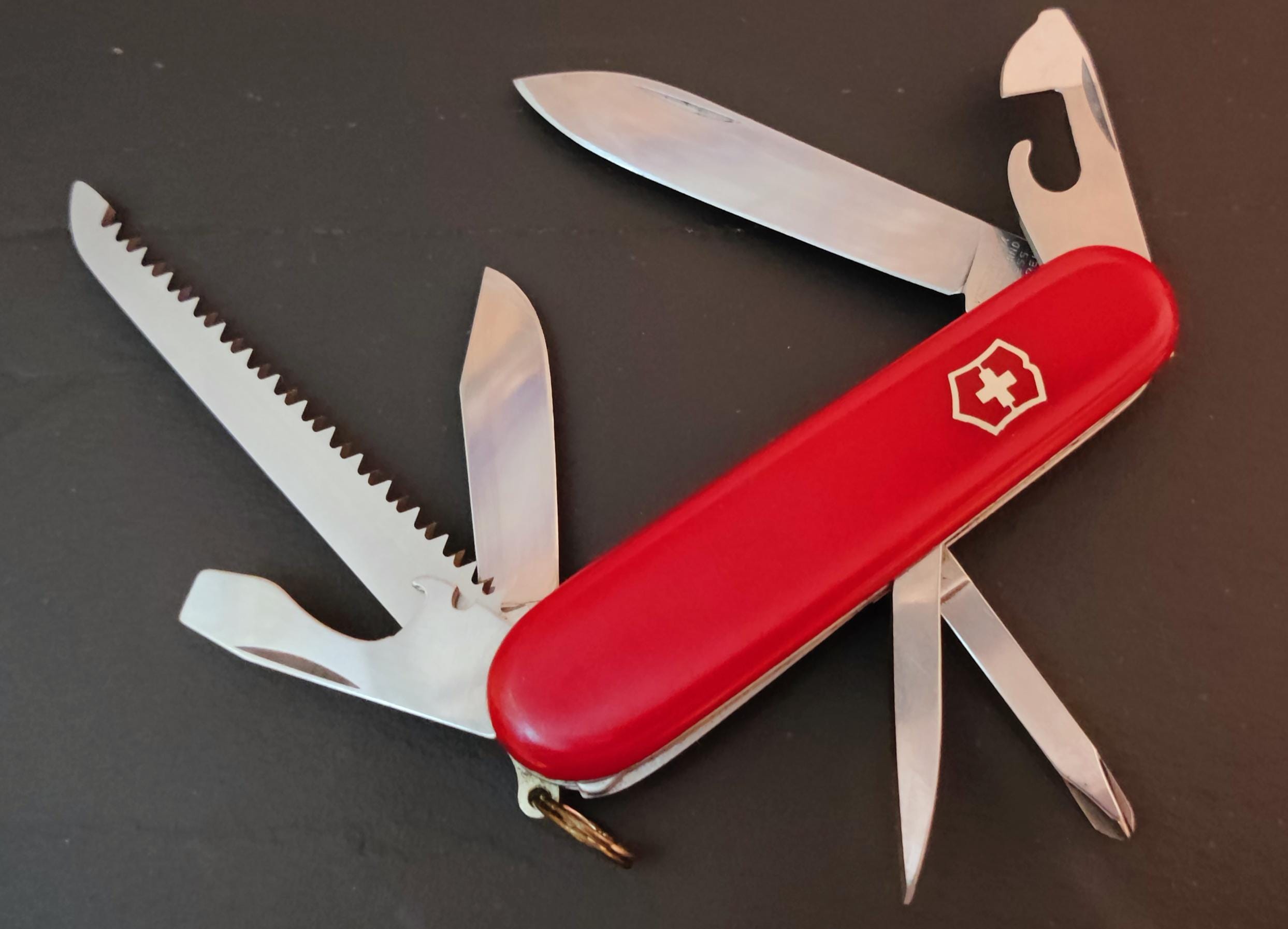
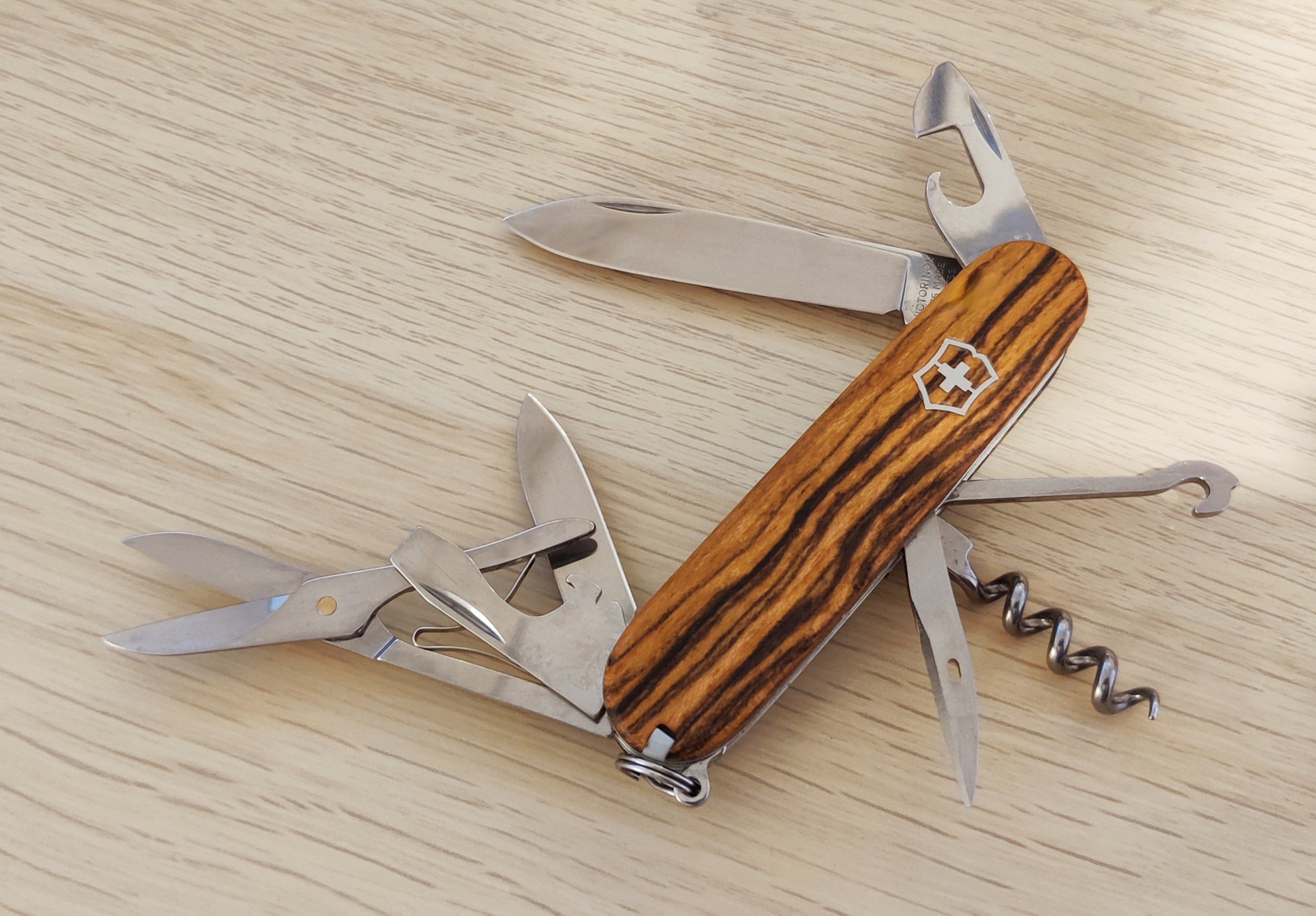
The Victorinox Cadillac 5146m, often referred to by collectors as the Deluxe Automobile, represents the most elaborate automotive-themed configuration of its era.
Appearing in the late 1950s / early 1960s, it is structurally related to the Automobile 8134m — but unlike the Elinox-positioned Automobile, the Cadillac belongs to the Victoria line, reflecting its more refined and fully equipped positioning.
If the Automobile was the practical driver’s knife, the Cadillac was its deluxe counterpart.
Today, it stands among the true Grails of vintage 91 mm collecting.
I. Technical Overview — The deluxe automotive configuration

Cadillac 5146m 1961-1966
- Closed length: 91 mm
- Old reference: 5146m
- Line: Victoria
- Architecture: 5 layers
- Production period: Late 1950s – 1973
Tool configuration
Large blade
Inline technician screwdriver
Wood saw
Metal file
Scissors
Long Nail File (LNF)
Can opener + small screwdriver
Bottle opener + large screwdriver + wire stripper
Back Layer Tools
Reamer / awl
Rear Phillips screwdriver
Scale Tools
Toothpick
Tweezers
Victoria positioning — the true “Deluxe” identity
While the Automobile 8134m was part of the Elinox range, the Cadillac 5146m was positioned within the Victoria line.

This distinction reflects its elevated specification:
- 5-layer construction
- Inline technician screwdriver
- Scissors and metal file
- Long Nail File (LNF)

Catalogue 1960's
The Cadillac was not merely another automotive knife — it was the most complete automotive configuration available at the time.
Explore the rare inline technician screwdriver and its dedicated Victorinox models:
👉🪛Victorinox Technician Screwdriver — Inline Tool, Catalogue Models & Special Runs
II. St. Christoph — Automotive symbolism

Cadillac 5146m 1959
The Cadillac always appears in red Cellidor scales with the St. Christoph metal inlay.

The two St Christoph variants
St. Christoph, patron saint of travelers, was widely associated with automobile travel in the post-war decades.
👉Victorinox Metal Inlays of the 1960s — Nickel-Silver Models History
On the Cadillac, the inlay defines the knife’s identity and reinforces its automotive specialization.

Cadillac 5146m 1966-1971
III. 1973 — End of the Deluxe Automobile
The Cadillac shares the same chronological arc as the Automobile:
- Appearing in the late 1950s / early 1960s
- Produced throughout the 1960s
- Disappearing during the catalogue restructuring of 1973

End 1950's, 1960's, early 1970's Cadillacs - note the LNF layer position change
In 1973, the Cadillac 5146m is phased out and replaced by the Grand Prix, a simplified 4-layer model featuring a rear Phillips screwdriver and the Ford T metal inlay.

Late 1971-1973 Cadillac
This marks a clear structural shift:
- From complex Victoria-era 5-layer automotive configurations
- To streamlined 4-layer models aligned with the modernized catalogue
👉1973 — A Turning Point for Victorinox Metal Inlays
With the disappearance of the inline technician screwdriver from the range, the Cadillac era comes to an end.
Position within the 91 mm range
The Cadillac occupies a singular structural position:
- 5-layer Victoria automotive configuration
- Inline technician screwdriver + rear Phillips
- Scissors + LNF combination
- St. Christoph metal inlay
No direct successor replicated its full architecture.
Explore the history and evolution of the Victorinox Long Nail File (LNF):
💅Victorinox Long Nail File (LNF) — Models, Evolution & the Hidden Manicure Blade
Collector Perspective and Significance
A true Grail
Among vintage 91 mm models, the Cadillac 5146m is widely regarded as one of the most desirable.
Its appeal rests on:
- Victoria positioning
- Inline technician screwdriver
- LNF layer
- 5-layer structure
- St. Christoph metal inlay
Well-preserved examples are rare, as many were genuinely used.
Corporate metal inlays — Brown Boveri

Beyond the standard St. Christoph version, the Cadillac was occasionally produced with corporate metal inlays, most notably the Brown Boveri editions.
👉Cadillac Brown Boveri Clip Point Variant
These versions further reinforce its premium positioning within the Victoria range.
👉Victorinox Non-Regular Metal Inlays
Related Models
- 👉Automobile 8134m – The simpler 3-layer Elinox automotive configuration.
- 👉Grand Prix – The 4-layer successor that replaced the Cadillac.
- 👉Handyman 7236m – Another inline technician screwdriver configuration from the same era.
- 👉Master Craftsman 136m – A structurally related 5-layer model with metal file, oriented toward outdoor use.
Conclusion
The Victorinox Cadillac 5146m stands at the summit of the automotive-themed Officer knives of its time.
Positioned within the Victoria line and equipped with one of the most complete 5-layer toolsets of the era, it embodies the deluxe expression of the Automobile concept.
Its disappearance in 1973, replaced by the simplified Grand Prix, marks the end of a distinctive chapter in Victorinox history — and secures the Cadillac’s status today as one of the most refined Grails of the 91 mm lineage.
This article is part of the SAKnife Archives, an independent collector-driven project dedicated to documenting Victorinox Swiss Army Knives. All photographs shown come from the SAKnife private collection unless otherwise noted. The historical and technical information presented here is based on period catalogues and expert collector databases. Additional material will be added as new information emerges.
Identify every Victorinox 91 mm configuration using the structural identification tree:
👉 🔎 Victorinox 91mm Identification Tree – Identify Your Swiss Army Knife by Toolset
Identify the production period of your Swiss Army Knife using the interactive visual tool based on tang stamps and tool evolution:
👉 ⌛ Swiss Army Knife Production Period Guide – Victorinox Interactive Tool Evolution
Explore the evolution of Victorinox 91 mm Swiss Army Knives and discover related model sheets in the historical timeline:
👉 📘 Swiss Army Knife History & 91 mm Model Evolution