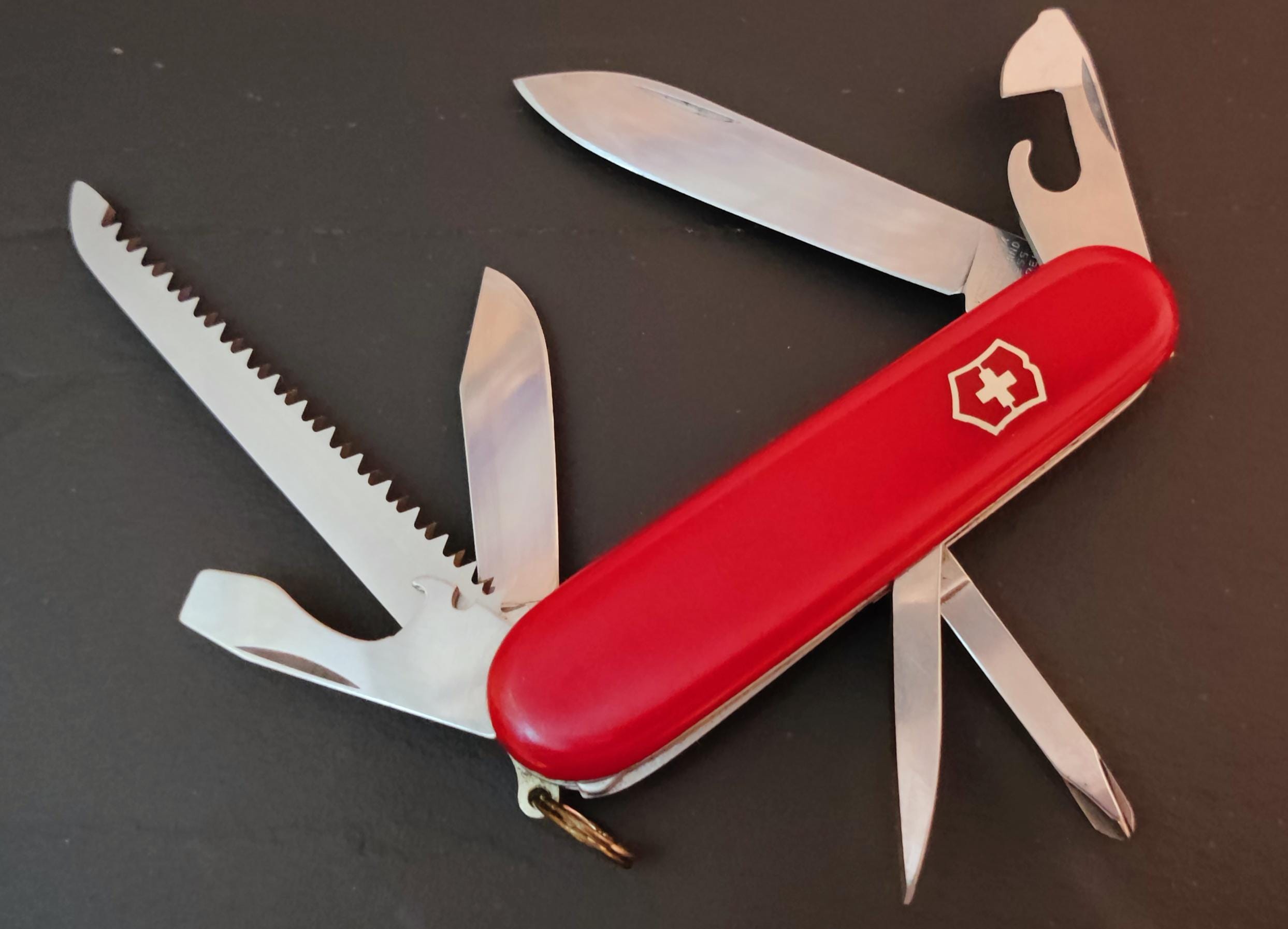
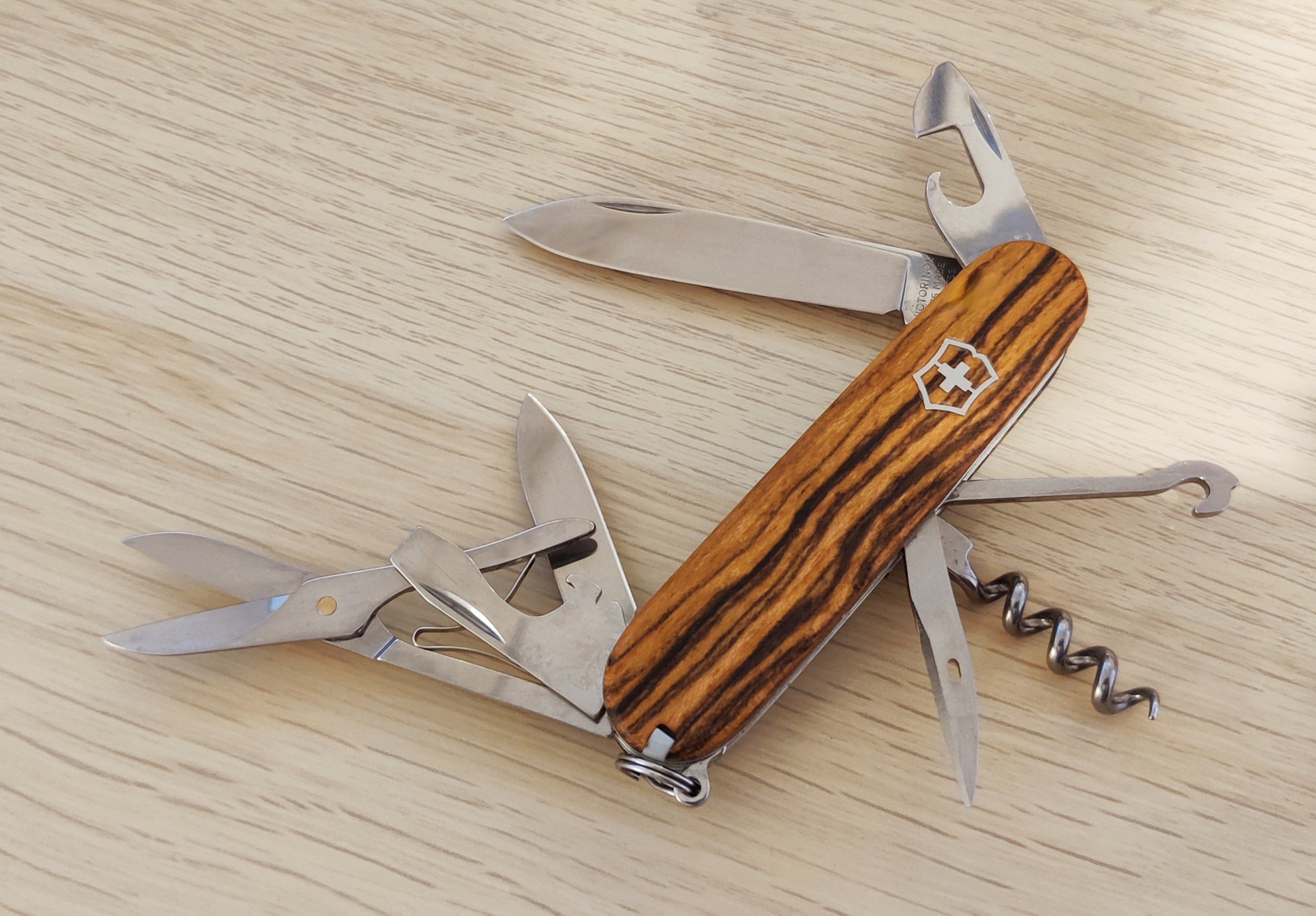
Also listed as “Motorist” in the 1987 catalogue (ref. 1.4642.73)
The Small-Blade Successor to the 1960s Automobile
Introduction
Introduced in 1973, the configuration commonly known as the Automobile Special is the simplified successor to the 1960s Automobile.
Rarely documented in catalogues — and confirmed once as “Motorist” (1986, ref. 1.4642.73) — it replaces the inline technician screwdriver with a small blade while retaining the Ford Model T metal inlay.
Production continues until the late 1980s.
I. Technical Overview — The Rationalized Automobile
- Closed length: 91 mm
-
Introduced: 1973
- Reference: 1.4642.73
- Discontinued: Late 1980s
- Architecture: 3 layers
Tool configuration

Automobile Special 1973-1976
Large blade
Small blade
Metal file
Can opener + small screwdriver
Bottle opener + large screwdriver + wire stripper
Back Layer Tools
Phillips screwdriver
Reamer / awl
Scale Tools
Toothpick
Tweezers
II. 1973 — Coexistence with the Original Automobile
The restructuring of the 91 mm range in 1973 creates a transitional period:
- The original Automobile (with inline technician screwdriver) continues briefly.
- The simplified configuration appears with a small blade instead of the technician driver.
Both coexist through the mid-1970s.

1960's Automobile St Christoph, Automobile 1970's & Automobile Special Ford T 1973
By the later 1970s, only the simplified version remains observed.

Automobile Special 1976-1978
III. Permanent Ford T Identity
Throughout its entire existence, the Automobile Special carries the Ford Model T metal inlay.
👉1973 — A Turning Point for Victorinox Metal Inlays
👉Victorinox Catalogue Metal Inlay Models of the 1970s — From Nickel-Silver to Stainless Steel
Subtle variations in finish and execution occur across decades, but the automotive identity remains consistent.

Grand Prix & Automobile Special 1973
Like the Grand Prix, the Ford T inlay anchors the model thematically — even after the technician screwdriver disappears.

Mid 1980's Automobile Special
Despite its long production life, the model appears only rarely in catalogues. The confirmed 1986 listing under the name Motorist remains the clearest documentary reference.

IV. Corporate Platform
The Automobile Special served extensively as a corporate base model, particularly within Swiss industrial sectors.
Documented examples include Brown Boveri as for his forefather the Automobile

Its simple but clearly mechanical 3-layer layout made it suitable as both a practical tool and symbolic corporate gift.
 In many cases, the Ford T inlay was replaced with company-specific inserts.
Position within the 91 mm Range
The Automobile Special occupies a precise niche:
- Direct successor to the 1960s Automobile
- Parallel to the Grand Prix
- More versatile than the technician-driver predecessor
- Transitional bridge between Elinox-era technical knives and the streamlined 1980s lineup
It represents the final phase of the classic automotive branch.

Late 1980's Automobile Special with Keyring
Collector Perspective and Significance
The Automobile Special stands out because:
- It coexisted with the original Automobile
- It marks the end of the inline technician era
- It retained the Ford Model T inlay throughout production
- It appears rarely in catalogues
Early coexistence examples or late variants with Keyring are particularly significant for collectors.
Related Models
- 👉Automobile (8134m) – Inline technician predecessor
- 👉Grand Prix – Parallel 4-layer automotive model
-
👉Clipper – Contemporary file-based configuration
Conclusion
The Victorinox Automobile Special closes the chapter opened by the original 1960s Automobile.
Introduced in 1973, it simplifies the technical configuration while preserving the automotive identity through the Ford Model T inlay.
Produced quietly until the late 1980s and rarely documented in catalogues, it remains a structurally coherent and historically significant transitional model within the 91 mm range.
This article is part of the SAKnife Archives, an independent collector-driven project dedicated to documenting Victorinox Swiss Army Knives. All photographs shown come from the SAKnife private collection unless otherwise noted. The historical and technical information presented here is based on period catalogues and expert collector databases. Additional material will be added as new information emerges.
Identify every Victorinox 91 mm configuration using the structural identification tree:
👉 🔎 Victorinox 91mm Identification Tree – Identify Your Swiss Army Knife by Toolset
Identify the production period of your Swiss Army Knife using the interactive visual tool based on tang stamps and tool evolution:
👉 ⌛ Swiss Army Knife Production Period Guide – Victorinox Interactive Tool Evolution
Explore the evolution of Victorinox 91 mm Swiss Army Knives and discover related model sheets in the historical timeline:
👉 📘 Swiss Army Knife History & 91 mm Model Evolution