The Slimmest 91 mm Metal File Model Still in Production
Introduction
The Victorinox Mountaineer 235m holds a unique position in the 91 mm Officer range.
Although the 84 mm Mountaineer 235km had existed since the 1950s, the 91 mm version only appears in the early 1970s, just before the major 1973 catalogue restructuring.
Unlike many transitional models of that period, the Mountaineer remains in continuous production to this day.
It is now the slimmest 91 mm Swiss Army Knife with a metal file still in the standard catalog — effectively the most compact Ranger alternative available.
I. Technical Overview — A balanced 4-layer configuration

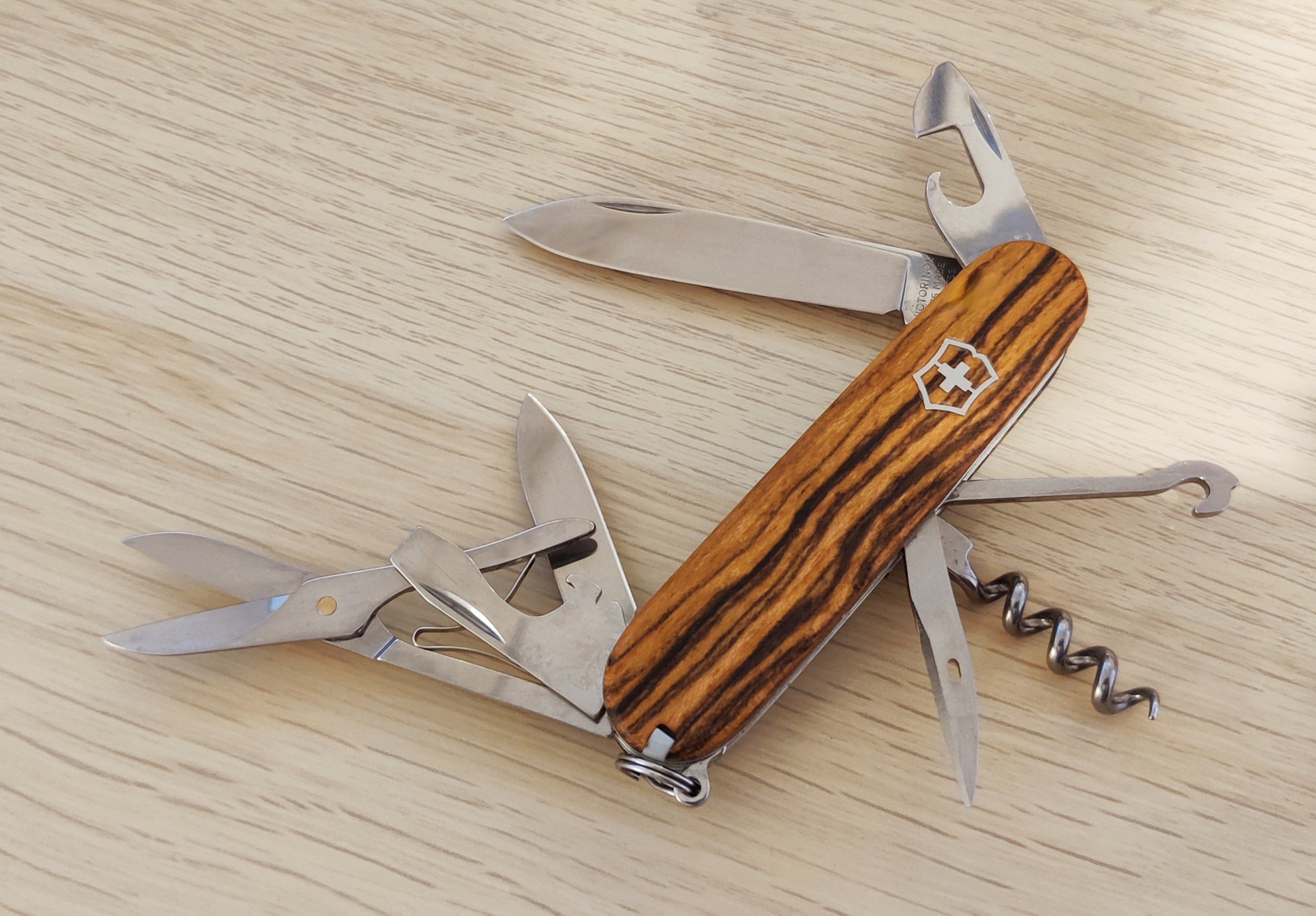
Mountaineer 2010's
- Closed length: 91 mm
- Old reference: 235m
- Architecture: 4 layers
- Production period: Early 1970s – present
- Keyring: Standard (no bail versions known)
Tool configuration
Large blade
Small blade
Metal file
Scissors
Can opener + small screwdriver
Bottle opener + large screwdriver + wire stripper
Back Layer Tools
Reamer / awl
Corkscrew
Scale Tools
Toothpick
Tweezers
A late arrival in 91 mm
For nearly two decades, the Mountaineer name was associated exclusively with the 84 mm format.

Mountaineer 84mm in 1950's Catalogue

Mountaineer 84mm 235kmaU 1961-1968
The absence of a 91 mm equivalent is notable, especially since metal file configurations already existed in larger or more specialized models during the 1960s.
When the 91 mm Mountaineer appears in the early 1970s, it enters the range at a moment of structural transition.
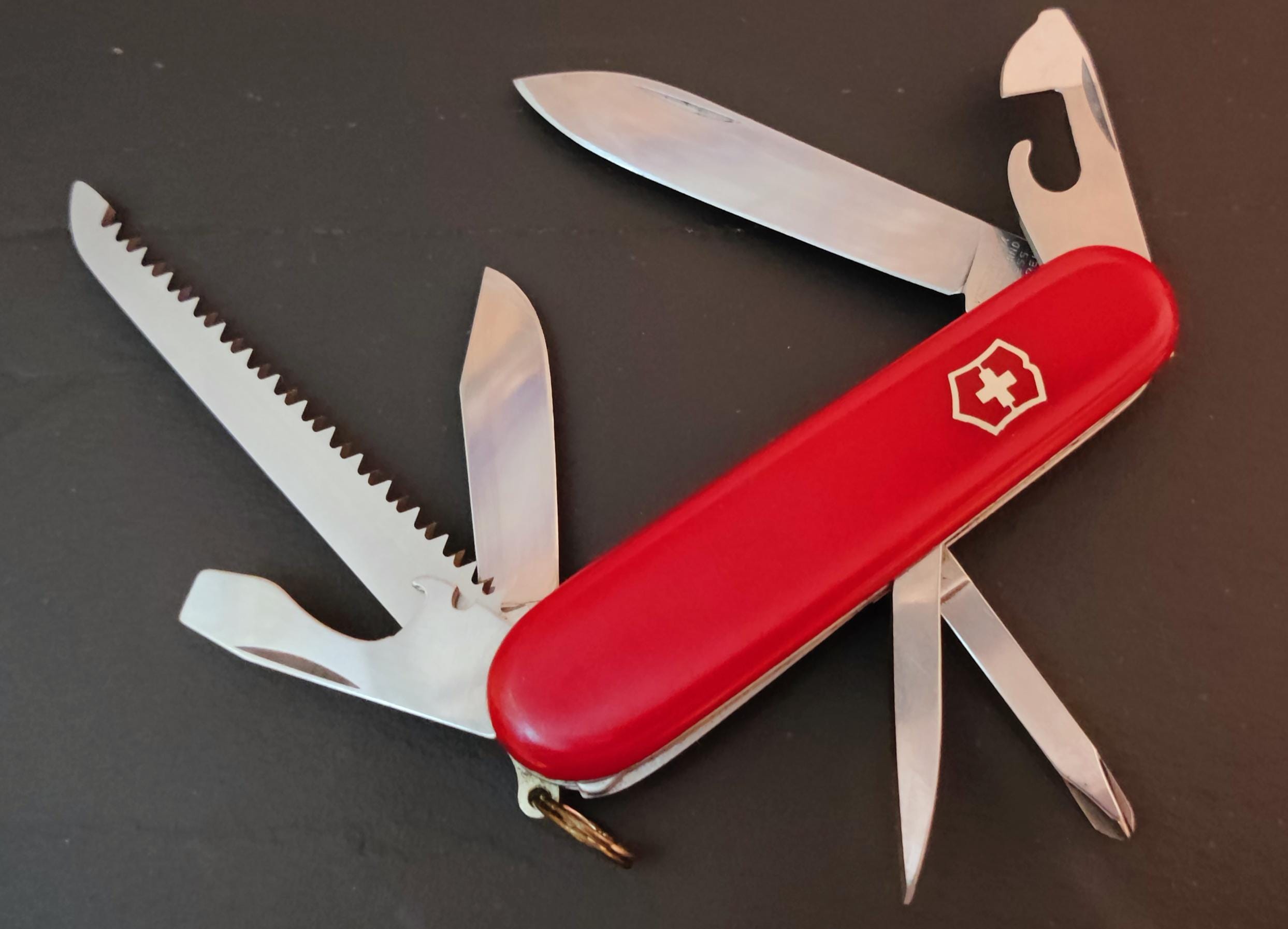
While the keyring had already replaced the bail across the Officer line, the earliest Mountaineer examples still feature the 1960s-style metal file without nail cleaner, showing that older components were still in use during its introduction.
It therefore reflects a bridge between generations — structurally modern, yet retaining certain tool characteristics inherited from the previous decade.

Early 1970's Mountaineer 91mm 235maU
II. 1973 and structural stability
The Mountaineer appears just before the 1973 restructuring and survives it without modification.

Mountaineer in early 1970's Catalogue

Mountaineer 1971-1973 casaï&cie
Unlike automotive-oriented configurations, the Mountaineer is neutral and versatile.

Late 1970's Mountaineer

Catalogue 1984

Mid 1980's Mountaineer
This structural simplicity likely explains its longevity.
Position within the 91 mm range
The Mountaineer occupies a precise niche:
- 4-layer configuration
- Metal file + scissors
- No wood saw
- Slimmer than Ranger (236m)
For users wanting a 91 mm Swiss Army Knife with a metal file without moving to a 5-layer model, the Mountaineer remains the cleanest solution.
Collector Perspective and Significance
The rationalized metal file model
The Mountaineer does not carry rare inlays or transitional tool experiments.
Its importance lies in:
- Its appearance at the 1973 turning point
- Its uninterrupted production since
- Its role as the standardized 4-layer metal file configuration
It represents the moment when the metal file stopped being a thematic or specialized layer — and became a stable, cataloged option.
Corporate continuity — ABB / Brown Boveri
After the disappearance of the Grand Prix, the Mountaineer became a preferred platform for certain corporate editions.

Example ABB (Brown Boveri) Grand Prix becomes Mountaineer in the late 1980's

Mountaineer 1988 - Brown Boveri becomes ABB
👉Victorinox Non-Regular Metal Inlays
In doing so, it quietly inherited part of the corporate metal inlay tradition previously associated with automotive / craftsmanship-themed models.
Related Models
- 👉Ranger 236m – The 5-layer metal file + wood saw configuration
-
👉Grand Prix – The discontinued 4-layer automotive metal file
Conclusion
The Victorinox Mountaineer 235m may not be dramatic — but it is structurally significant.
Appearing just before the 1973 rationalization and remaining in production ever since, it embodies the stabilized form of the 91 mm metal file configuration.
In a lineup where many specialized models disappeared, the Mountaineer endured — and today stands as the slimmest and most efficient metal file option in the modern 91 mm range.

2010's Catalogue
This article is part of the SAKnife Archives, an independent collector-driven project dedicated to documenting Victorinox Swiss Army Knives. All photographs shown come from the SAKnife private collection unless otherwise noted. The historical and technical information presented here is based on period catalogues and expert collector databases. Additional material will be added as new information emerges.
Identify every Victorinox 91 mm configuration using the structural identification tree:
👉 🔎 Victorinox 91mm Identification Tree – Identify Your Swiss Army Knife by Toolset
Identify the production period of your Swiss Army Knife using the interactive visual tool based on tang stamps and tool evolution:
👉 ⌛ Swiss Army Knife Production Period Guide – Victorinox Interactive Tool Evolution
Explore the evolution of Victorinox 91 mm Swiss Army Knives and discover related model sheets in the historical timeline:
👉 📘 Swiss Army Knife History & 91 mm Model Evolution