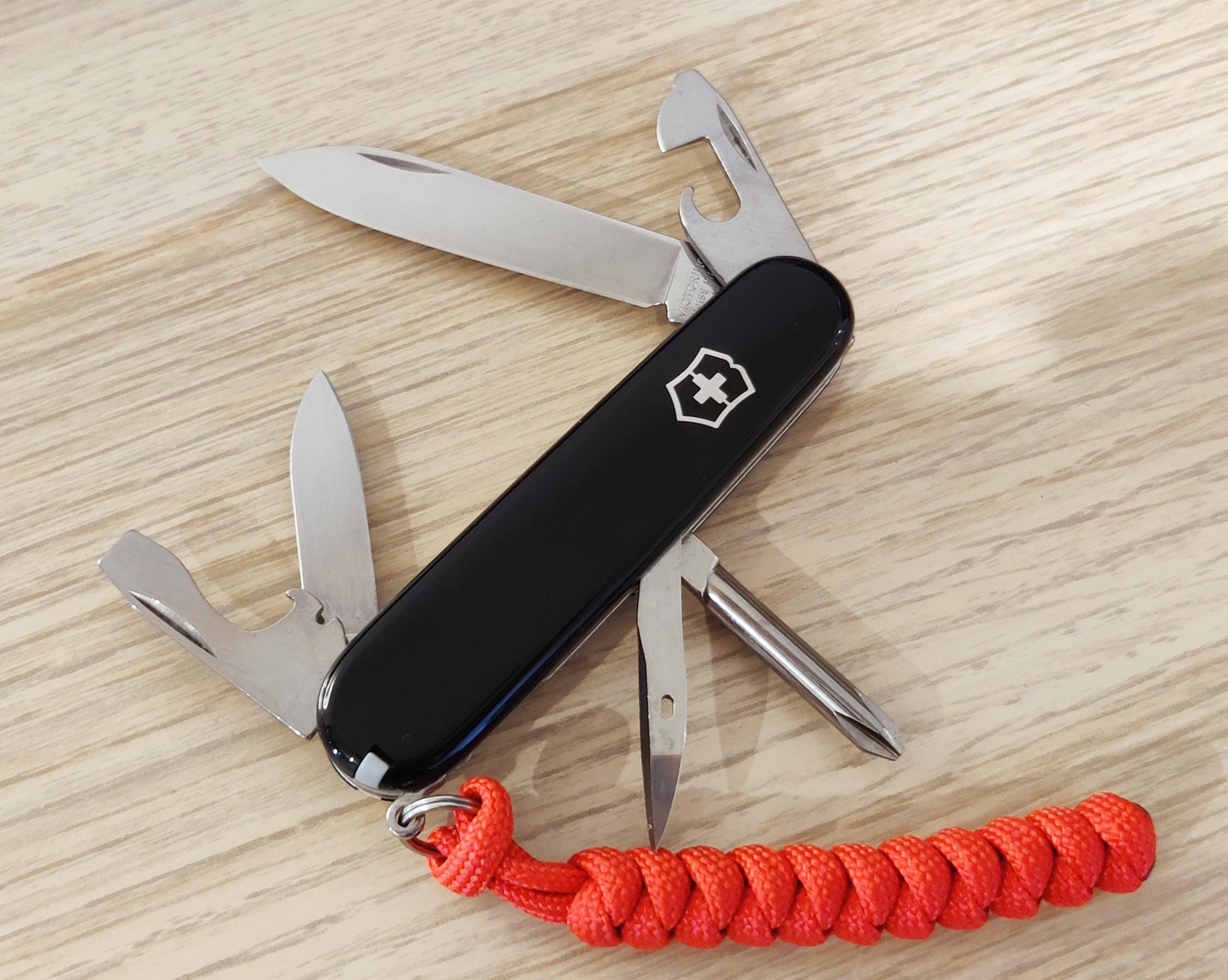
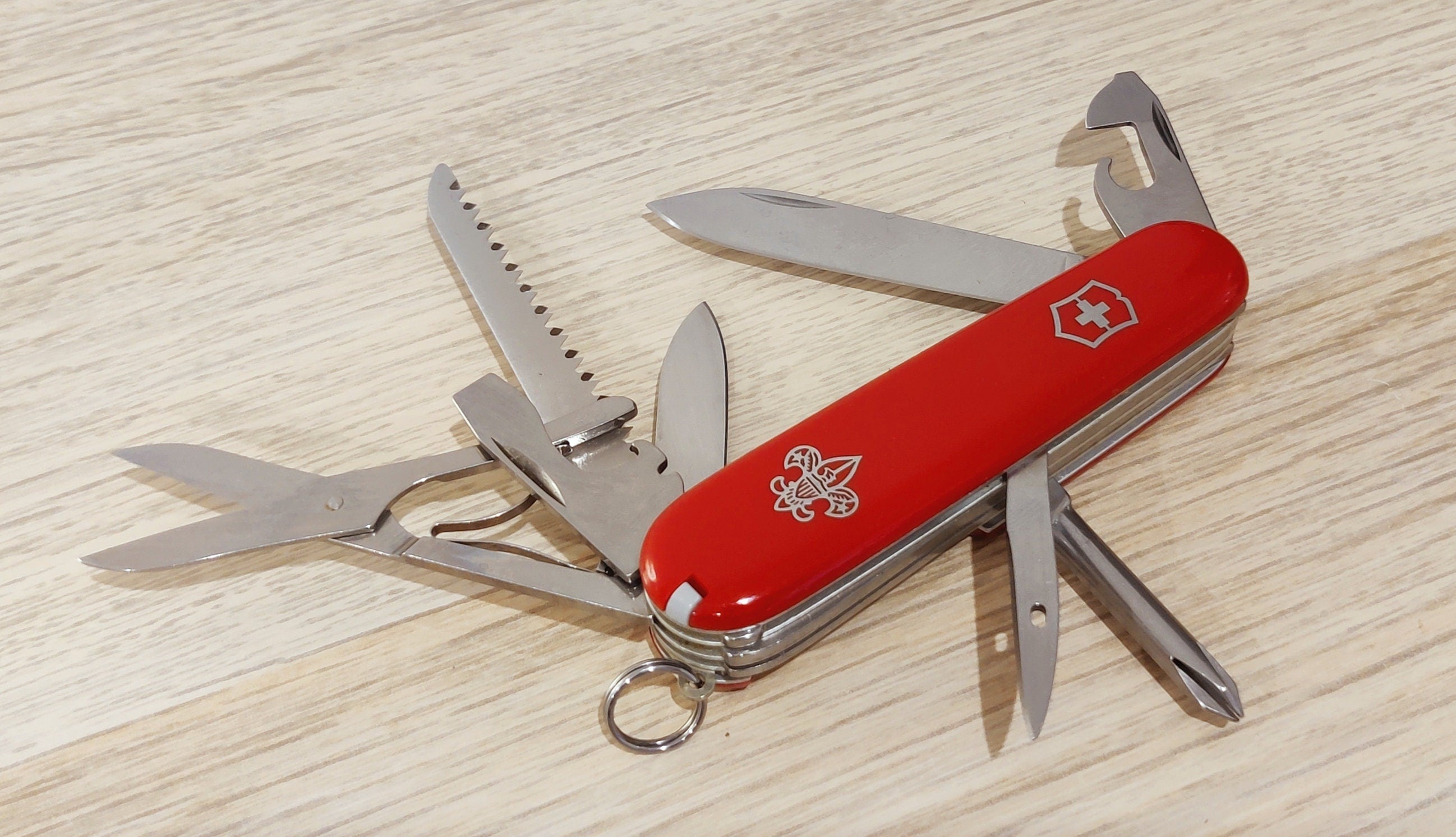
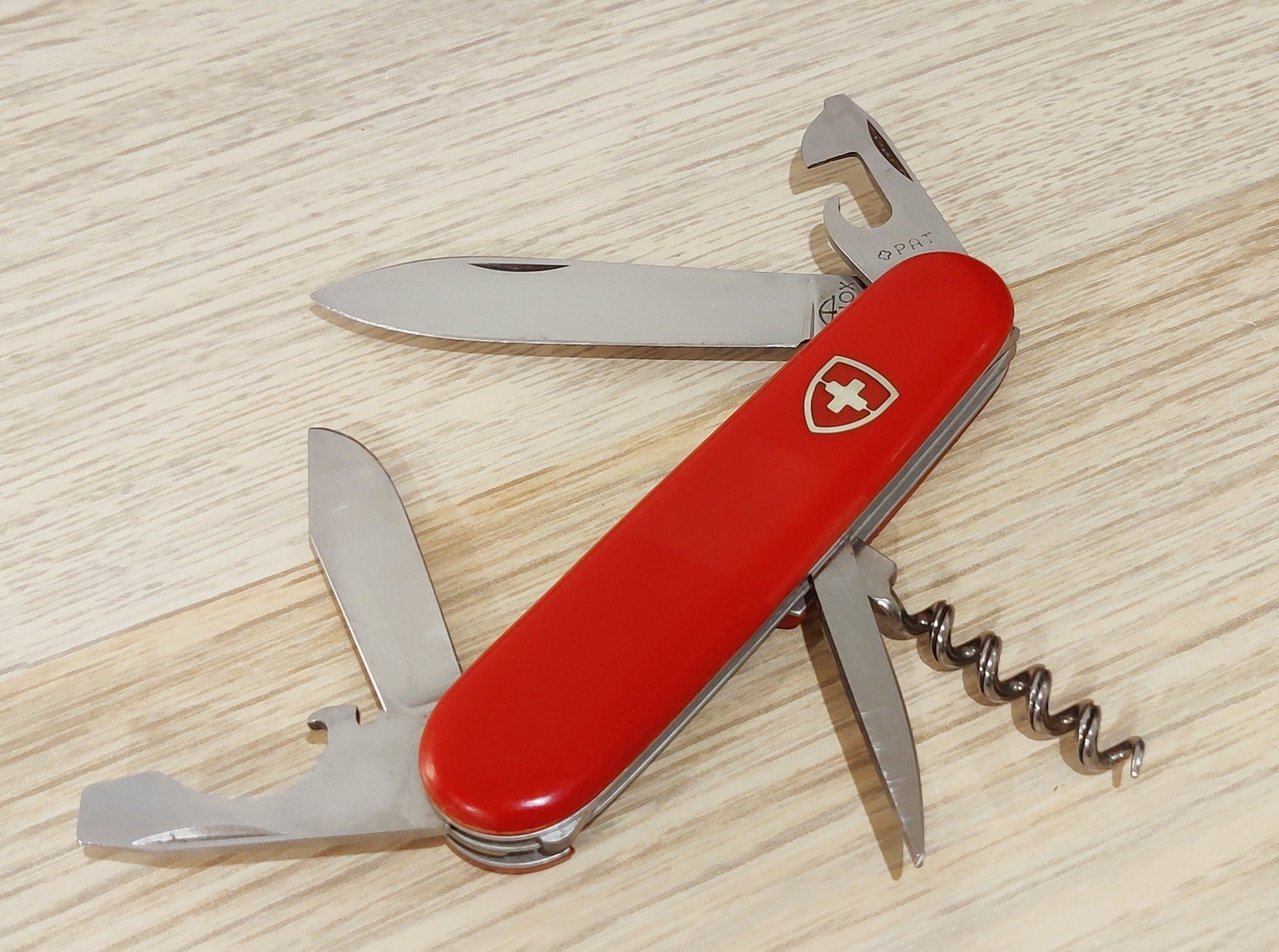
The second half of the 1980s marks a new phase in the evolution of the Victorinox 91 mm platform.
After the industrial stability of the previous decade, Victorinox introduces tools that significantly transform the structure of the catalogue.

1987 leafset extract
Two major innovations appear in 1986: the Combo Tool and the pliers. Together, they redefine how Swiss Army Knife toolsets can be built — either by reducing layers or by expanding the mechanical capabilities of the knife.
This period also sees the arrival of a new flagship model: the SwissChamp, which becomes the most complete representation of the modern Swiss Army Knife.
1986 · The SwissChamp Becomes the New Flagship
In 1986, Victorinox introduces the SwissChamp, a model that quickly replaces the Champion as the flagship of the 91 mm range.

1986 Catalogue cover
Bringing together an unprecedented number of functions, the SwissChamp integrates scissors, wood saw, metal file, magnifying glass and the newly introduced pliers within a single knife.
This model represents the culmination of several decades of incremental tool development and demonstrates the full potential of the Officer’s knife platform as a true multitool.
See the dedicated model sheet:
👉 SwissChamp
The Combo-Tool and the Search for Compact Efficiency
One of the most influential innovations of this period is the arrival of the Combo-Tool on the 91 mm platform.

Combo-Tool
Already present on smaller Victorinox knives, the Combo-Tool combines the functions of:
- can opener
- bottle opener
- flat screwdriver
By merging these functions into a single tool, Victorinox can eliminate the traditional opener layer while maintaining the same practical capabilities.
This structural simplification allows the creation of knives with identical functionality but one layer thinner, opening the door to a new generation of compact multitools.

Golfer 91mm 1986

Scientist 1986
Models such as the Scientist (literally Passenger retrofit) and Golfer (same functions as the Climber in 2 layers) perfectly illustrate this approach: highly functional knives designed to remain slim and practical for everyday carry.
Explore how the combo tool reshaped compact Swiss Army Knife design:
👉 🃏Victorinox Combo Tool — Compact Evolution, Models & EDC Logic
The Arrival of Pliers
The other major innovation of the period is the introduction of pliers into the 91 mm platform.

First 2.5mm pliers & 2nd 3mm pliers
The first versions appear around 1985–1986, initially featuring 2.5 mm thickness. These early pliers prove somewhat fragile and are rapidly reinforced, leading to the 3 mm version that becomes the standard configuration.
This new tool significantly expands the mechanical capabilities of the Swiss Army Knife. For the first time, the knife includes a true gripping tool capable of holding, bending, and manipulating small objects.

Early 1990's Catalogue
The addition of pliers creates a new family of multitool configurations such as the Mechanic, Deluxe Climber and Deluxe Tinker, it also has been directly integrated into the two 6 layers models Craftsman & Handyman in replacement of the Fishscaler, thus led to new Fishing models more compact.

Handyman & Craftsman 1986 with 1st pliers
Fishing Range Experiments
The pliers also prove particularly useful within Victorinox’s fishing-oriented models.
👉🎣 Victorinox Fishing Line - Fish Scaler, Fisherman & Angler Evolution
In this context, the tool becomes ideal for:
- tightening fishing sinkers
- handling hooks
- adjusting fishing lines
This practical application leads to experimental configurations combining fish scalers and pliers, reinforcing the fishing sub-range that had already developed strongly since the introduction of the Fisherman decades earlier.

Platform Refinements
Alongside these major innovations, several smaller refinements appear during this period.
One of them is the introduction of the chisel, which begins to appear on some of the larger multitool configurations on the back of the metal file layer. This simple yet effective tool proves useful for woodworking, scraping, and precision carving tasks.

Another discreet improvement concerns the awl / reamer, which now incorporates a sewing eye. This modification allows the awl to function as a stitching tool, enabling repairs of leather, canvas, and outdoor gear directly in the field.

These refinements illustrate Victorinox’s continuous improvement of the Officer’s knife platform.
Collector Note · The Arrival of BSA Metal Inlays
During the late 1980s, Victorinox also introduces a new generation of metal inlay scales for the Boy Scouts of America (BSA).
Catalogue 1987
See the dedicated article:
👉Victorinox BSA Metal Inlays
Toward the Ideal Everyday Knife
Beyond the introduction of new tools, the late 1980s reveal a broader design philosophy emerging within the Victorinox catalogue.
Victorinox increasingly explores ways to reduce thickness while preserving functionality, seeking to create knives that offer the most useful toolsets in the most compact format possible.
This shift becomes possible largely thanks to the Combo Tool, which allows the traditional opener layer to be removed without sacrificing practical utility.

1986 experiment example: the 91mm Lumberjack Big
👉Lumberjack Big
As a result, the catalogue begins to rebalance:
- 5-layer models remain present but no longer dominate the range
- 3-layer and 4-layer configurations become increasingly prominent

This period marks the early emergence of what would later be known as Everyday Carry (EDC) philosophy — the idea of carrying the most practical toolset in the smallest possible format.
A Platform Ready for Further Expansion
By the early 1990s, the Officer’s knife platform has gained two new structural possibilities:
- compact architectures enabled by the Combo Tool
- mechanical multitool configurations enabled by pliers
These innovations significantly expand the design possibilities of the Swiss Army Knife and prepare the ground for the increasingly specialized models that will appear in the following decade.
This article is part of the SAKnife Archives — a collector-driven research project documenting the historical evolution of Victorinox Swiss Army Knives. Information is based on documented knives Collection historical catalogues, collector databases and documented tool evolutions.
Previous period:
👉📜 Victorinox 1973–1985 — Consolidation, Rationalisation and Industrial Stability
Next period:
👉📜1991–2024 · Platform Maturity & Catalogue Segmentation
Identify every Victorinox 91 mm configuration using the structural identification tree:
👉 🔎 Victorinox 91mm Identification Tree – Identify Your Swiss Army Knife by Toolset
Identify the production period of your Swiss Army Knife using the interactive visual tool based on tang stamps and tool evolution:
👉 ⌛ Swiss Army Knife Production Period Guide – Victorinox Interactive Tool Evolution
Explore the evolution of Victorinox 91 mm Swiss Army Knives and discover related model sheets in the historical timeline:
👉 📘 Swiss Army Knife History & 91 mm Model Evolution