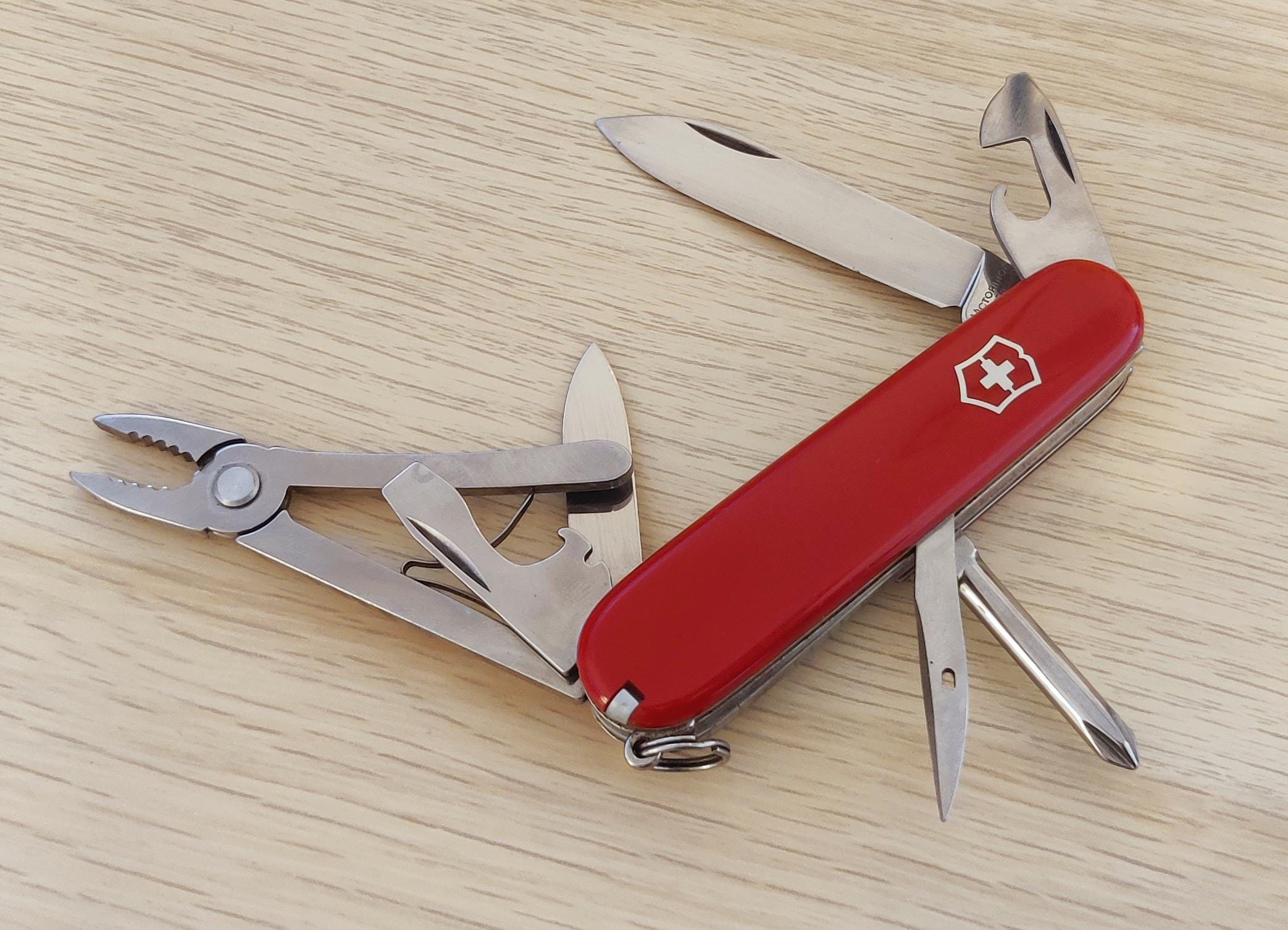
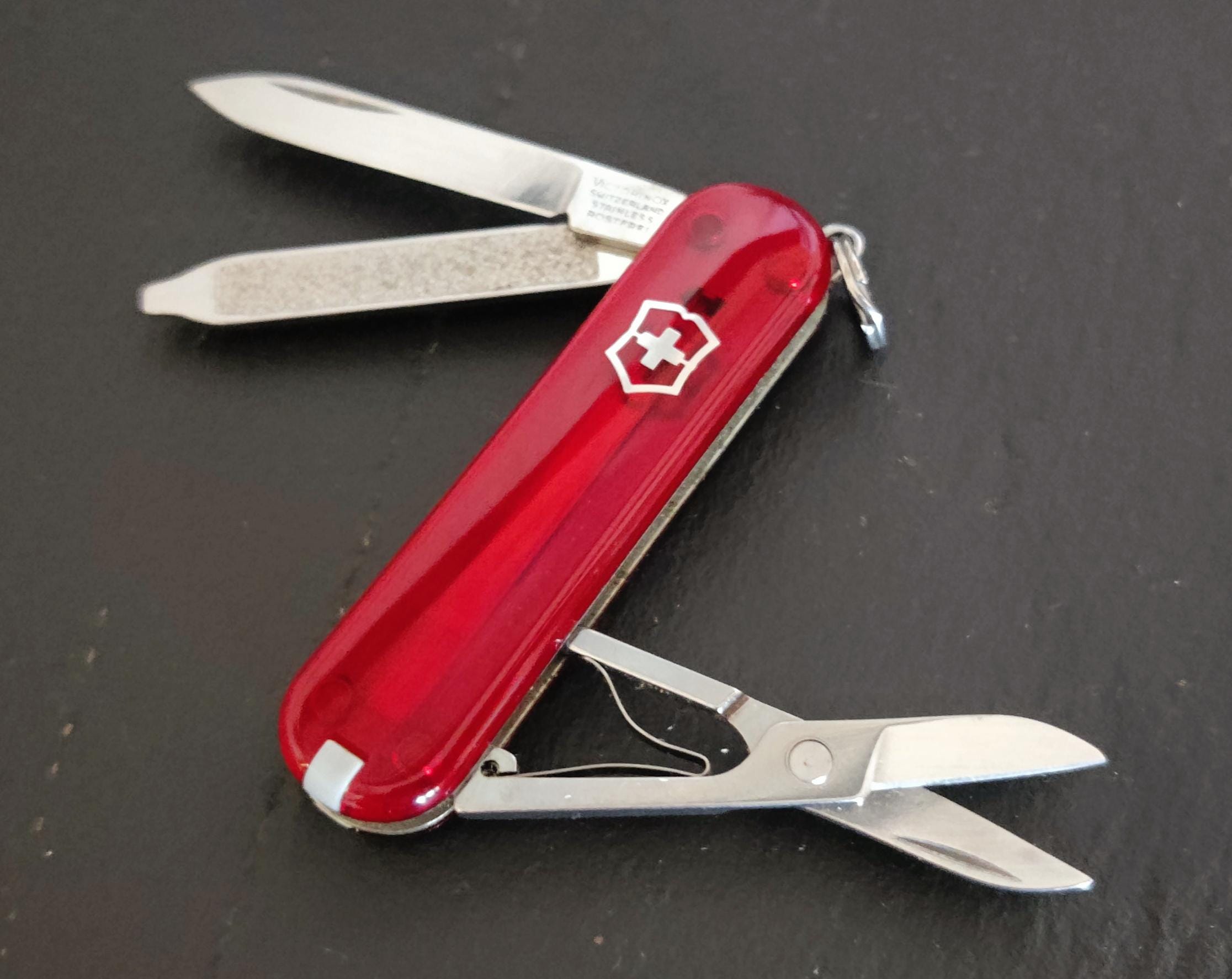
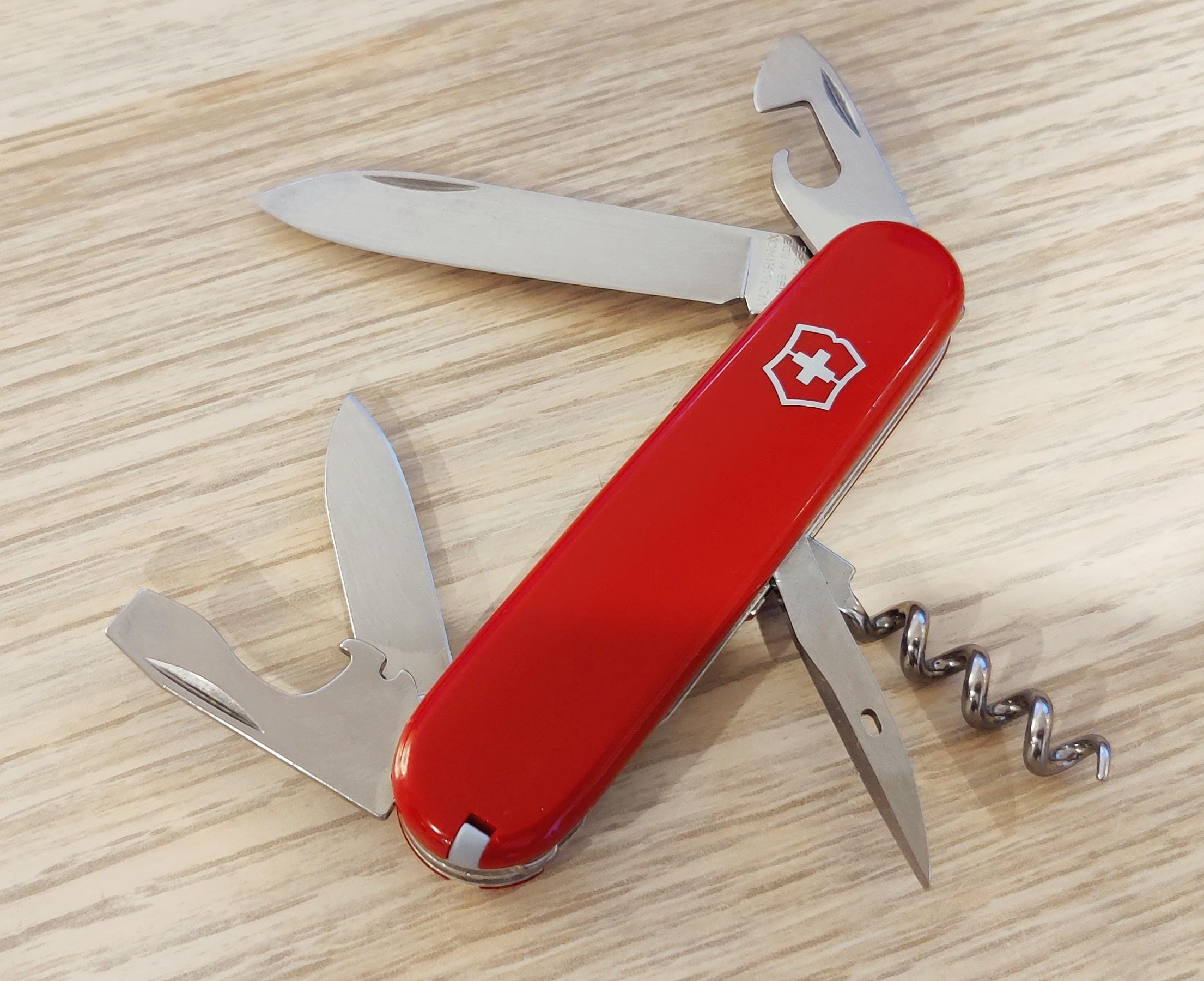
Between 1937 and the end of World War II, Victorinox does not radically redesign the Officer’s knife.
Instead, the company quietly establishes the elements that will define the modern Swiss Army Knife.
During these years, the knife acquires its iconic visual identity while Victorinox strengthens its industrial foundations despite the constraints of wartime Europe.

Model 234 1937-1946
This period marks the birth of the little red Swiss knife — the object that will later become famous around the world.
1937 · The Arrival of Cellidor
In 1937, Victorinox introduces a major material change: the traditional fibre scales are replaced by red Cellidor on the Officer’s knife range.
This new material offers several advantages:
- brighter and more durable colour
- improved resistance to humidity
- a smooth and stable surface suitable for industrial production
The introduction of Cellidor gives the knife the appearance that will later become globally recognizable: a small red pocket knife bearing the Swiss shield.

Model 234k 1937-1946
Metal inlays had already existed on earlier knives with wooden handles, but the new Cellidor scales make their integration far easier and more consistent. This change allows Victorinox to produce decorative inlays at an industrial scale, opening the door to corporate, institutional and commemorative knives.


Early 1940's Catalogue dedicated to corporates / advertising
👉Victorinox Non-Regular Metal Inlays
With Cellidor, the modern visual identity of the Swiss Army Knife is born.
Wartime Stability and Industrial Expansion

1942 Catalogue
During the Second World War, Switzerland remains neutral but mobilised, and industry operates under significant constraints.
Material shortages and economic restrictions encourage stability rather than innovation. Victorinox therefore maintains the established architecture of the Officer’s knife, relying on a configuration that has already proven reliable:
- large blade
- small blade
- opener layer
- corkscrew
- awl / reamer
And usual options
- Woodsaw
- Scissors

Premium materials scales like buffalo horn remain well represented aside the new born red Cellidor

Officer's Knives
Rather than redesigning the knife, Victorinox focuses on maintaining production continuity while refining its manufacturing processes.
At the same time, the company continues to strengthen its industrial infrastructure. In 1943, Victorinox expands its facilities in Ibach, increasing production capacity and modernising its manufacturing operations.
This investment reflects Carl Elsener’s long-term vision. Even during wartime uncertainty, Victorinox prepares for the growth that will follow the conflict.
1942 · The First Long Nail File
One notable innovation appears during the war years with the introduction of the Long Nail File (LNF).
In 1942, this tool appears on the model 207k, one of the earliest examples of the Officer’s knife integrating a long nail file.

This configuration can be seen as the ancestor of what collectors later refer to as the Golfer LNF.
While modest in appearance, the long nail file marks an important evolution: the Officer’s knife begins to incorporate tools that respond to civilian and urban uses, not only practical outdoor tasks.
This subtle shift anticipates the diversification of the catalogue that will take place after the war.
Explore the history and evolution of the Victorinox Long Nail File (LNF):
💅Victorinox Long Nail File (LNF) — Models, Evolution & the Hidden Manicure Blade
A Platform Ready for the Post-War Era
By the end of World War II, several defining elements of the modern Swiss Army Knife are already in place:
- the red Cellidor scales
- the recognizable Swiss shield
- the mature Officer’s knife architecture
- the first appearance of tools oriented toward civilian use, such as the long nail file
As Allied troops move across Europe in the final years of the conflict and in the immediate post-war period, many American soldiers discover and purchase the small red Swiss knife as a souvenir. Its compact design, practical tools and distinctive appearance make it both a useful pocket tool and a memorable symbol of Switzerland.

These knives travel back to the United States in soldiers’ pockets and duffel bags, quietly introducing the Swiss Army Knife to a much wider audience.
The platform is now visually distinctive, mechanically stable, and ready to evolve.
In the years immediately after the war, Victorinox will introduce structural adjustments and new tool combinations that prepare the rapid expansion of the 1950s.
This article is part of the SAKnife Archives — a collector-driven research project documenting the historical evolution of Victorinox Swiss Army Knives. Information is based on historical catalogues, collector databases and documented tool evolutions.
Next period:
👉📜 Victorinox 1946–1951 · Post-War Identity & Structural Refinement
Identify every Victorinox 91 mm configuration using the structural identification tree:
👉 🔎 Victorinox 91mm Identification Tree – Identify Your Swiss Army Knife by Toolset
Identify the production period of your Swiss Army Knife using the interactive visual tool based on tang stamps and tool evolution:
👉 ⌛ Swiss Army Knife Production Period Guide – Victorinox Interactive Tool Evolution
Explore the evolution of Victorinox 91 mm Swiss Army Knives and discover related model sheets in the historical timeline:
👉 📘 Swiss Army Knife History & 91 mm Model Evolution