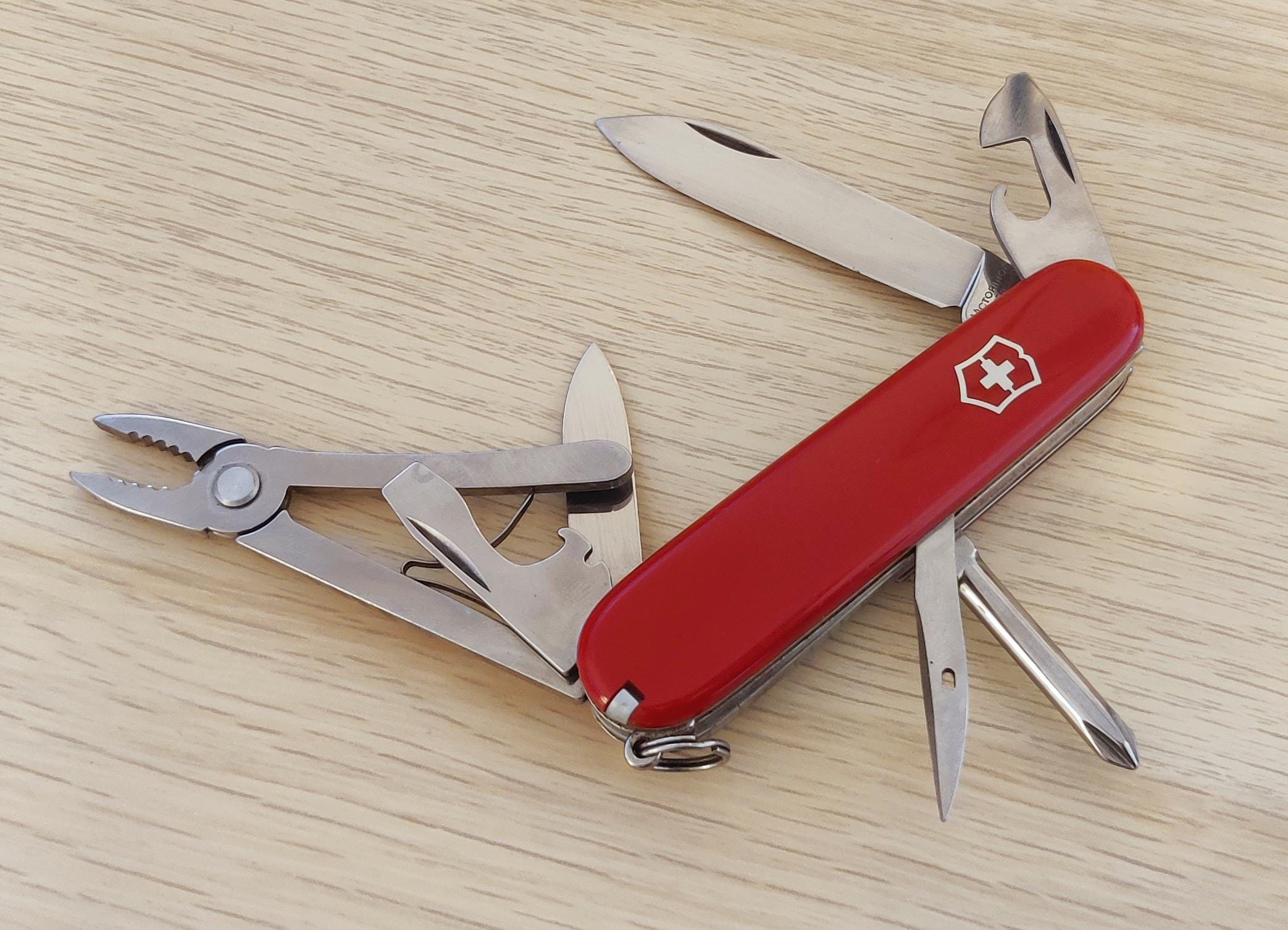
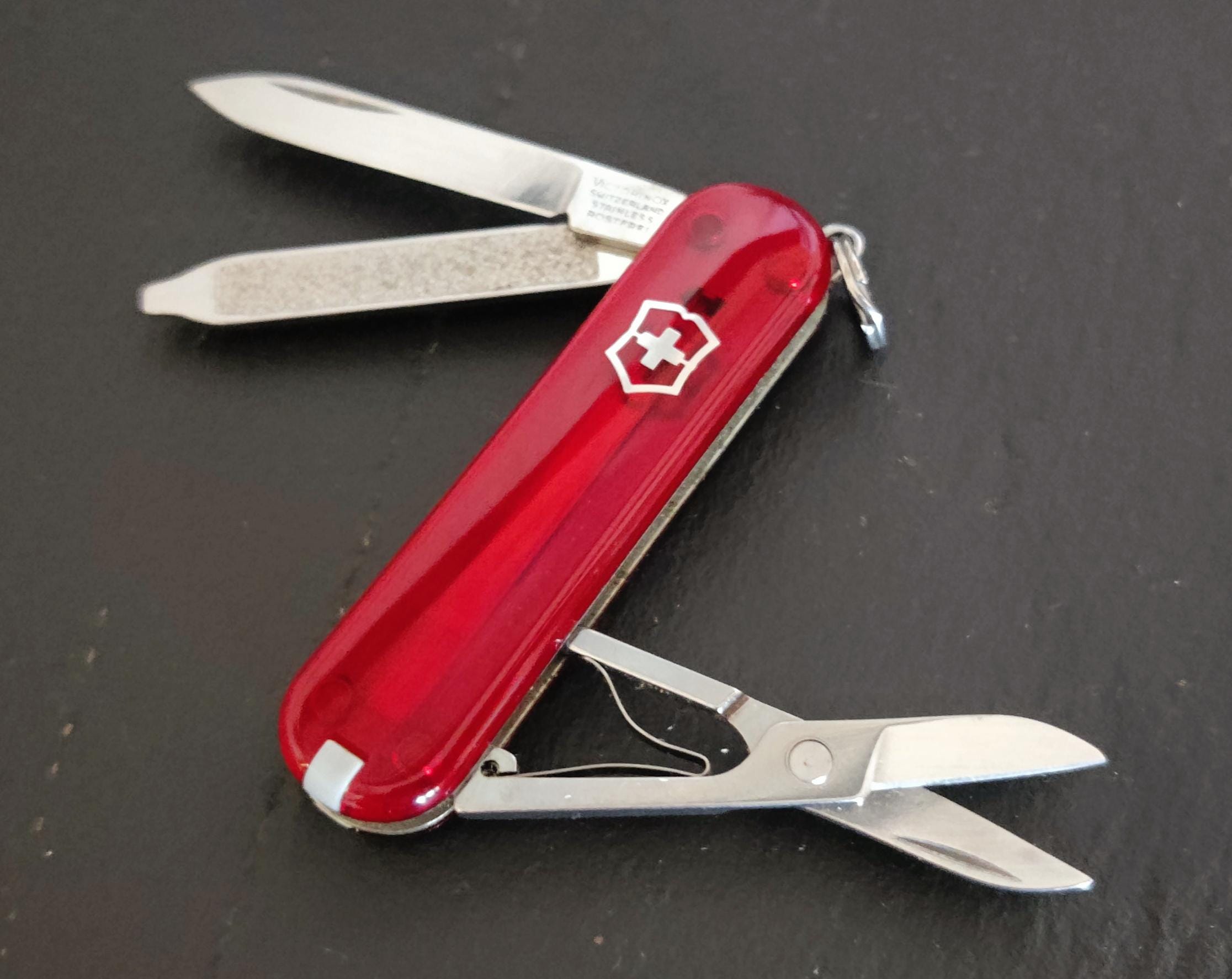
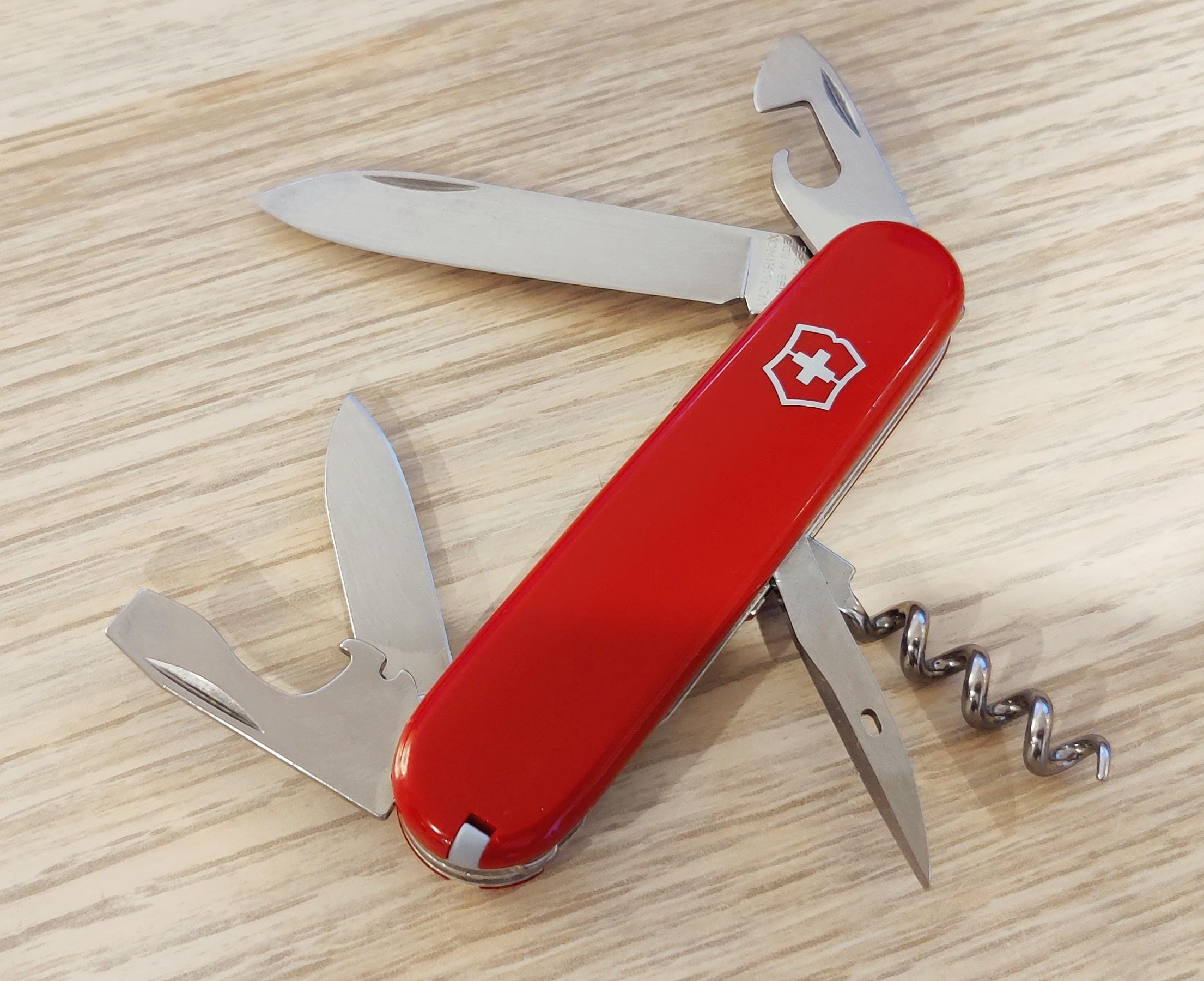
The war is over. Europe is rebuilding.
Victorinox is not reinventing the Officer’s knife — it is consolidating it.
Between 1946 and 1951, the 84 mm and 91 mm platforms ''Officer's knives'' quietly stabilize into the modern foundation that will support the next era of development.
This is not yet the multitool explosion.
It is the moment the architecture becomes coherent, modern, and scalable.
A Catalogue Between Tradition and Modernity
Late-1940s catalogues still display many refined traditional knives — gardener patterns, farmer knives, elegant regional forms shared by other European manufacturers.

Catalogue late 1940's
But one format clearly stands apart.
The Officer’s knife appears prominently and consistently. It is no longer simply a military supply item — it is becoming the brand’s defining product.

Officer's Knife 234a 1946-1951 with Tweezers & Toothpick
Unlike traditional knife patterns, the Officer’s knife is Victorinox’s own invention. It is modular, standardized, and structurally expandable.

Increasingly, it represents the company’s identity.
Post-War Europe & Export Momentum
Cellidor scales, introduced in 1937, give the Officer’s knife its now-iconic red identity.
In 1945, U.S. Army Post Exchange orders expose the knife to American soldiers stationed in Europe. Many bring it home.
Red Cellidor. Swiss cross. Compact layered construction.
The Officer’s knife proves exportable.

''Y’all sure this is a Swiss knife?''
Victorinox likely recognizes that this proprietary, modular format — rather than traditional regional knife patterns — holds international civilian potential.

Blades engraved ''importe de suisse'' are often observed during that period
1946 · The Lobster Claw Modernization
In 1946, Victorinox introduces a redesigned can opener known as the “lobster claw.”
It replaces a pattern that had remained largely unchanged since the late 19th century.

At this stage, the openers are still in the pre-1951 configuration (opposite of today’s layout). But mechanically and visually, the lobster claw signals modernization.

Climber 235U 1946-1951 Horn, ''importe de suisse'' on the blade

Woodsman 236 1946-1951
It can also lift caps — making it, in some ways, a structural ancestor of the later Combo Tool.
The 91 mm Waiter (247) will retain this design until its disappearance in the 1970s — a quiet reminder of this transitional phase.
See more: 👉📝Victorinox 247 “Waiter 91mm” and 248 “Gourmet 91mm”
Long Nail File Expansion on 84 & 91 mm
The Long Nail File (LNF), previously seen on smaller knives, makes a decisive entry into the 84 mm and 91 mm Officer platform during this period.

Huntsman Small 84mm 246kU 1946-1951
Two models illustrate this shift clearly:
-
Model 245 (84 mm) — an early Climber LNF, combining blades, openers and scissors with the addition of the Long Nail File as a dedicated grooming layer.
-
Model 246 (91 mm) — the Huntsman LNF of its time, integrating blades, openers, scissors and wood saw, complemented by the Long Nail File for expanded civilian versatility.
These are not marginal variations.
They demonstrate that the Officer’s platform is no longer limited to military or field utility. Grooming functionality is now fully integrated into core multi-layer configurations.
Late-1940s catalogues show this diversification clearly: the 84 mm and 91 mm ranges are expanding not only in layer count, but in purpose.

Extract Officer's Knives only - See LNF variants bottom right
Victorinox is refining a modular civilian system.
Explore the history and evolution of the Victorinox Long Nail File (LNF):
💅Victorinox Long Nail File (LNF) — Models, Evolution & the Hidden Manicure Blade
1950–1951 · Leadership Continuity & Structural Readiness
In 1950, Carl Elsener III assumes leadership of Victorinox. The structural refinements of the late 1940s — material identity, tool rationalisation, and platform diversification — now have strategic continuity behind them.
By 1951, the Officer’s knife completes its post-war phase with a final structural adjustment: the openers adopt their modern configuration, with the cap lifter/large screwdriver and the can opener placed in the arrangement that will define the classic 91 mm platform.
This configuration unlocks the platform’s full potential — structurally as well as functionally — and sets the stage for the next phase.
Why 1946–1951 Matters
This period does not introduce dramatic new tools.
It does something more fundamental.
It stabilizes the Officer’s knife as Victorinox’s modern civilian platform:
- Cellidor identity firmly established
- Wartime structural rationalization consolidated
- Post-war export momentum confirmed
- Lobster claw modernization introduced
- LNF expanded to 84 and 91 mm
- Openers configuration finalized in 1951
By 1951, the Officer’s knife was structurally ready for the developments that would follow in the 1950s.
This article is based on cross-referenced analysis of period-correct Victorinox knives, factory documentation, and long-term collector research.
Dates, transitions, and tool evolutions are presented conservatively, prioritising verifiable construction changes over catalogue assumptions.
Previous period:
👉📜 Victorinox 1937–1946 · Birth of the Little Red Swiss Knife
Next period:
👉📜 Victorinox 1951–1957 · Modern Tools Expansion
Identify every Victorinox 91 mm configuration using the structural identification tree:
👉 🔎 Victorinox 91mm Identification Tree – Identify Your Swiss Army Knife by Toolset
Identify the production period of your Swiss Army Knife using the interactive visual tool based on tang stamps and tool evolution:
👉 ⌛ Swiss Army Knife Production Period Guide – Victorinox Interactive Tool Evolution
Explore the evolution of Victorinox 91 mm Swiss Army Knives and discover related model sheets in the historical timeline:
👉 📘 Swiss Army Knife History & 91 mm Model Evolution