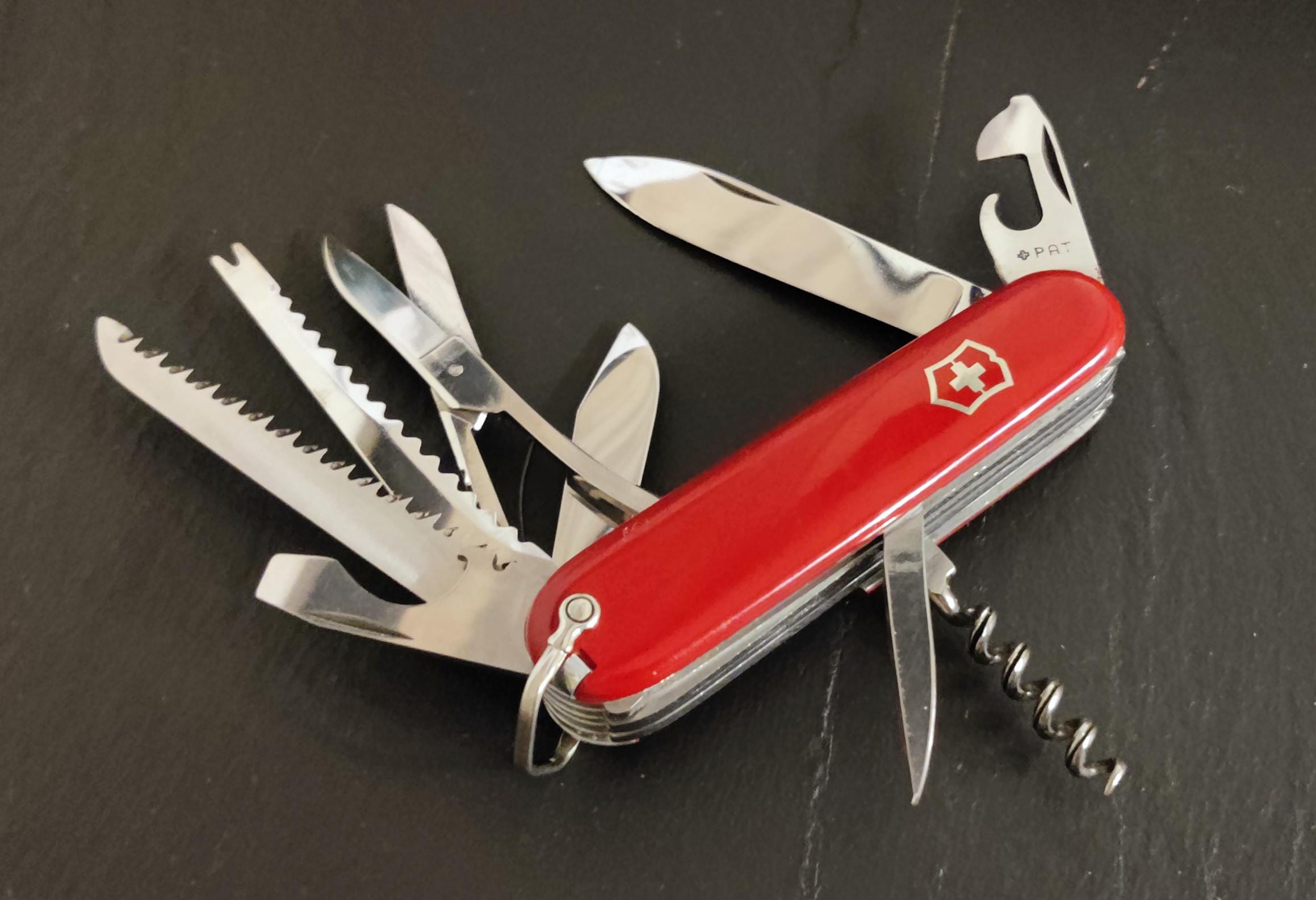
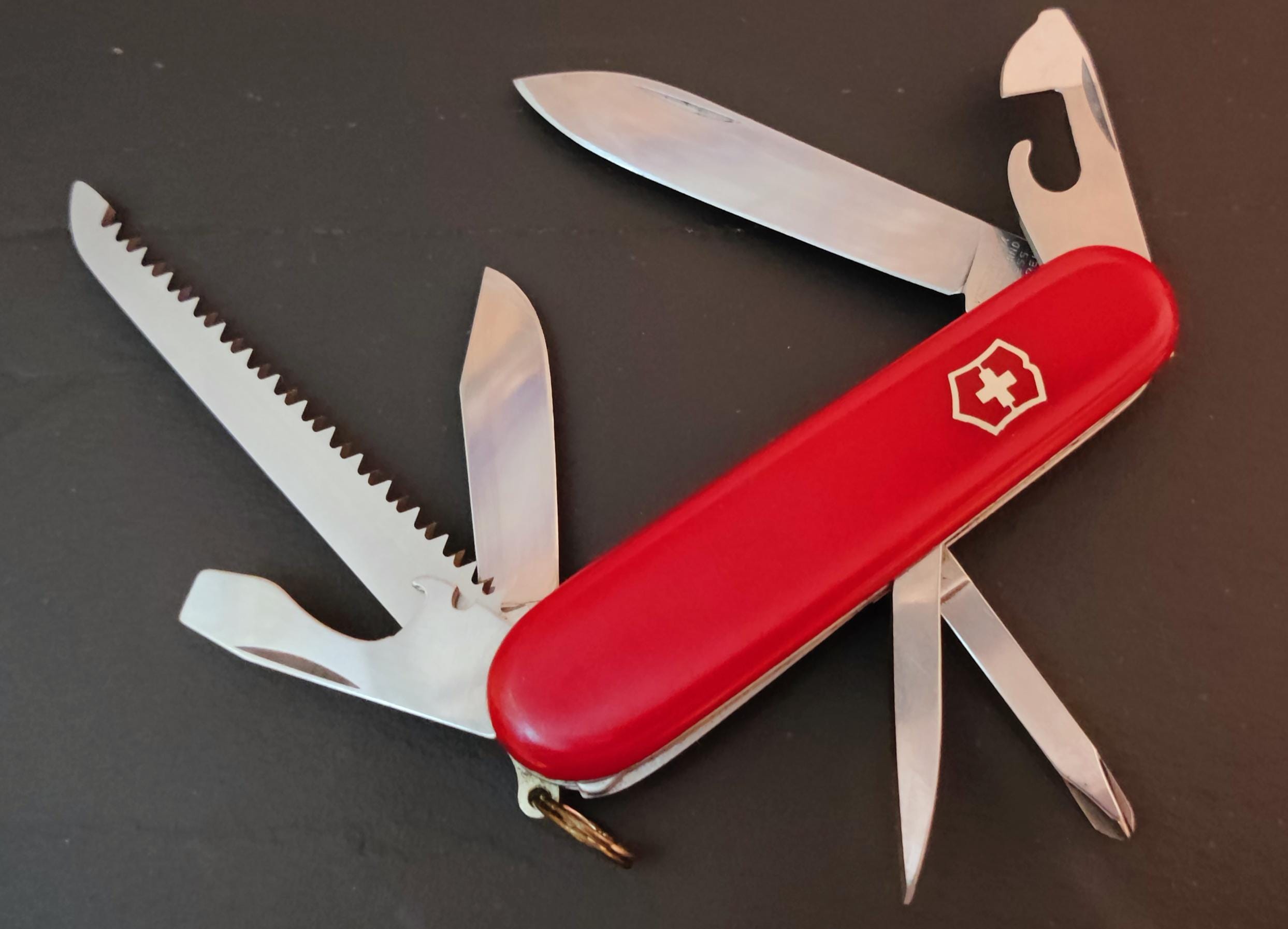
After the pivotal year of 1973, Victorinox entered a remarkably stable phase.
Between 1973 and 1985, the 91 mm lineup did not undergo radical structural revolutions — but it was carefully refined, rationalised, and strategically repositioned.
This period represents the last phase of the classic Officer era before the major technical shift of 1985 (Combo Tool & pliers).
A Period of Controlled Stability
Unlike the 1950s (tool expansion) or the 1960s (layer multiplication), the years 1973–1985 are characterised by:
-
Progressive aesthetic refinements
-
Subtle component upgrades
-
Strategic model rationalisation
-
Export-focused restructuring
Victorinox was not inventing new architectures — it was consolidating them.

Catalogue 1984
The Metal Inlay Transition (1974–1978)
Between 1974 and 1978, Victorinox gradually replaced nickel-silver inlays and logos with stainless steel versions.

Handyman 1973 & Handyman 1985, Shield logo difference
This shift reflects:
-
Industrial modernisation
-
Material standardisation
-
Long-term durability strategy
It marks the end of the traditional warm-toned nickel-silver era.
👉Victorinox Catalogue Metal Inlay Models of the 1970s — From Nickel-Silver to Stainless Steel
Tweezers Modernisation (1978)
In 1978, tweezers changed from aluminium heads to grey plastic heads.

Handyman 1973 & Handyman 1985, Tweezers difference
This small component update illustrates:
-
Cost optimisation
-
Standardised production
-
Modern materials replacing metal micro-parts
A minor detail — but one that helps precisely date knives from this era.
The End of Elinox (1977)
In 1977, the Elinox brand name disappeared, officially replaced by the “Economy” designation.

This change marks the definitive shift:
-
From an export-driven innovation sub-brand
-
To a simplified, cost-oriented secondary range


Standard Economy 1977-1980 light red color ''red cherry 🍒''
The two Elinox-exclusive 3 layers models:
-
Picnicker
-
Automobile
were discontinued.
This confirms the transformation of Elinox from a distinct export identity into a streamlined entry-level segment.
Explore how ELINOX evolved from early economy models to a platform for innovation and experimentation within Victorinox:
👉 📜 ELINOX Era (1957–1990s) — Victorinox Product Line Evolution
The Rationalisation of 5-Layer Models
The 1960s saw an explosion of 5-layer metal-file-based multitools.
👉📘Victorinox History & Catalogue - 91 mm Models Evolution
During 1973–1985, many of these disappeared:
🗑 136f
🗑 236f
🗑 Cadillac (8146m)
🗑 Fishermesser (235fm)
🗑 Outdoorsman (8236m)
🗑 Handyman (7236m)
Their functionality was not lost — it was absorbed.
Most of their toolsets became available in the slightly thicker (≈ +2 mm) 6-layer Handyman and Craftsman (ex-Champion line).

Craftsman 1973-1976

Handyman 1976-1978
This represents a strategic simplification:
fewer overlapping models, broader coverage per knife.
But Not All 5-Layers Disappeared
Two new 5-layer models emerged:
-
Modeler (metal file + magnifying glass)

Modeler 1973
-
Woodsman (wood saw + magnifying glass)

Woodsman 1983-1985
These were not heavy-duty workhorses — they were precision-oriented configurations.
The late Woodsman with magnifier, appearing around 1983, became one of the most appreciated collector / EDC models
Rather than expanding layer count, Victorinox refined combinations.
1978: The NASA Master Craftsman Contract
In 1978, NASA selected the Master Craftsman for astronaut equipment.

Master Craftsman ''Astronaut'' with Space Shuttle metal inlay
This marked a historic validation of Victorinox’s multi-layer architecture at the highest level.
👉 Victorinox Master Craftsman – Astronaut Model
This contract reinforced the legitimacy of the 6-layer architecture as the new structural standard.
The Arrival of Coloured Scales
This decade also saw the progressive introduction of coloured scales, moving beyond traditional red.

1984 Catalogue
Black scales in particular began appearing on flagship models such as:
-
Champion C
-
Huntsman
-
Climber
-
Camper
-
Spartan

Champion C Black 1979-1983

Champion C Black Hoffritz 1983-1985
While technically identical to their red counterparts, these versions signalled an important shift:
-
A more modern visual identity
-
Greater consumer segmentation
-
The beginning of aesthetic diversification within the catalogue
Victorinox was subtly preparing the ground for the marketing-driven expansions of the 1990s.
Structural Summary of the Period
1973–1985 is defined by:
-
No major tool inventions
-
No new mechanical concepts
-
Progressive aesthetic diversification (inlays & coloured scales)
-
A strategic elimination of redundant 5-layer models
It is a period of refinement — not revolution.
And that is precisely why it matters.
Toward 1985 · The Next Structural Break
This long phase of stability sets the stage for the next true rupture:
👉 1985 — the introduction of the Combo Tool and pliers, redefining compact tool density and multi-function philosophy.
That revolution will be the subject of the next article.
This article is part of the SAKnife Archives, a collector-driven research project dedicated to the structural evolution of Victorinox 91 mm models. Analysis is based on period catalogues (1973–1985), documented knives Collection, and cross-referencing with specialist collector databases.
Previous period:
📜Victorinox Transitional Year 1973 – a pivotal moment in Swiss Army Knife history
Next period:
📜1986–1991 · Compact multitools and the rise of the SwissChamp
Combo
Identify every Victorinox 91 mm configuration using the structural identification tree:
👉 🔎 Victorinox 91mm Identification Tree – Identify Your Swiss Army Knife by Toolset
Identify the production period of your Swiss Army Knife using the interactive visual tool based on tang stamps and tool evolution:
👉 ⌛ Swiss Army Knife Production Period Guide – Victorinox Interactive Tool Evolution
Explore the evolution of Victorinox 91 mm Swiss Army Knives and discover related model sheets in the historical timeline:
👉 📘 Swiss Army Knife History & 91 mm Model Evolution