Introduction
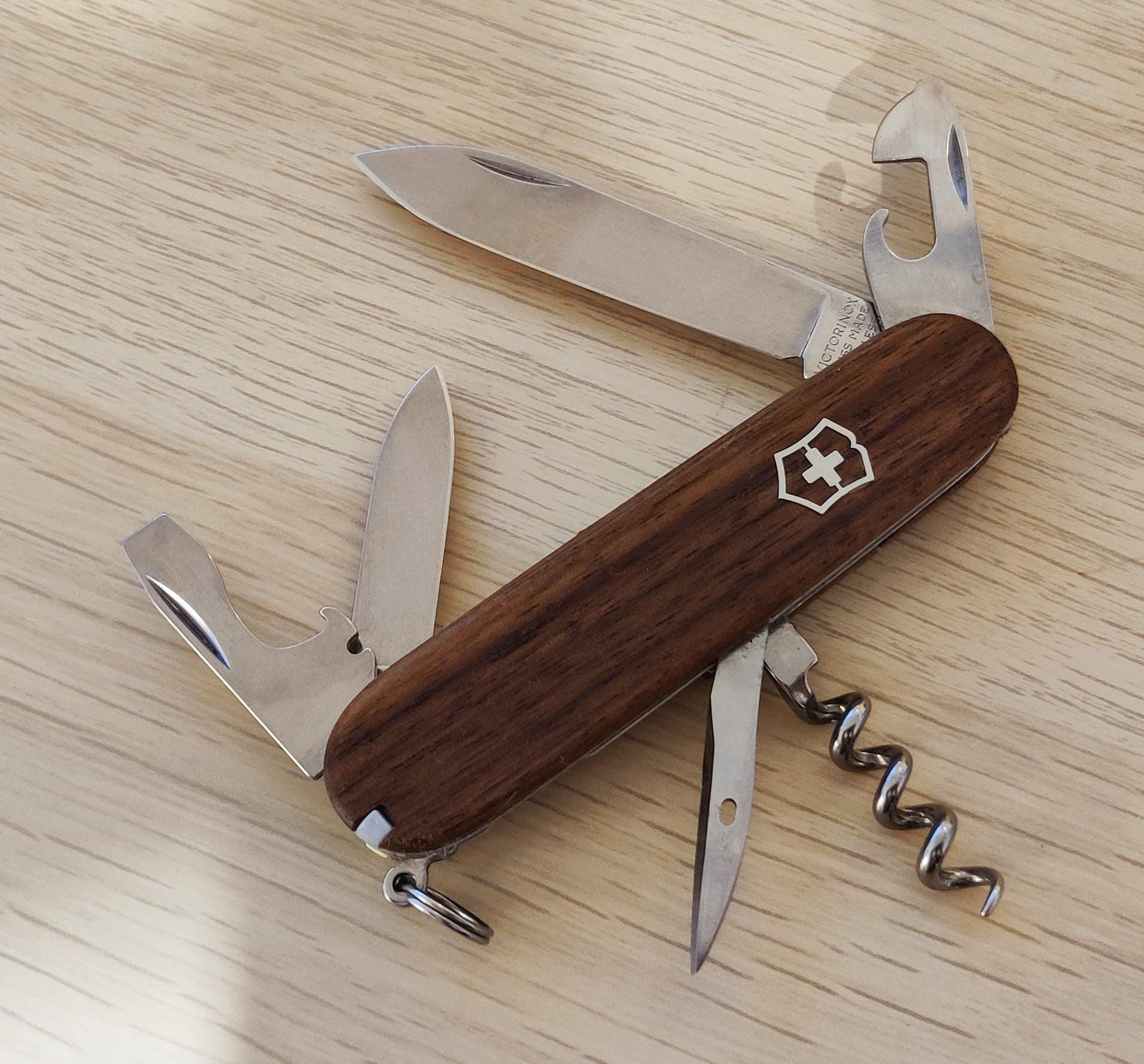
The Victorinox “Zürihegel” is a late 1980s special run based on the Spartan platform, featuring a pruner blade in place of the small blade.
Combining local identity, functional adaptation, and event-related distribution, it stands apart from typical corporate knives of the period.
I. Technical Overview

Model: Zürihegel (Spartan Variant)
Length: 91 mm
Layers: 2
Tools
- Large blade
- Pruner blade (replacing small blade)
- Can opener
- Cap lifter (with screwdriver / wire stripper)
Back tools
- Corkscrew
- Awl
Scale tools
- Toothpick
- Tweezers
II. “Zürihegel”: Meaning and Local Context
The term “Zürihegel” originates from Swiss German dialect.
- “Züri” refers to Zurich
- “Hegel” refers to a boy or young person in Swiss German dialect
The expression can be understood as “Zurich boy” and is closely associated with local identity and youth culture in the region.
This cultural dimension is essential to understanding the model. Unlike purely commercial or technical special runs, the Zürihegel reflects a strong local anchoring.
The Pruner Blade in Context

The choice of a pruner blade is particularly significant.
This type of blade is traditionally used for:
- gardening
- pruning plants and vines
- agricultural work
In the Zurich region, where horticulture and small-scale agriculture are deeply rooted in everyday life, this tool represents a practical and familiar function.
Its inclusion transforms the knife from a standard Spartan into a tool more closely aligned with local usage.
Rather than a novelty, the pruner blade appears here as a deliberate adaptation to a regional lifestyle.
III. Event Context: “Zürihegel” and Known Variants
The name “Zürihegel” is directly associated with
De schnällscht Zürihegel,
a major youth sporting event in Zurich, created in 1951 and still active today.

👉 Official event website:
https://www.zuerihegel.ch/
This long-running competition gathers thousands of children every year in sprint and relay races across Zurich neighborhoods.
This strongly suggests that the knife was produced as an event-related item, likely distributed to participants, organizers, or partners.
Known Variants
At least two versions of the Zürihegel knife are known, both sharing the same tool configuration but differing in scale design.
Version 1 — Event + Sponsor (Blue / Red)
- Front scale (blue): metal inlay “Zürihegel” with Zurich shield

- Back scale (red): metal inlay “Angst” in gothic lettering

The “Angst” branding refers to Angst AG Zürich, a large and long-established butcher and wholesale meat supplier based in Zurich, active since the 1940s and supplying hundreds of businesses in the region.


👉 Company history:
https://www.angstag.ch/index.php/geschichte/
This configuration represents a classic event + sponsor pairing, typical of corporate distributions tied to local events.
Version 2 — Event Only (Full Blue)
- Front scale (blue): metal inlay “Zürihegel”

- Back scale: no secondary branding

This version appears to be a simplified or primary event edition, without sponsor co-branding.
Related Models
Conclusion
The Victorinox Zürihegel is not simply a modified Spartan.
It represents a combination of local identity, functional adaptation, and event-related production. The integration of the pruner blade reflects regional usage, while the Zürihegel branding connects the knife to a well-established Zurich cultural and sporting context.
Together, these elements make it a distinctive example of how Victorinox adapted both toolsets and branding to specific local environments.
For broader context on limited editions and factory outliers, see:
👉Victorinox Special Runs — SAKnife Archives
👉Victorinox Commemorative & Collector Metal Inlays
This article is part of the SAKnife Archives, an independent collector-driven project dedicated to documenting Victorinox Swiss Army Knives. All photographs shown come from the SAKnife private collection unless otherwise noted. The historical and technical information presented here is based on period catalogues and expert collector databases. Additional material will be added as new information emerges.
Identify every Victorinox 91 mm configuration using the structural identification tree:
👉 🔎 Victorinox 91mm Identification Tree – Identify Your Swiss Army Knife by Toolset
Identify the production period of your Swiss Army Knife using the interactive visual tool based on tang stamps and tool evolution:
👉 ⌛ Swiss Army Knife Production Period Guide – Victorinox Interactive Tool Evolution
Explore the evolution of Victorinox 91 mm Swiss Army Knives and discover related model sheets in the historical timeline:
👉 📘 Swiss Army Knife History & 91 mm Model Evolution