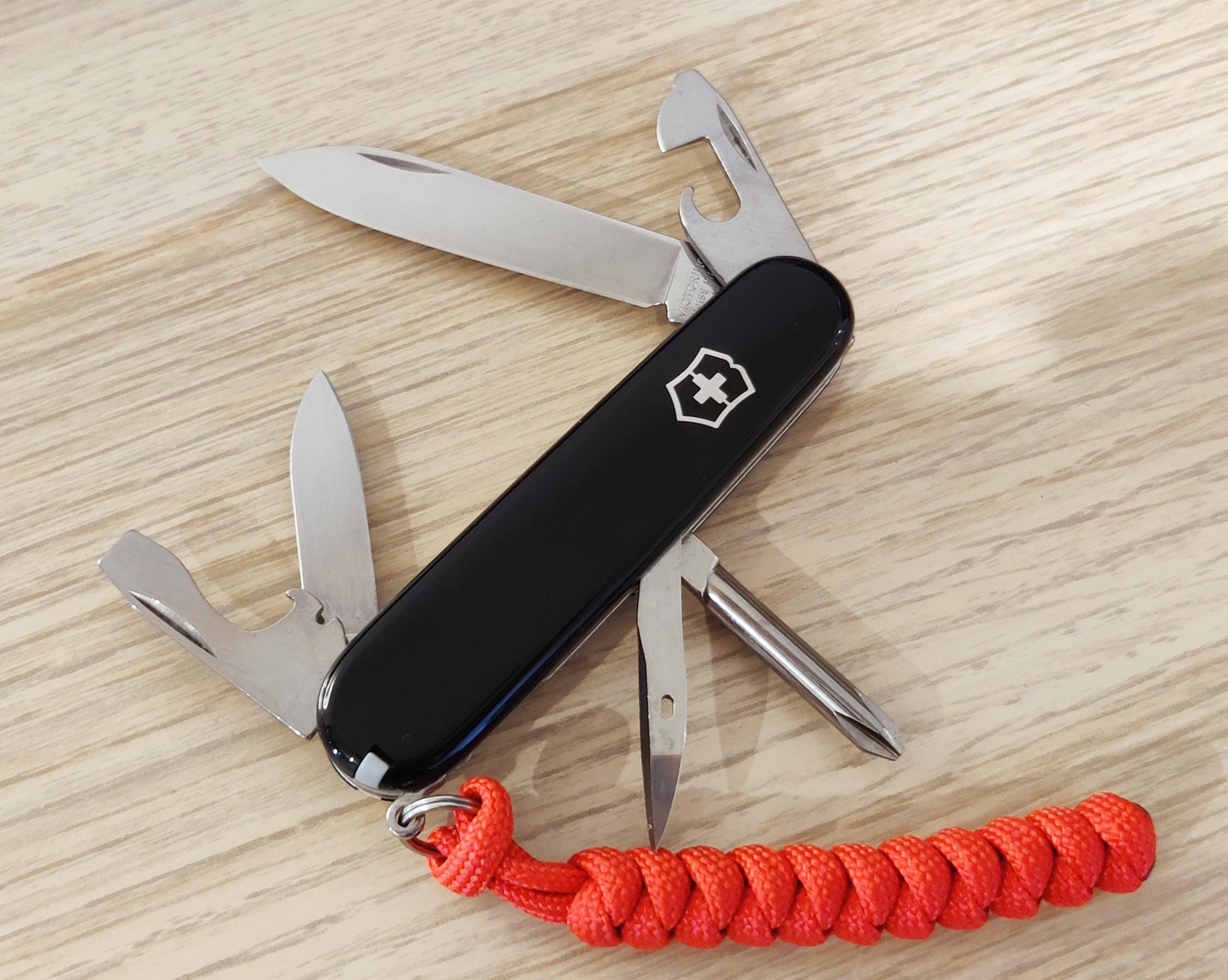
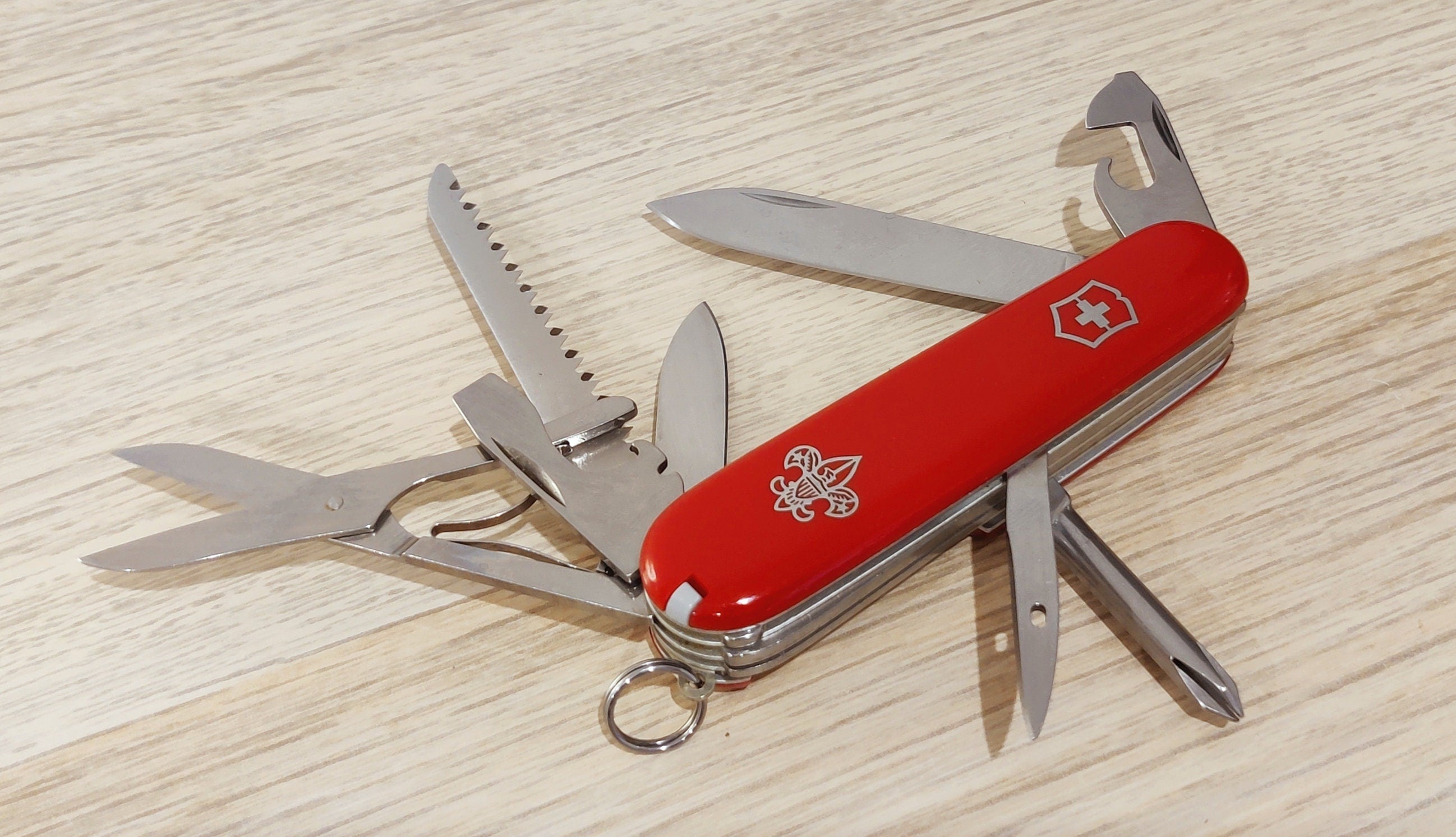
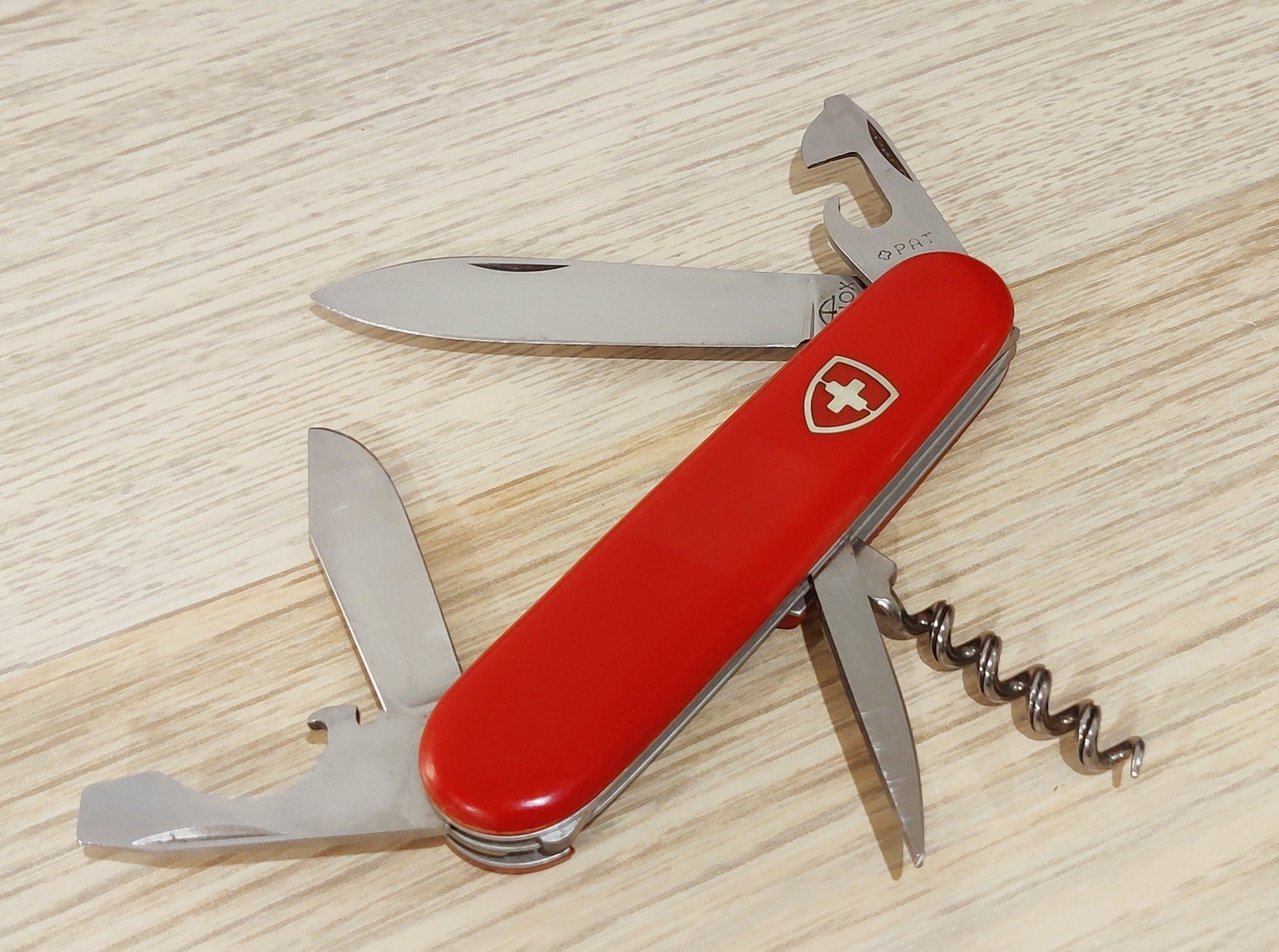
The Victorinox Standard is one of the most fundamental models in the history of the 91 mm Officer Knife range.
Originally designed as a simple two-layer pocket knife, it represents the base architecture from which many later models would evolve.

From Victorinox 2018/2019 Catalogue
The Standard did not disappear abruptly when the Spartan name appeared. Instead, Standard (without scales tools) and Spartan (with scales tools) coexisted in parallel for several years, reflecting Victorinox’s gradual approach to range evolution, market segmentation, and export strategies.
I. Technical overview — A shared architecture

 Spartan today
Core configuration (Standard & Spartan)
- Closed length: 91 mm
- Category: Officer Knife
- Architecture: two main tool layers
Main tools (by functional groups)
- Large blade + Small blade
- Can opener with small screwdriver + Bottle opener with flat screwdriver & wire stripper
Back tool
- Reamer / awl
- Corkscrew
Scale tools as the defining difference
- Standard: no tweezers and toothpick
- Spartan: tweezers and toothpick
Mechanically and structurally, the two models are identical.
The presence or absence of tweezers and toothpick is the only functional distinction between them.
Model references (historical and modern)
In the historical Victorinox reference system, the Standard was catalogued as model 234.
Additional letter suffixes were used to indicate specific features:
-
a→ presence of tweezers and toothpick -
U→ presence of a keyring (bélière)
As a result, variants such as 234a, 234U, or 234aU can be encountered.
From the late 1970s onward, Victorinox progressively adopted a standardized modern reference system, under which the Spartan is now catalogued as reference 1.3603.
II. Historical evolution — Parallel models, not a replacement
1. The Standard as the original baseline (1897 Officer's knife–1960s)
 1930's
 1940's
 1950's
1950's Catalogue, fun to note the name Camper on that 234U
From the interwar period through the first Officer's knife to the early 1960s, the Standard exists as a pure, minimalist Officer Knife.
Key traits
- No tweezers or toothpick
- Slim profile, low cost, high durability
- Frequently encountered with black or early red scales
- Widely exported, especially to the United States
In this period, the Standard represents the entry point into the Victorinox Officer range.
2. The spread of tweezers and toothpick and the Spartan name (late 1960s)
In the late 1960s, Victorinox introduces tweezers and toothpick across several models that did not have before.
To clearly distinguish versions equipped with these new features, the Spartan name begins to appear.
Importantly:
- The Standard does not immediately disappear
- Both versions are produced in parallel
Approximate timeline
- c. 1968–mid 1970: first 234a variants and early Spartans appear
- mid 1970–early 1980s: Standard and Spartan coexist
- mid to late 1980s: Spartan becomes dominant in most catalogs
This overlap reflects Victorinox’s preference for progressive transitions rather than abrupt changes.
3. Standard, Spartan, and the Elinox connection
During the 1960's, Elinox plays an important role within the Victorinox range.
 Elinox Standard 1960'
 Victoria Standard 1960's
Originally highlighting stainless steel, Elinox gradually becomes associated with:
- simplified specifications
- economy-oriented models
- export and price-sensitive markets
During that period, there is no noticable difference between the Elinox and the Victoria Standard (234) apart the branding
In the mid 1970s-early 1980s:
- Standard configurations without tweezers and toothpick increasingly align with Elinox or Economy positioning

- the Spartan represents the fully featured, modernized Officer Knife

Rather than being replaced, the Standard is effectively repositioned.
Explore how ELINOX evolved from early economy models to a platform for innovation and experimentation within Victorinox:
👉 📜 ELINOX Era (1957–1990s) — Victorinox Product Line Evolution
4. The Spartan as the stabilized model (1980s–present)
By the 1980s, the Spartan becomes the official and permanent designation worldwide.
 Standard (no-ring)
Characteristics
- Two-layer architecture unchanged from the original Standard
- Tweezers, toothpick and ring now systematic
- Modern Victorinox tang stamps
- Continuous production to the present day
- Ring or no-ring is the difference between Standard and Spartan now

1985 Catalogue
After the 1980's, the Standard name fades, but its design lives on unchanged.

Catalogue 1987
Collector perspective and significance
A rare case of parallel production
The Standard / Spartan story illustrates a true parallel model strategy, rather than a simple replacement:
- same knife
- same core tools
- different positioning
Collector interest
- Late Standard models (234) without ring, especially from the 1970s–1980s
- Transitional 234a / 234aU examples
- Elinox-marked Standards reflecting the Economy shift
- Premium material Handles like Horn, Staghorn, Mother of Pearl

Standard 234 Staghorn 1957-1961
Foundational role within the range
The Standard / Spartan architecture forms the structural baseline for closely related 91 mm Officer models such as:
These knives expand directly upon the Standard platform by adding specific layers, while preserving its core layout.
Conclusion
The Victorinox Standard and Spartan illustrate a core principle of Victorinox history:
models rarely disappear — they evolve, overlap, and are repositioned.
Rather than a simple renaming, the transition from Standard to Spartan reflects a period of parallel production, where the same technical platform served different expectations, price points, and markets. The presence or absence of ring became a defining marker, not a structural change.
For collectors, this long overlap creates a rich and nuanced field of study, where late 234 Standards, early Spartans, and Elinox-positioned variants form a coherent historical continuum rather than separate categories.
Seen through this lens, the Standard / Spartan is not merely an entry-level Officer Knife, but a foundational design whose continuity helps explain the logic behind many other 91 mm models.
This article is part of the SAKnife Archives, an independent collector-driven project dedicated to documenting Victorinox Swiss Army Knives. All photographs shown come from the SAKnife private collection unless otherwise noted. The historical and technical information presented here is based on existing data shared by recognized collector communities, forums, and expert collector databases. Additional period examples and variants will be added over time as the archive continues to grow.
Identify every Victorinox 91 mm configuration using the structural identification tree:
👉 🔎 Victorinox 91mm Identification Tree – Identify Your Swiss Army Knife by Toolset
Identify the production period of your Swiss Army Knife using the interactive visual tool based on tang stamps and tool evolution:
👉 ⌛ Swiss Army Knife Production Period Guide – Victorinox Interactive Tool Evolution
Explore the evolution of Victorinox 91 mm Swiss Army Knives and discover related model sheets in the historical timeline:
👉 📘 Swiss Army Knife History & 91 mm Model Evolution