Limited Production Swiss Army Knives Outside the Standard Catalog
Victorinox Special Runs refer to limited production Swiss Army Knives manufactured outside the standard Victorinox catalog. These knives were often produced for corporate, institutional, or specific commercial requests and feature unique toolsets, configurations, or combinations never offered as regular catalog models.
This article explores the historical origins of Special Runs, their technical characteristics, and why these non-standard Victorinox knives hold particular importance for collectors
This made on order dimension is essential: unlike limited editions initiated by Victorinox itself—such as commemorative or marketing-driven releases—Special Runs originate from an external commission, most often from companies or institutions, and are frequently conceived as Corporate, or Retailer Editions.
Unlike advertising models, which became more common from the 1970s onward, Special Runs were primarily small-batch productions with technical or functional deviations.
The examples presented here are a selection among many, chosen to illustrate the technical, historical, and collecting relevance of this distinctive category.
What defines a Victorinox Special Run?
A Victorinox Special Run is not merely a logo variant, nor simply a limited edition. Its defining characteristic lies in the client-driven origin combined with a non-catalog toolset, assembled specifically for a commissioned series.
This distinction explains why Special Runs often feature:
-
Unusual or transitional tool combinations,
-
Discontinued or repurposed components,
-
Highly specific functional logic tied to a profession or industry,
-
And, in many cases, metal inlays, reinforcing their premium corporate positioning.
Early Special Runs (1960s–1970s)
Special Runs can be identified as early as the 1960s, well before the term itself was commonly used.
-
Hiker Small 84mm Pilatus

A particularly important example, as this model appears to have existed only as a Special Run for Pilatus, with no known equivalent in the standard Victorinox catalogue.


Produced for an industrial context, this knife replaces the usual metal file with a wood saw, a configuration aligned with the needs of the wood-processing industry. The Pawag is one of the clearest early demonstrations of the function-first logic behind Special Runs.

An instructive and somewhat amusing case: the inline flat screwdriver was replaced by a small clip-point blade, most likely due to tool availability constraints, while maintaining a prestigious presentation associated with Brown Boveri.
Metal inlays as a premium marker
From the outset, most Special Runs feature the client’s logo as a metal inlay, reinforcing their status as high-end corporate gifts.
Notably, even after the 1990s, when Victorinox increasingly shifted toward printed logos for standard production, metal inlays continued to appear on select Special Runs.
-
Key modern example: the Marzocco Special Run (2025), produced for La Marzocco, confirms that metal inlays remain the preferred solution for prestige corporate commissions.


Increased frequency after 1980
While Special Runs are relatively rare before 1980, they become noticeably more frequent afterward, particularly with the introduction of new tools into the Victorinox ecosystem, such as the pliers.
Representative examples include:
-
Mechanic Techline for RadioShack, retailer edition and special run

-
Yeoman Mechanic Heuliez for Heuliez

A particularly interesting variant is the Yeoman Heuliez without hook. All components date from pre-1991, strongly suggesting a pre-Yeoman configuration, produced before the Yeoman officially entered the Victorinox catalogue.
👉Yeoman


Another well-known example from this period is the Hoffritz Limited Edition, commissioned by Hoffritz, retailer edition and special run


Cost-driven use of outdated tools
It is important to note that, for cost-control and inventory-optimization reasons, Victorinox frequently relied on outdated or discontinued tools when assembling Special Runs, allowing the company to use remaining stocks of older components.
This practice explains several seemingly anachronistic configurations. A clear example is the Pawag, produced after 1961 yet fitted with a wood saw typical of the 1950s, illustrating Victorinox’s pragmatic reuse of existing tool inventories in limited series production.
Discontinued tools
Some of the most desirable Special Runs are those that incorporate obsolete tools, no longer since decades in standard production.
-
Engineer for Telemecanique, equipped with the highly sought-after inline Technician screwdriver, produced for Telemecanique

-
Fuchs Helikopter, following a similar logic of discontinued tool reuse

-
Zurihegel, notable for its unusual small pruner blade

These knives are particularly valued by collectors due to the combination of limited production and tools otherwise unavailable.
Purpose-built tools and niche functions
Certain Special Runs go even further by introducing highly specialized tools:
- Spatula tool
Used on models such as the Analytical, produced for Hewlett-Packard
👉HP Analytical

-
Custom-developed tools
👉The Marzocco Barista also includes a wrench 🔧 tool specifically designed for servicing the brand’s espresso machines.

-
Divot tool
Found on the single-layer 👉Golfer Special
- 👉Spartan Golfer Dresden Bank, commissioned for Dresden Bank with a Golfer ⛳ Metal inlay

Collector bonus: the Golftimer L.L.Bean


👉Victorinox Timekeeper & SuperTimer
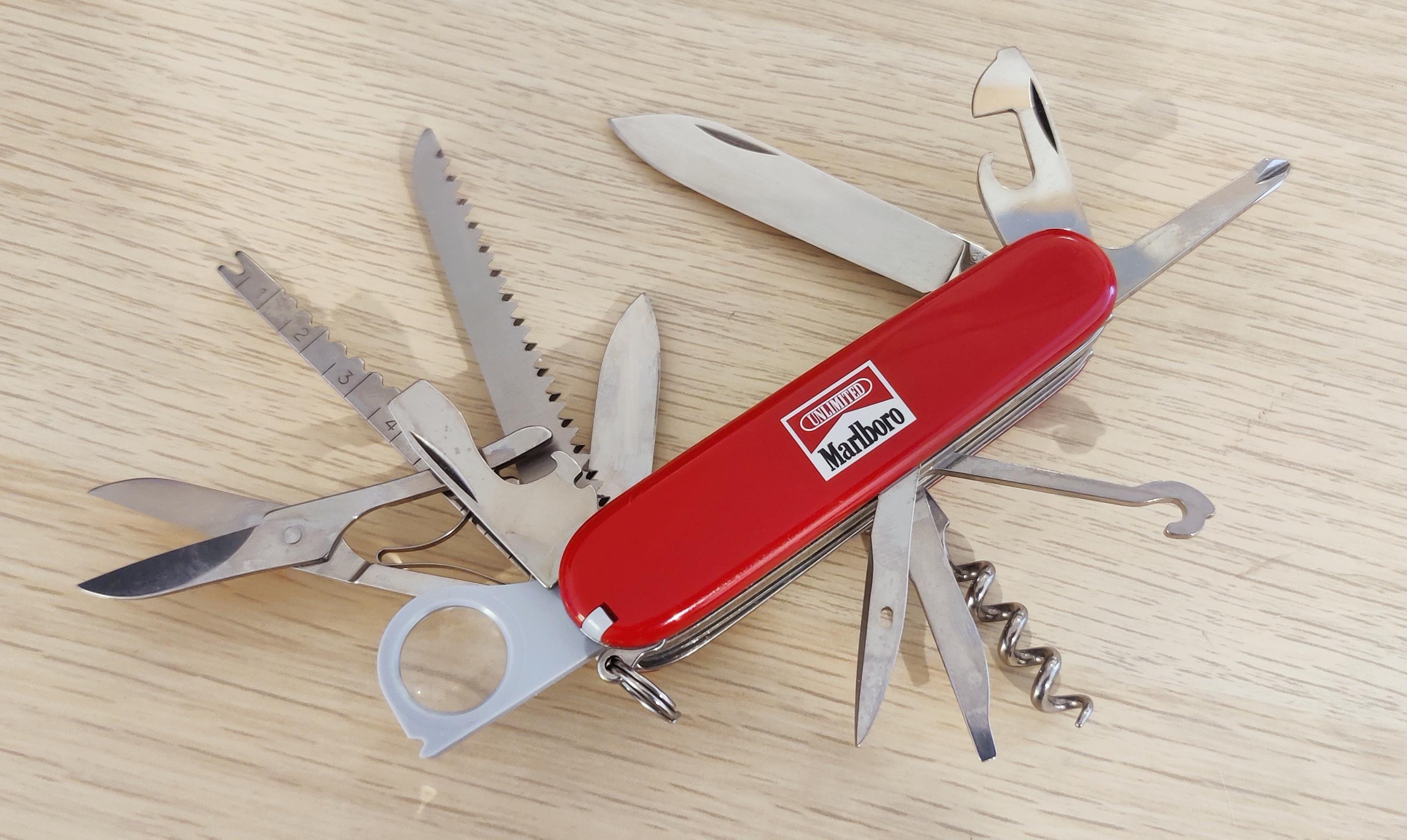
Special Runs without metal inlays: the Marlboro series
Not all Special Runs rely on metal inlays. The Marlboro Unlimited series is a key example.
Available through a points-based catalogue, these knives were produced in three distinct retailer edition / special run:
 From top to bottom:
-
Troubleshooter
-
Trailguide
-
Outdoorsman
Commissioned by Marlboro under the brand Marlboro Unlimited, they demonstrate that Special Runs can also serve large-scale marketing strategies, while still featuring non-catalog toolsets.
Conclusion
Victorinox Special Runs represent a distinct and often overlooked segment of Swiss Army Knife history. Produced outside the standard catalog, these knives reflect Victorinox’s ability to respond to specific functional or institutional requests while experimenting with unique configurations.
For collectors, Special Runs provide valuable insight into non-standard production practices and transitional design logic.
Victorinox Special Runs form a distinct collecting theme:
-
rare before 1980,
-
more numerous thereafter, particularly as new tools became available,
-
shaped by a balance of functional innovation, industrial pragmatism, and corporate prestige.
Produced outside the standard catalog, these knives reflect Victorinox’s ability to respond to specific functional or institutional requests while experimenting with unique configurations.
For collectors, Special Runs provide valuable insight into non-standard production practices and transitional design logic.
This article is based on cross-referenced Victorinox catalogs, documented non-catalog knives, and collector research. The Special Runs discussed here reflect confirmed production variations rather than undocumented aftermarket modifications.
Explore related non-standard production:
👉Victorinox Non-Regular Metal Inlays
👉Victorinox Commemorative & Collector Metal Inlays
This article is part of the Metal Inlays Thematic published in SAKnife Archives, a curated guide exploring the history, intent, and evolution of Victorinox metal inlay Swiss Army Knives.
👉Metal Inlays Thematic — Historical & Collector Guide