The Phillips alternative to the Spartan
Introduction
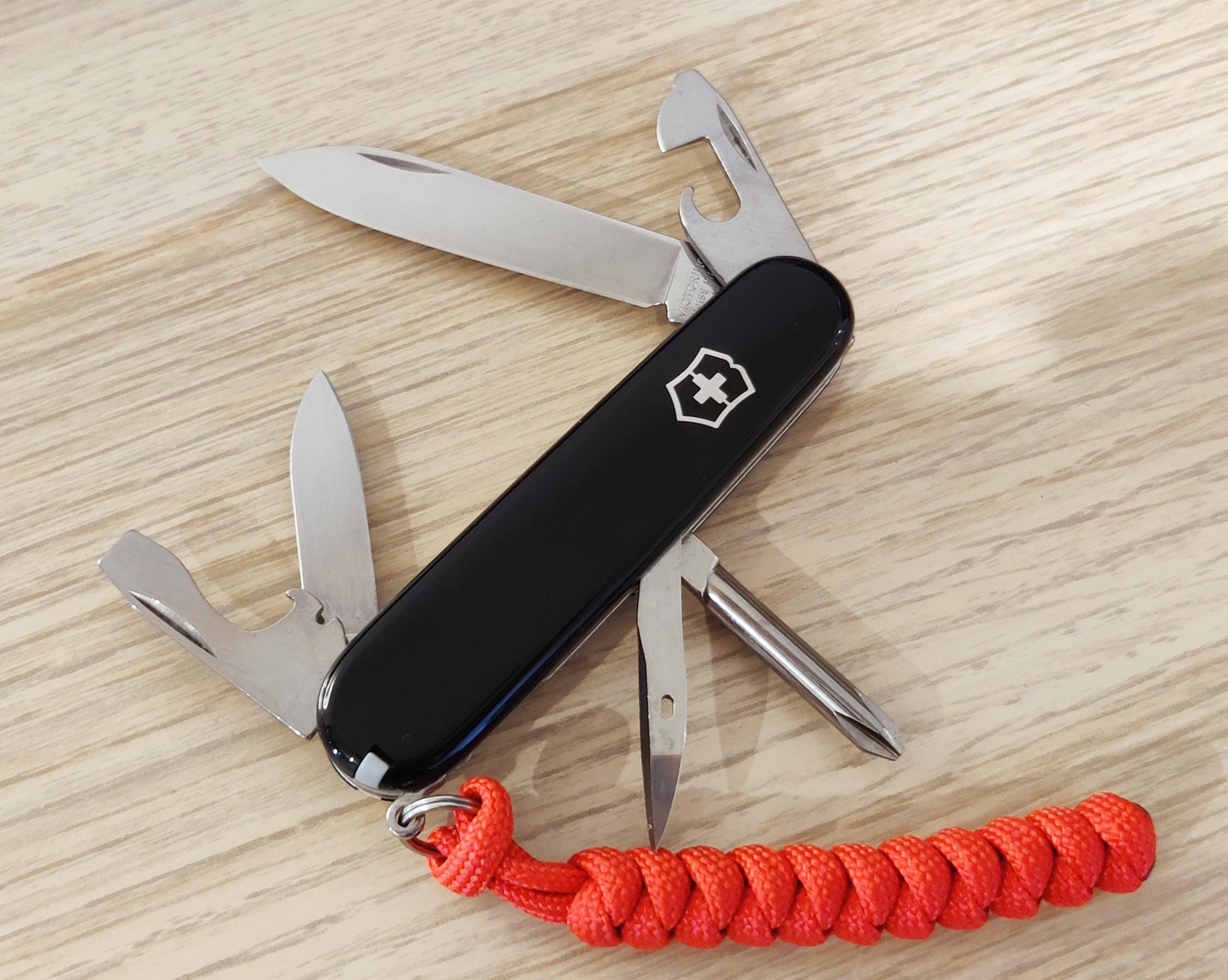
The Victorinox Tinker is often described as the “Phillips version of the Spartan.”
Historically, this is accurate — but incomplete.
In its early history, the Tinker is not conceived as a fully independent model, but as a Phillips screwdriver option within the same functional family as the Standard / Spartan. During the 1950s and early 1960s, Victorinox treats the corkscrew and the Phillips screwdriver as parallel choices, not as defining identities.
Only later does the Tinker gradually emerge as a clearly identified model in its own right.
I. Technical overview — A two-layer technical Officer Knife

Tinker Liberty 🗽
Core configuration
- Closed length: 91 mm
- Category: Officer Knife
- Architecture: two main tool layers
- Old Victorinox reference: 134
- Modern Victorinox reference: 1.4603
Main tools
Large blade & Small blade
Can-opener & Cap-lifter
Back Layer Tools
Phillips screwdriver
Awl / Reamer – with a sewing eye
Scale Tools
Toothpick
Tweezers
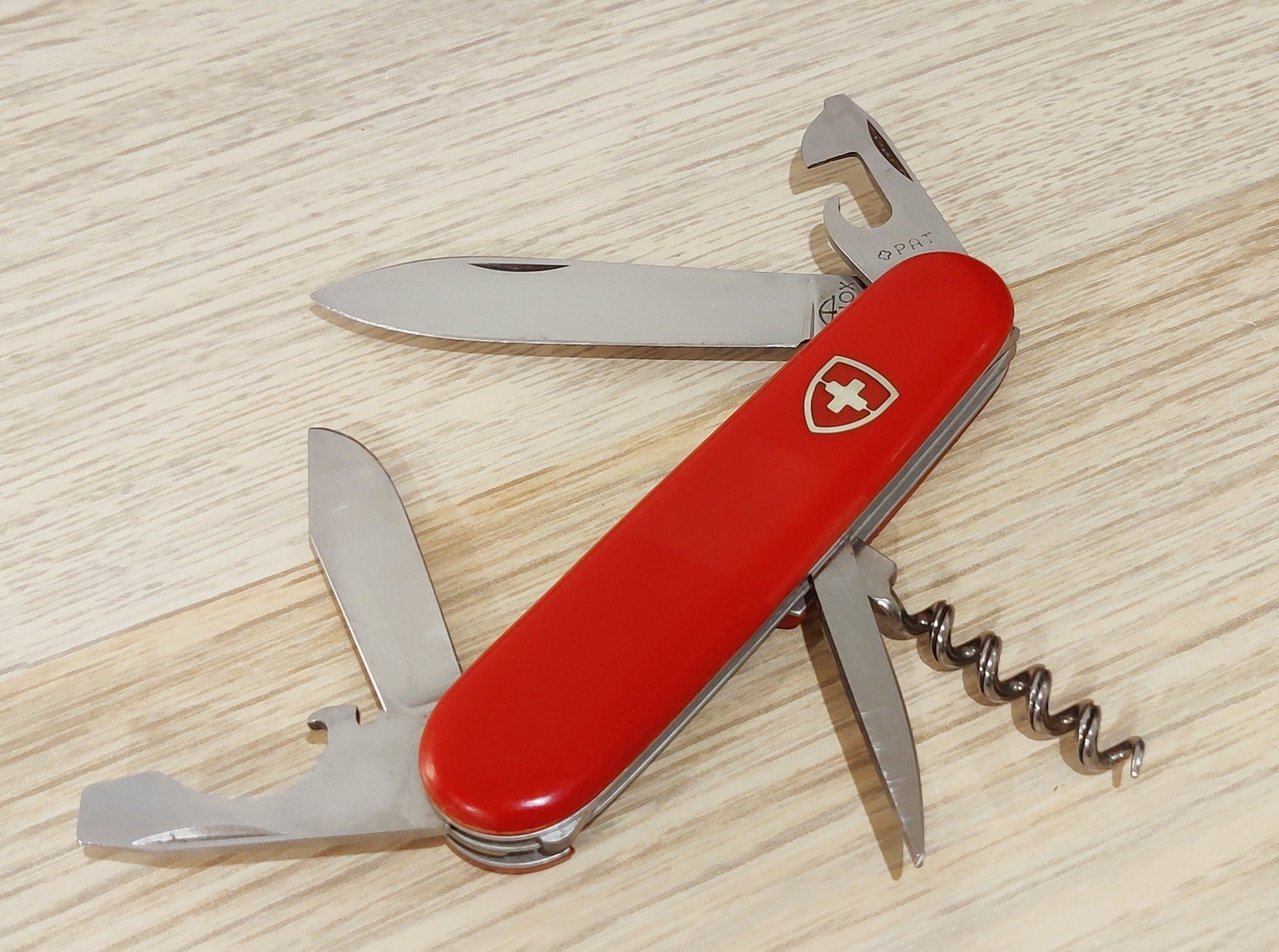
Mechanically, the Tinker shares the exact same structure as the Spartan.
The only functional difference lies in the back tool: corkscrew vs Phillips screwdriver.
II. Historical evolution — From Phillips option to named model
1. Army Models, Phillips option, and early naming (1950s–early 1960s)
During the 1950s and early 1960s, simple Officer Knives are grouped under what period material commonly refers to as the “Army Models”.

1954 Catalogue
This family includes:
- corkscrew-based Standard / Spartan-type knives
- Phillips-equipped alternatives
- both 91 mm and 84 mm formats
At this stage:
- the Phillips screwdriver is an option, not a standalone model
- naming remains fluid and secondary
- functionality takes precedence over branding
A key and often overlooked detail is that the name “Tinker” appears first on the 84 mm model:

1950's Catalogue
- 134k (84 mm) carries the Tinker name
- 234k (84 mm, corkscrew) exists in parallel
- the 91 mm Phillips configuration (134) remains largely generic
This strongly suggests that Tinker initially designates a Phillips concept, not a fixed model identity.
2. Appearance in the Elinox line (from 1964)
From 1964 onward, the 91 mm model 134 is documented within the Elinox line, while remaining available in parallel within the Victoria catalogue.

Tinker Elinox 1960's

Tinker Victoria 1960's
This dual presence reflects segmented approach at the time, where the same technical configuration could coexist across different commercial lines rather than replacing one another.
Whether explicitly named or not, the existence of Elinox-marked Tinker knives from this period provides a reliable material reference for the 91 mm Phillips configuration in the mid-1960s.
This moment marks the first clear documentary anchor for the 91 mm Tinker configuration, even though its conceptual roots are earlier.
Explore how ELINOX evolved from early economy models to a platform for innovation and experimentation within Victorinox:
👉 📜 ELINOX Era (1957–1990s) — Victorinox Product Line Evolution
3. A long 84 mm dominance, and late adoption of the 91 mm (1970s–1980s)
Despite the existence of the 91 mm configuration, catalogues from the 1970s show a clear market preference for the 84 mm Tinker.
Throughout this decade:
- the Tinker name is overwhelmingly associated with the 84 mm format (134k)
- the 91 mm version appears only sporadically, or not at all, in many catalogues
- Victorinox continues to position the 84 mm Tinker as the natural Phillips counterpart within the Army Models family

1970's Catalogue
This suggests that, for the public at the time, the compact 84 mm format better matched the practical, technical identity of the Tinker.
It is only in the 1980s that the 91 mm Tinker finally appears clearly and consistently in catalogues, marking its true commercial stabilisation as a full-size Officer Knife. From that point onward, the Tinker becomes firmly established as the Phillips-based alternative to the Spartan in the 91 mm range.

91mm Tinker in 1986 catalogue
Collector perspective and significance
A design defined by choice
The Tinker illustrates a core Victorinox principle: use dictates tools, not tradition.
By offering Phillips and corkscrew variants side by side for decades, Victorinox acknowledged early on that no single configuration could satisfy all users. The Tinker embodies this philosophy in its purest form: minimal layers, a deliberate tool choice, and a clearly technical orientation.
Collector interest
From a collector’s perspective, the Tinker offers several points of interest despite its apparent simplicity:
- Early Phillips-based Army Models from the 1950s–60s
- The 134k Tinker (84 mm), which carried the name long before the 91 mm version became common
- Early post-1964 134 knives from the Elinox line
- Transitional Phillips screwdriver designs and markings
These variations highlight how slowly and pragmatically the model’s identity took shape.
The Tinker BSA — an unexpected scouting variant
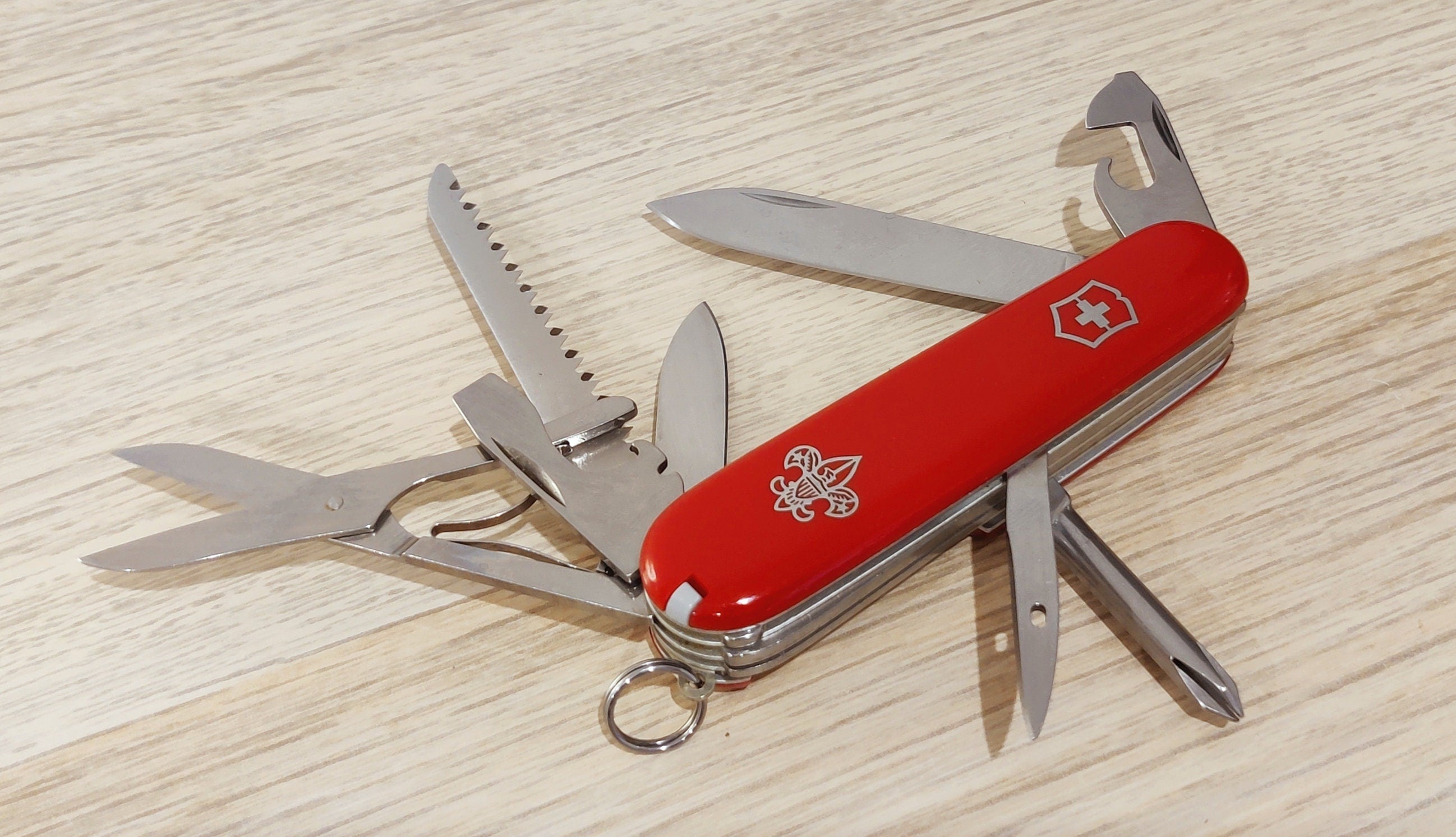
An often overlooked chapter is the Tinker BSA, produced for the Boy Scouts of America.
Issued in both red and black Cellidor scales with a BSA shield, it represents a rare crossover between technical Army Models and the scouting world.
See more: 👉Victorinox BSA Metal Inlays

Tinker BSA Black with metal inlay

Tinker BSA Red with metal inlay

1990's Cub Scouts BSA Tinker 91mm
Position within the 91 mm range
The Tinker sits naturally alongside:
- 👉Spartan / Standard — corkscrew-based equivalent
- 👉Hiker — Woodsaw added to the Tinker base
- 👉Super Tinker — scissors added to the Tinker base
- 👉Fieldmaster — Phillips philosophy extended to four layers
Together, these models form the Phillips branch of the Officer Knife range.
Conclusion
The Victorinox Tinker was not born as a model — it was born as an option.
For decades, that option found its most natural expression in the 84 mm format, which dominated catalogues well up to the 1970s. The 91 mm Tinker, although technically present earlier, only truly establishes itself in the 1980s, once market expectations and range structure align.
From that point forward, the Tinker becomes what it is today: a simple, focused, and enduring expression of Victorinox’s pragmatic design philosophy.
Beyond its technical relevance, the Tinker (both 91mm & 84mm) also achieved an unexpected form of cultural immortality: it is the Swiss Army Knife most frequently seen in the MacGyver television series, where its Phillips screwdriver and minimalist toolset perfectly matched the show’s improvisational spirit. This repeated on-screen presence cemented the Tinker’s image as the ultimate problem-solving knife — practical, clever, and unpretentious.

This article is part of the SAKnife Archives, an independent collector-driven project dedicated to documenting Victorinox Swiss Army Knives. All photographs shown come from the SAKnife private collection unless otherwise noted. The historical and technical information presented here is based on period catalogues and data shared by recognized collector communities, forums, and expert collector databases. Additional period examples and variants will be added over time as the archive continues to grow.
Identify every Victorinox 91 mm configuration using the structural identification tree:
👉 🔎 Victorinox 91mm Identification Tree – Identify Your Swiss Army Knife by Toolset
Identify the production period of your Swiss Army Knife using the interactive visual tool based on tang stamps and tool evolution:
👉 ⌛ Swiss Army Knife Production Period Guide – Victorinox Interactive Tool Evolution
Explore the evolution of Victorinox 91 mm Swiss Army Knives and discover related model sheets in the historical timeline:
👉 📘 Swiss Army Knife History & 91 mm Model Evolution