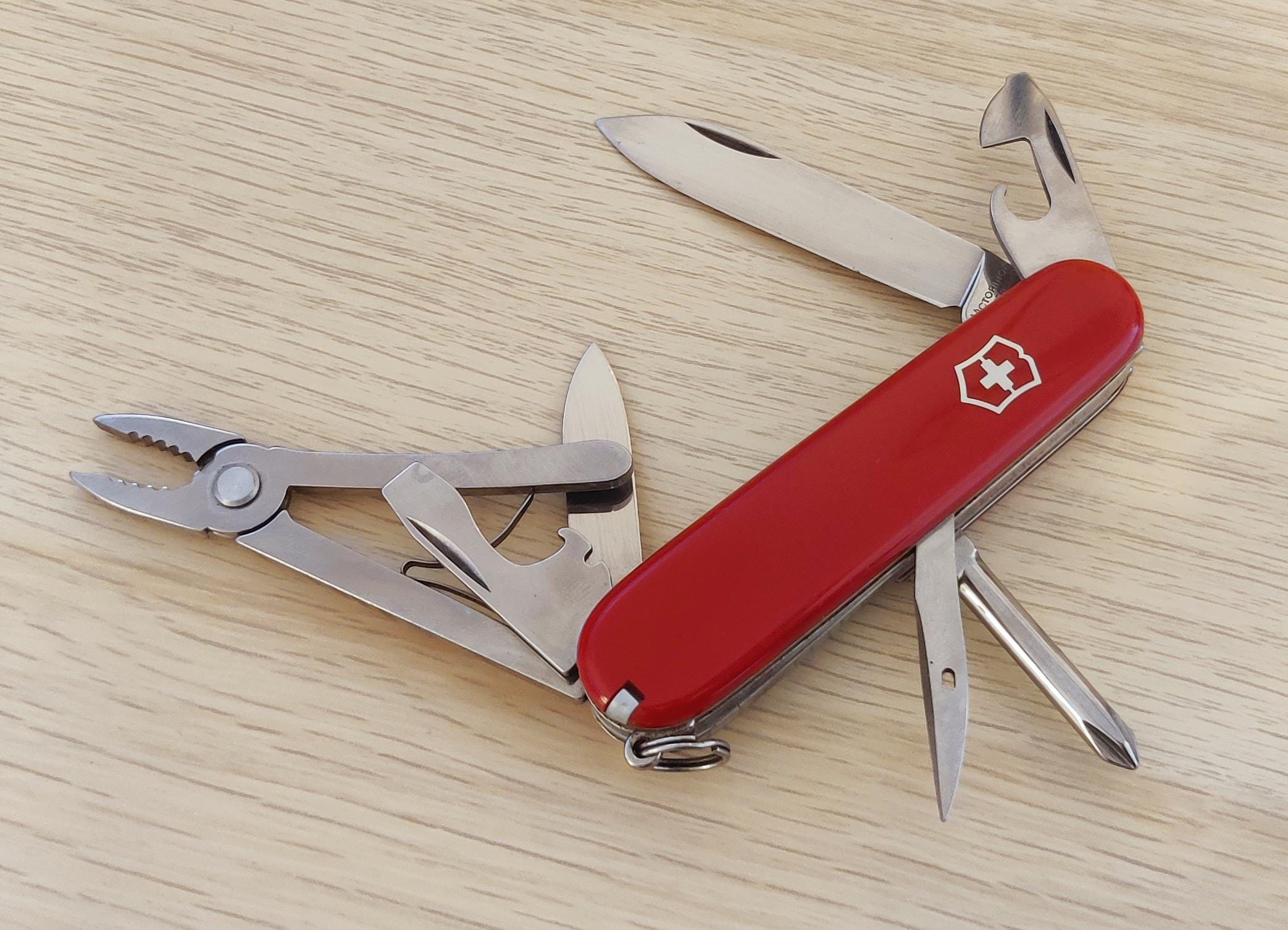
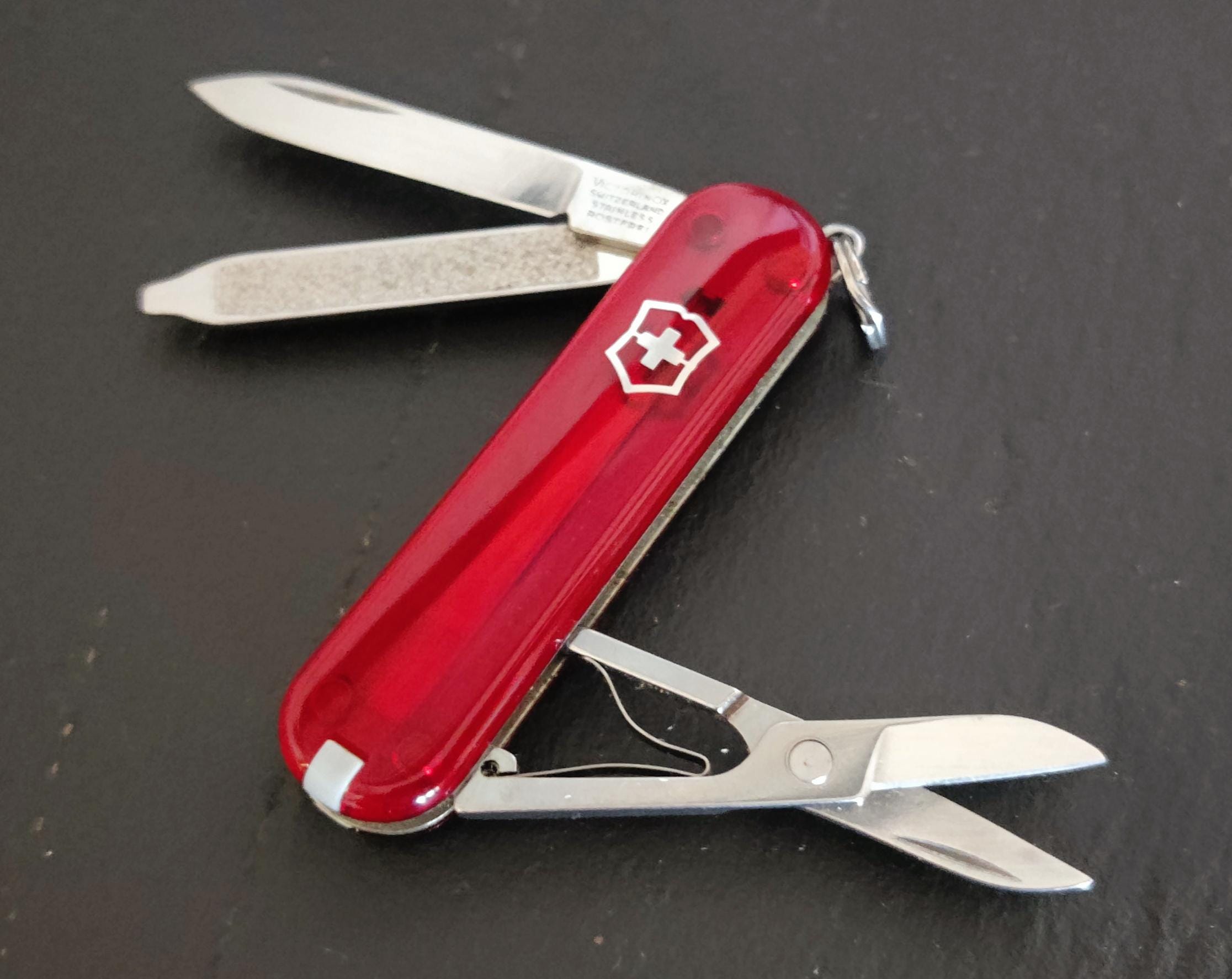
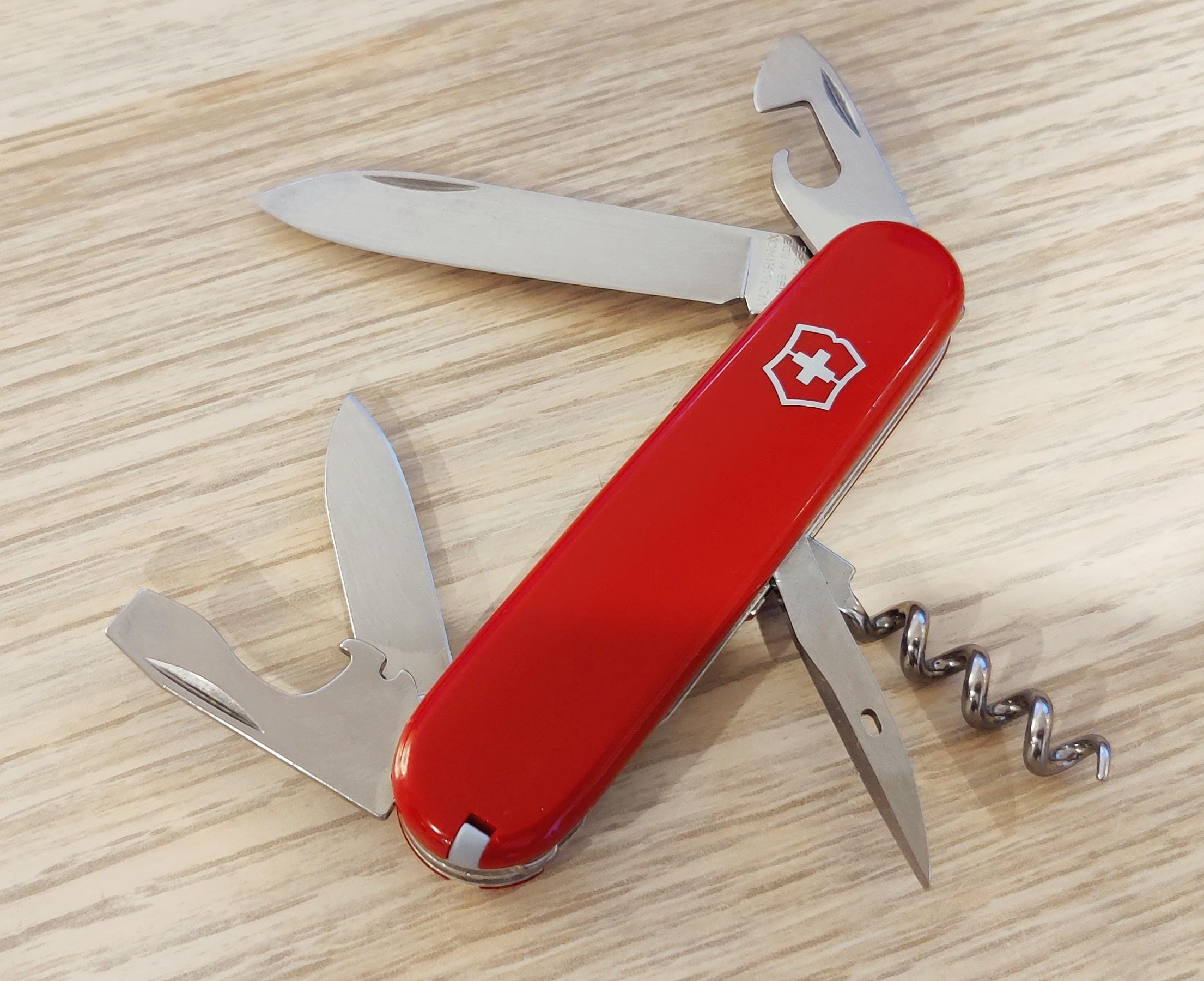
The discreet 91 mm Phillips counterpart to the Huntsman
Introduction
The Victorinox Fieldmaster 136 is today recognized as the Phillips-equipped counterpart to the Huntsman.
Yet its early history is remarkably discreet.
Based on surviving examples, the 91 mm configuration appears in the late 1950s, but it remains absent from Swiss Victorinox catalogues for decades. Instead, its 84 mm counterpart — the 136k “Craftsman” — is clearly documented during the 1960s and 1970s.
The 91 mm Fieldmaster physically exists long before it is officially acknowledged in Swiss catalogues.
I. Technical Overview — A 4-layer Phillips configuration

- Closed length: 91 mm
- Old reference: 136
- Architecture: 4 layers
- Back tool: Phillips screwdriver
The Fieldmaster mirrors the Huntsman mechanically, with one defining structural difference:
- Huntsman → Corkscrew
- Fieldmaster → Phillips screwdriver
Tool configuration
Large blade
Small blade
Wood saw
Can opener + small screwdriver
Bottle opener + large screwdriver + wire stripper
Scissors
Back Layer Tool
Phillips screwdriver
Scale Tools
(optional before 1973)
Before 1973, the Fieldmaster exists primarily with bail (bélière) and without Toothpick & Tweezers as standard equipment.
Scale tools appear as optional refinements rather than systematic features during this early period.
II. Late 1950s appearance — Without Swiss catalogue presence
Multiple surviving examples indicate the 91 mm 136 configuration appears in the late 1950s.

136aU 1957-1961
However:
- It does not appear in Swiss Victorinox catalogues prior to the 1980s.
- The 84 mm 136k “Craftsman” is clearly documented instead.

1950's Catalogue showing 84mm 136k
This suggests that during the 1960s and 1970s, the Phillips + saw configuration was commercially emphasized in the 84 mm range within Switzerland, even if the 91mm version existed there

136aU 1966-1968 from Luzern Switzerland
III. Hoffritz USA — An export identity
While absent from Swiss catalogues, the Fieldmaster appears consistently in Hoffritz USA catalogues between the 1950s and 1980s.


Hoffritz Catalogue early 1960's

Hoffritz Catalogue late 1960's

Hoffritz Catalogue 1970's
This confirms that:
- The 91mm model was marketed in the American export market.
- Its commercial recognition developed abroad before stabilizing in Switzerland.
This export-driven visibility is a recurring theme in mid-century Victorinox history.

Fieldmaster 136 early 1970's
IV. 1980s — Official Swiss recognition
By the 1980s, the Fieldmaster finally appears clearly in Swiss catalogues under its modern name.

Victorinox 1986 Catalogue

Fieldmaster 1986-1991
From this point onward:
- Toothpick & Tweezers become standardized
- The bail disappears
- The model becomes fully integrated into the modern 91 mm Officer lineup
It remains in production today.
Position within the 91 mm range
The Fieldmaster sits structurally between:
-
👉Huntsman (corkscrew)
- 👉Master Craftsman (adds metal file layer)
- 👉Hiker (no scissors)
It represents the 4-layer saw configuration for users who prefer a Phillips screwdriver over a corkscrew.
Unlike the Huntsman, however, it was not the dominant Swiss catalogue reference during the 1960s and 1970s.
Collector Perspective and Significance
A Swiss catalogue ghost
The Fieldmaster is a compelling example of a knife that:
- Clearly existed from the late 1950s
- Appeared in export catalogues
- Yet remained largely undocumented in Swiss catalogues for decades

1980's Swiss Cheese Inlay Fieldmaster
Bonus Collector — The BSA naming paradox

In a notable catalogue twist:
The Fieldmaster BSA edition is sometimes listed as “Huntsman” in BSA catalogues.


Fieldmaster BSA 1985-1991
Structurally → Fieldmaster (Phillips)
Commercially labeled → Huntsman
A reminder that catalogue naming conventions were not always perfectly aligned across markets.
Conclusion
The Victorinox Fieldmaster 136 is more than simply the Phillips version of the Huntsman.
Appearing quietly in the late 1950s, visible in export catalogues long before Swiss documentation, and officially stabilized only in the 1980s, it represents one of the more discreet evolutions within the 91 mm Officer family.
Today, it stands as a stable and enduring model — but its early history reveals a far more complex and export-driven trajectory than its corkscrew counterpart.
This article is part of the SAKnife Archives, an independent collector-driven project dedicated to documenting Victorinox Swiss Army Knives. All photographs shown come from the SAKnife private collection unless otherwise noted. The historical and technical information presented here is based on period catalogues and expert collector databases. Additional material will be added as new information emerges.
Identify every Victorinox 91 mm configuration using the structural identification tree:
👉 🔎 Victorinox 91mm Identification Tree – Identify Your Swiss Army Knife by Toolset
Identify the production period of your Swiss Army Knife using the interactive visual tool based on tang stamps and tool evolution:
👉 ⌛ Swiss Army Knife Production Period Guide – Victorinox Interactive Tool Evolution
Explore the evolution of Victorinox 91 mm Swiss Army Knives and discover related model sheets in the historical timeline:
👉 📘 Swiss Army Knife History & 91 mm Model Evolution