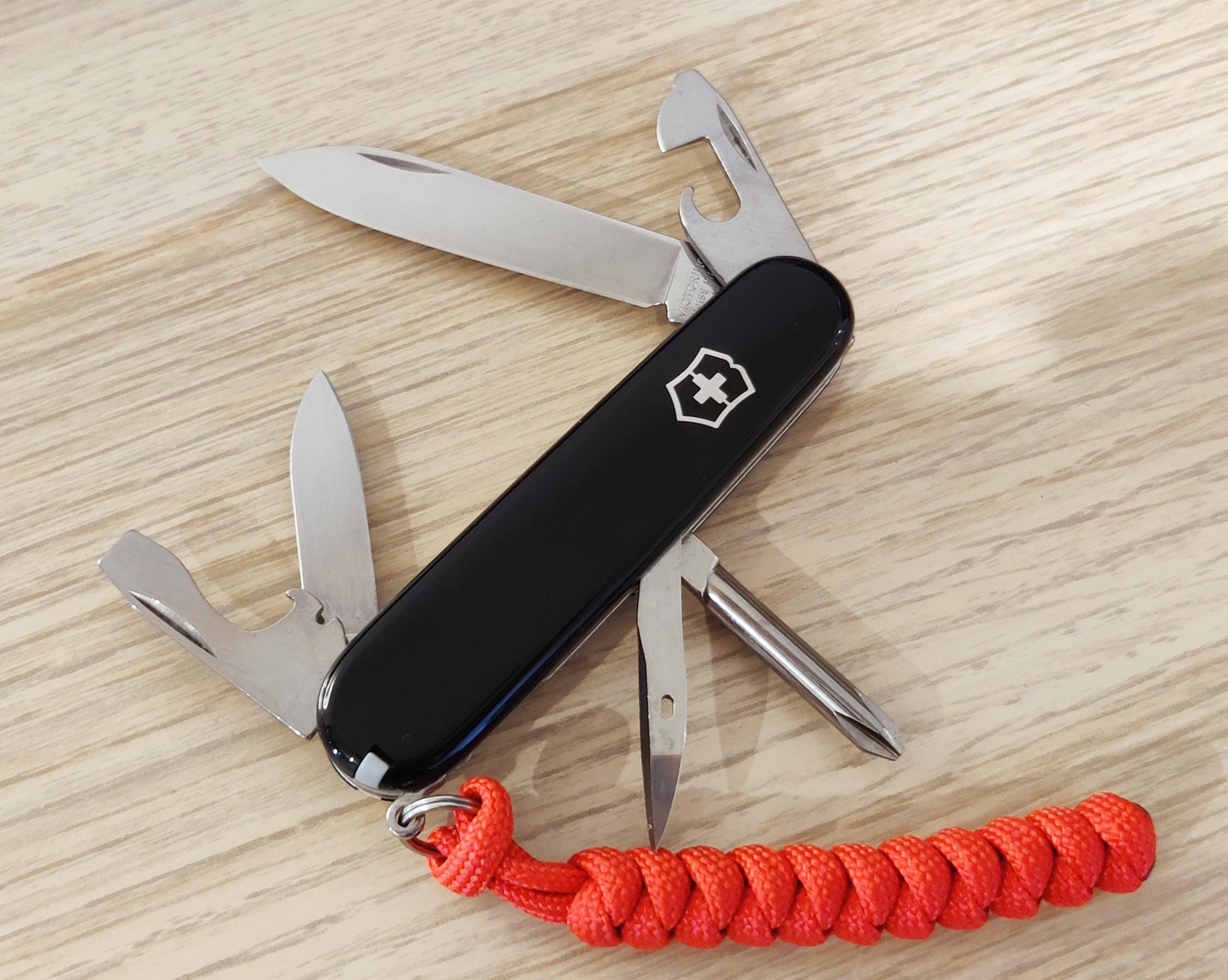
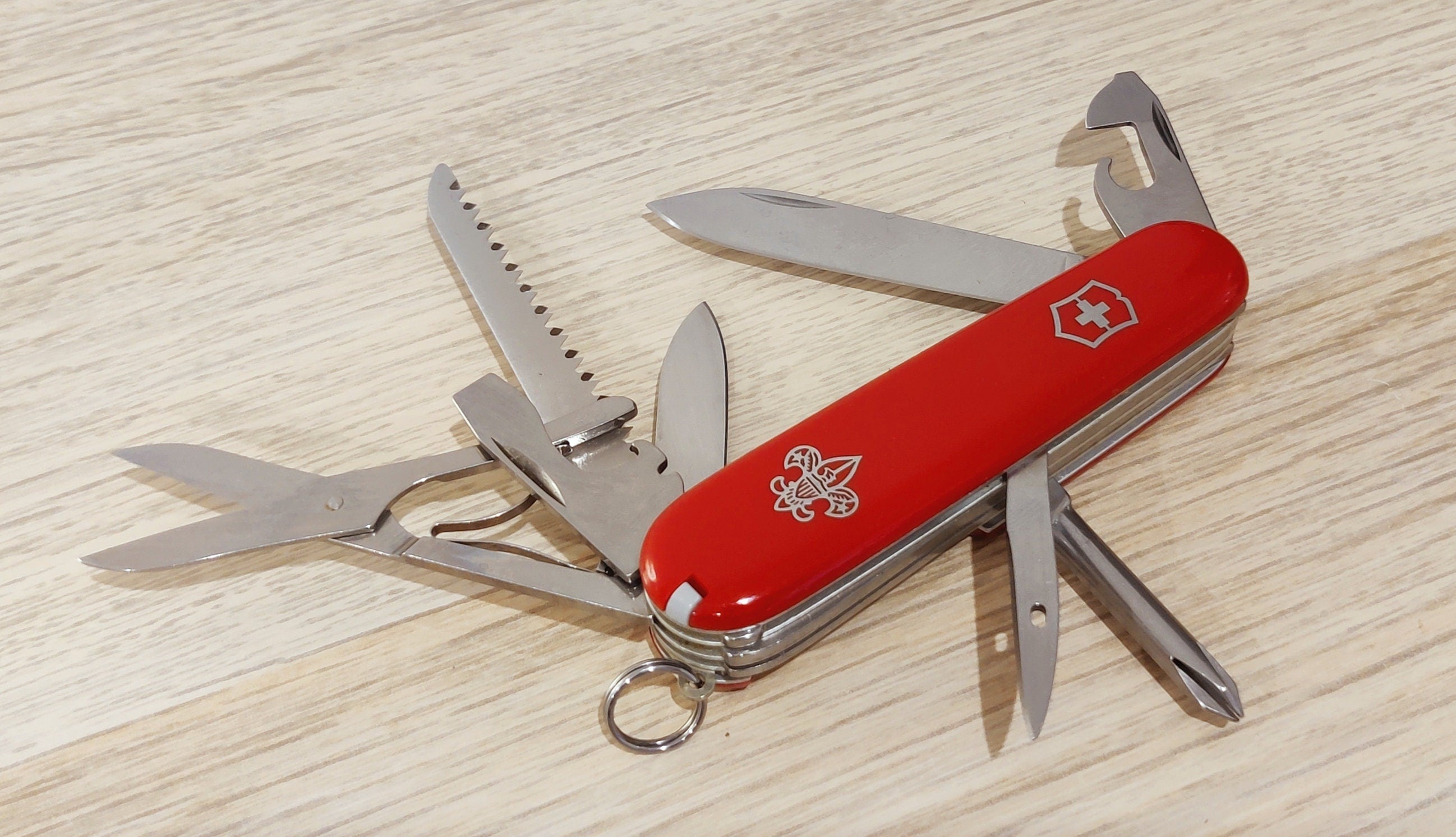
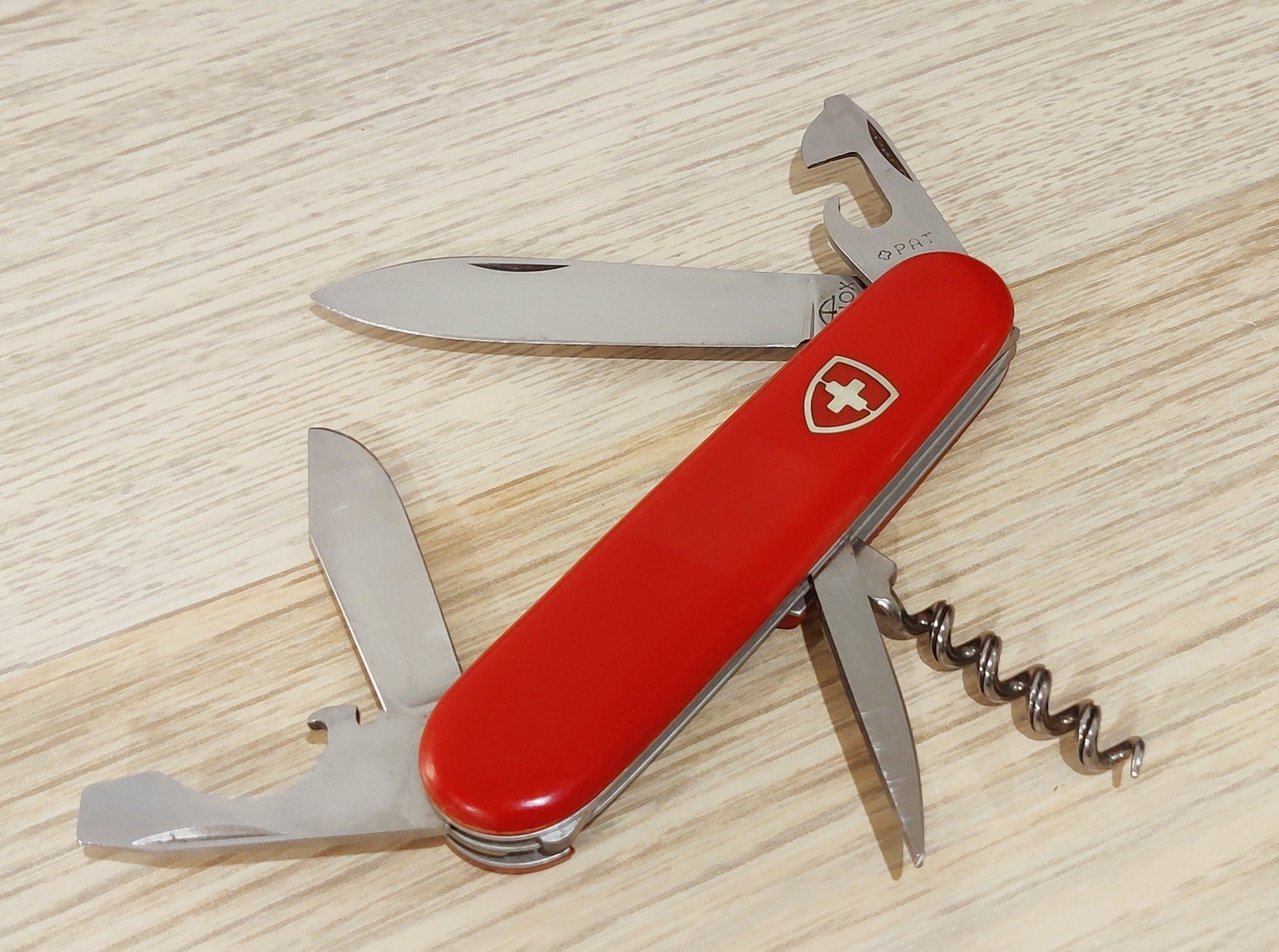
The Phillips-based alternative to the Camper
Introduction
The Victorinox Hiker is often perceived as a straightforward model: a three-layer Officer Knife with a wood saw and a Phillips screwdriver.
In reality, its history is far more discreet — and fragmented.
Like the Tinker, the Hiker appears early, already in the 1950s, but not as a clearly named model. Instead, it exists as a Phillips-based variant of the Camper, positioned within Boy Scouts–oriented ranges, particularly aimed at the U.S. market.
For decades, the Hiker remains largely absent from catalogues, despite clear physical evidence of sustained production.
I. Technical overview — A three-layer outdoor Officer Knife

Core configuration
- Closed length: 91 mm
- Category: Officer Knife
- Architecture: three main tool layers
- Modern Victorinox reference: 1.4613
Main tools
Large blade & Small blade
Can-opener & Cap-lifter
Wood saw
Back Layer Tools
Phillips screwdriver
Awl / Reamer – with a sewing eye
Scale Tools
Toothpick
Tweezers
Mechanically, the Hiker is identical to the Camper, with one defining substitution:
the corkscrew is replaced by a Phillips screwdriver.
II. Historical evolution — A knife without a catalogue identity
1. Early appearance in Boy Scouts–oriented ranges (1950s)
The Hiker configuration appears as early as the 1950s, within Victorinox’s Boy Scouts–oriented offerings.

Catalogue 1954
Period material indicates:
- a three-layer outdoor configuration (blades + openers + saw)
- a Phillips screwdriver, aligned with practical, technical use
- strong distribution toward the United States
In some period listings, an asterisk (*) marks this configuration as particularly well sold in the U.S., highlighting its commercial success despite limited formal branding.
At this stage, the knife exists as a functional variant, not as a named model.
2. A Phillips Camper — produced but undocumented (1960s–1970s)
In the following decades, the Hiker configuration becomes increasingly elusive in catalogues.

137U & 237U
Key observations:
- it does not appear consistently in decade catalogues
- it is absent from the Elinox line
- it remains confined to the Victoria range
Despite this apparent disappearance, numerous surviving examples confirm that production never truly stopped.
The Hiker effectively functions as a Phillips variant of the Camper (237), sold quietly alongside its corkscrew counterpart.

1961-1966 137U

1971-1973 137U
This places the Hiker among those Victorinox models that are produced without being fully formalised.
3. Official recognition — the Hiker name appears (1980s)
During the 1980s, Victorinox finally formalises the model.

Catalogue 1986
 Catalogue 1987
At this point:
- the name Hiker appears clearly in catalogues
- the Phillips + saw configuration is stabilised
- the knife is positioned as a technical outdoor Officer Knife
This phase marks the moment when a long-standing configuration finally receives a clear commercial identity, after decades of discreet production. From then on, the Hiker becomes a permanent member of the 91 mm range, a status it retains to this day.
Collector perspective and significance
A discreet but important model
The Hiker represents a recurring Victorinox pattern:
a knife can exist, sell, and evolve long before it officially “exists” on paper.
Its long undocumented phase makes it particularly interesting for collectors.
Collector interest
- Early Boy Scouts–oriented Hiker configurations from the 1950s
- Victoria-only production, never Elinox
- Transitional, catalogue-absent examples from the 1960s–70s
- Comparison pairs with contemporary Campers (237)
Bonus collector — Hiker National Ski Patrol
One of the most striking variants is the Hiker National Ski Patrol.
This edition features:
- the standard Hiker toolset
- a large metal inlay cross, visually dominant and highly distinctive

National Ski Patrol Hiker 137U 1961-1966
This variant illustrates how the Hiker’s technical, outdoor identity lent itself naturally to institutional and professional special runs.
Position within the 91 mm range
The Hiker sits naturally alongside:
- 👉Camper (237) — corkscrew-based equivalent
- 👉Fieldmaster — adds scissors to the Phillips outdoor concept
- 👉Huntsman — corkscrew + scissors + saw
- 👉Whitetail Deer — SKMW Special run
- 👉 Master Gardener — SKMW Special run
Together, these models define the outdoor branch of the 91 mm Officer Knife range.
Conclusion
The Victorinox Hiker is a knife that existed long before it was officially named.
Appearing as early as the 1950s within Boy Scouts–oriented ranges and strongly associated with the U.S. market, it lived for decades as a quiet Phillips variant of the Camper, produced in the Victoria range without catalogue prominence.
Its official recognition in the 1980s did not mark its birth, but its formal acknowledgment.
Today, still in production, the Hiker stands as a perfect illustration of Victorinox’s pragmatic philosophy: if a configuration works, it will survive — named or not.
This article is part of the SAKnife Archives, an independent collector-driven project dedicated to documenting Victorinox Swiss Army Knives. All photographs shown come from the SAKnife private collection unless otherwise noted. The historical and technical information presented here is based on period catalogues and data shared by recognized collector communities, forums, and expert collector databases. Additional period examples and variants will be added over time as the archive continues to grow.
Identify every Victorinox 91 mm configuration using the structural identification tree:
👉 🔎 Victorinox 91mm Identification Tree – Identify Your Swiss Army Knife by Toolset
Identify the production period of your Swiss Army Knife using the interactive visual tool based on tang stamps and tool evolution:
👉 ⌛ Swiss Army Knife Production Period Guide – Victorinox Interactive Tool Evolution
Explore the evolution of Victorinox 91 mm Swiss Army Knives and discover related model sheets in the historical timeline:
👉 📘 Swiss Army Knife History & 91 mm Model Evolution