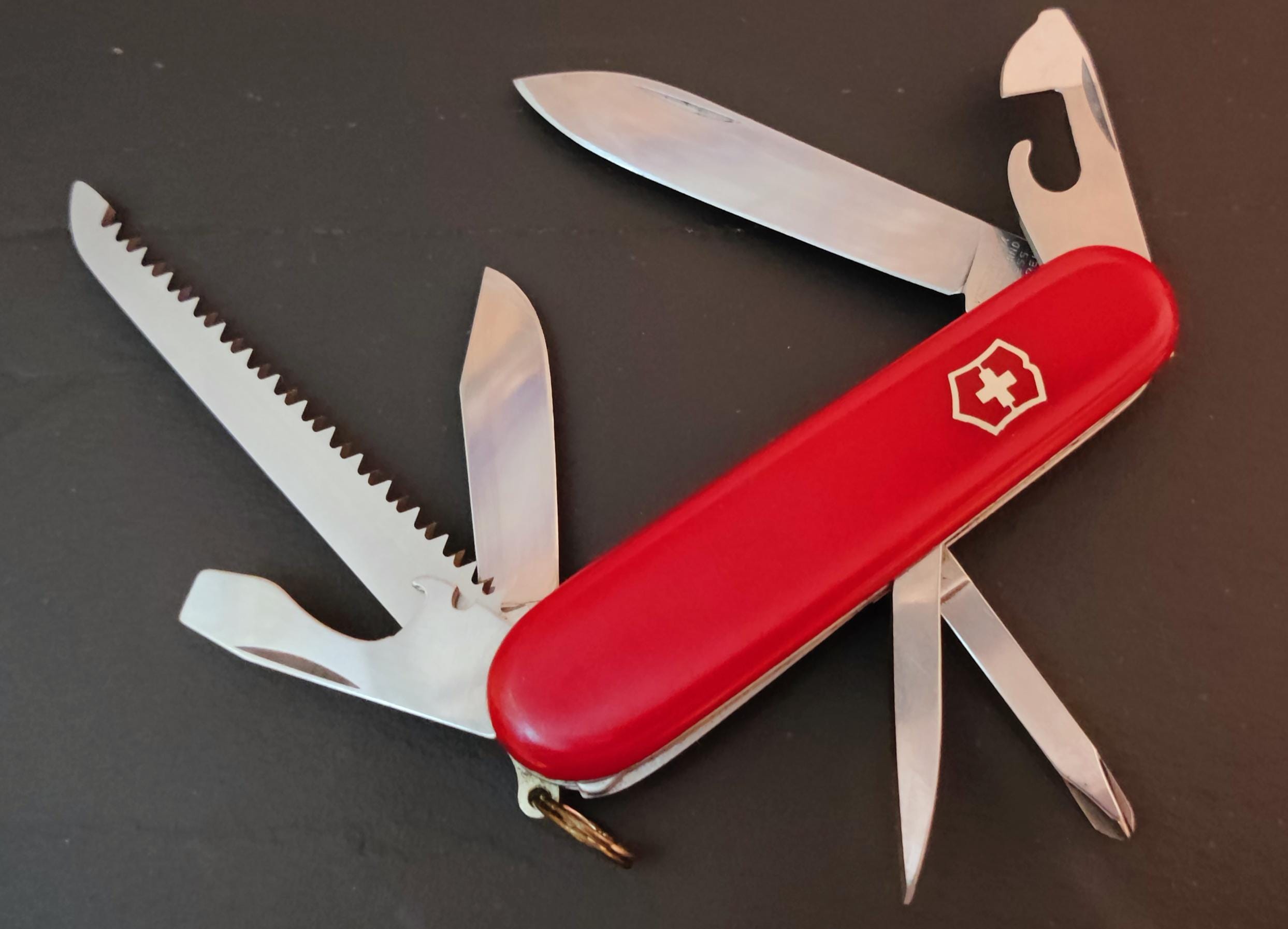
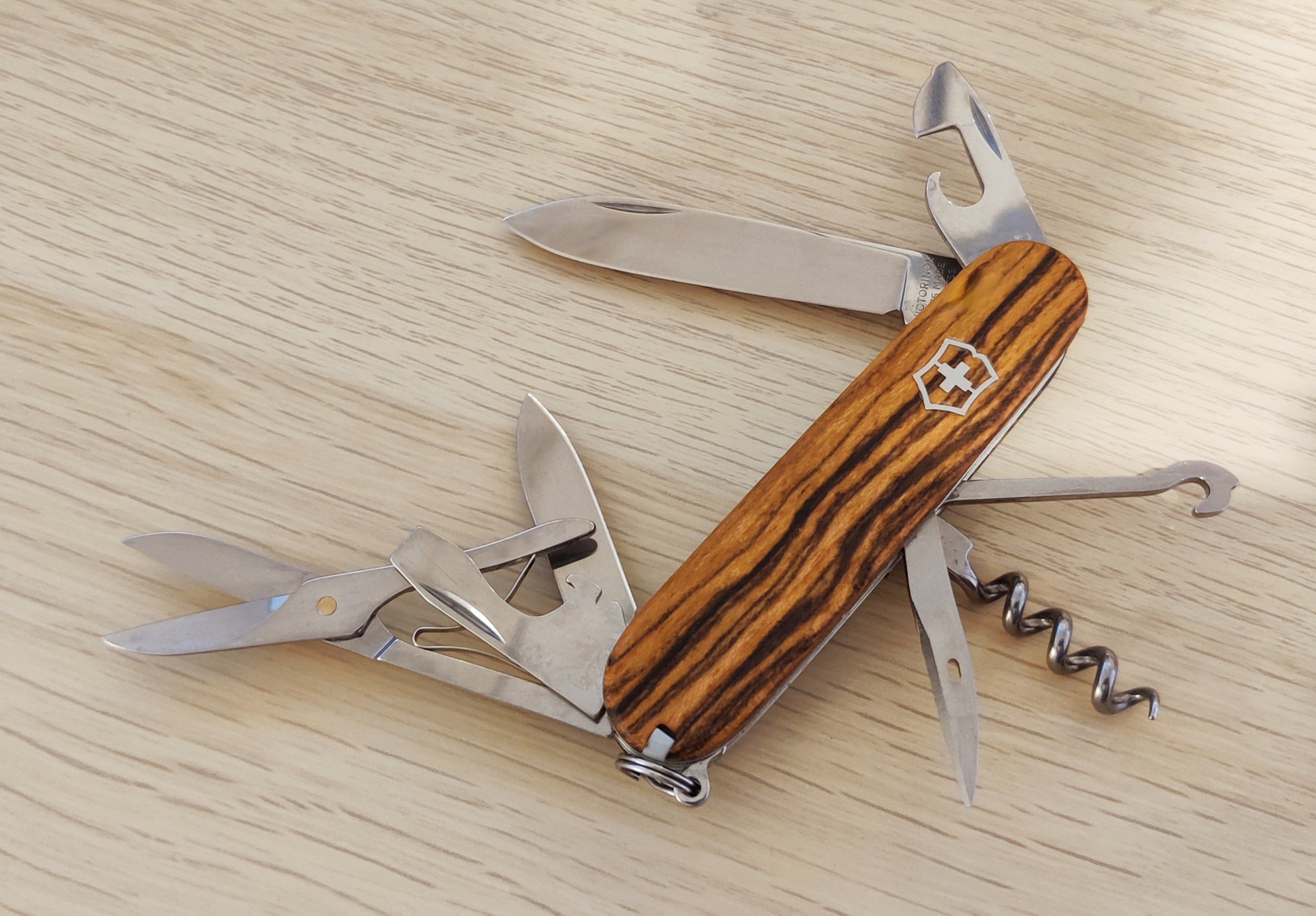
The Elinox Inline Technician Workhorse
Introduction
The Victorinox Handyman 7236m is one of the most technically distinctive 91 mm models of the 1960s.
Produced within the Elinox line, it belongs to the short-lived generation of knives equipped with the rare inline technician screwdriver — a tool associated with mechanical maintenance as well as electrical installations (terminal blocks, dominos, control panels).
Listed in 1960s catalogues under the name Handwerker Messer, the 7236m reflects a purely utilitarian philosophy.
Although fundamentally an Elinox-era model, production appears to have continued briefly after the 1973 restructuring, with the final examples featuring Victorinox tang stamps and livery before complete discontinuation in the mid-1970s.
I. Technical Overview — A 5-layer Elinox configuration
- Closed length: 91 mm
- Old reference: 7236m
- Line: Elinox (final examples Victorinox-stamped)
- Architecture: 5 layers
- Production period: 1960s – mid-1970s
Tool configuration


Handyman 7236m 1961
Large blade
Inline technician screwdriver
Wood saw
Metal file
Scissors
Can opener + small screwdriver
Bottle opener + large screwdriver + wire stripper
Back Layer Tools
Reamer / awl
Corkscrew
Scale Tools
Toothpick
Tweezers
Bail or later Keyring
The technician screwdriver — mechanical and electrical
The defining feature of the 7236m is the inline technician screwdriver.
Unlike the standard rear Phillips, this centrally mounted driver offers improved axial alignment and torque control.

1960's Catalogue
It was particularly suited for:
- Automotive adjustments
- Workshop machinery
- Electrical maintenance (dominos, screw terminals, junction boxes)
This firmly places the Handyman within the specialized technical lineage of the 1960s.
Explore the rare inline technician screwdriver and its dedicated Victorinox models:
👉🪛Victorinox Technician Screwdriver — Inline Tool, Catalogue Models & Special Runs
II. One of the only Elinox models with scissors
The Handyman 7236m holds a unique distinction:
It is one of only two known Elinox 91 mm models equipped with scissors, the other being the Outdoorsman 8236m.

Other Elinox configurations were simpler and did not include scissors.
Elinox vs Victoria scissors
Elinox scissors are identifiable by:
- A matte, non-polished finish
- A more utilitarian appearance
Victoria scissors of the same era are typically polished and more refined.

This subtle but important detail allows collectors to distinguish Elinox-origin configurations immediately.
Early and Late Production Details
The Handyman 7236m also illustrates the subtle transition taking place around 1968.
Early examples features the 1960s-style bail

Late 1971-1973 Handyman 7236m with Keyring & transition Scissors
The final production stage — shortly after 1973 — includes examples stamped Victorinox, marking the end of the inline technician generation.
Position within the 91 mm range
The Handyman 7236m occupies a precise structural niche:
- 5-layer configuration
- Inline technician screwdriver
- Metal file + wood saw
- Elinox matte scissors
Technically, it stands alongside the Cadillac 5146m within the inline technician family — but without Victoria LNF deluxe positioning or symbolic inlays.
No modern 91 mm model reproduces this exact architecture.
Collector Perspective and Significance
A rare Elinox configuration
The Handyman 7236m is significantly rarer than later standardized 5-layer models.
Its appeal lies in:
- The inline technician screwdriver
- The Elinox lineage
- The matte Elinox scissors
- Its short production window
The end of the inline generation
When Victorinox rationalized the lineup in 1973 and gradually phased out the inline technician screwdriver, the Handyman disappeared.

The 3 models with inline technician screwdriver: Cadillac, Automobile, Handyman 7236m
Later knives carrying the “Handyman” name refer to entirely different toolsets and should not be confused with the original 7236m.
The 7236m represents the authentic inline Elinox-era Handyman.
Related Models
- 👉 Cadillac 5146m – The Victoria deluxe 5-layer inline technician configuration
- 👉Automobile 8134m – The 3-layer Elinox inline technician model
- 👉Outdoorsman 8236m – The only other Elinox 91 mm configuration with scissors
- 👉Ranger 236m – The later standardized 5-layer metal file configuration
Conclusion
The Victorinox Handyman 7236m captures a brief but technically ambitious chapter in the evolution of the 91 mm Officer knife.
As one of only two Elinox models equipped with scissors and one of the rare inline technician screwdriver configurations, it reflects a period when Victorinox explored specialized mechanical and electrical toolsets before simplifying the range in the mid-1970s.
Today, it stands as one of the most mechanically fascinating and historically important Elinox models — a true insider’s collector piece.
Explore how ELINOX evolved from early economy models to a platform for innovation and experimentation within Victorinox:
👉 📜 ELINOX Era (1957–1990s) — Victorinox Product Line Evolution
This article is part of the SAKnife Archives, an independent collector-driven project dedicated to documenting Victorinox Swiss Army Knives. All photographs shown come from the SAKnife private collection unless otherwise noted. The historical and technical information presented here is based on period catalogues and expert collector databases. Additional material will be added as new information emerges.
Identify every Victorinox 91 mm configuration using the structural identification tree:
👉 🔎 Victorinox 91mm Identification Tree – Identify Your Swiss Army Knife by Toolset
Identify the production period of your Swiss Army Knife using the interactive visual tool based on tang stamps and tool evolution:
👉 ⌛ Swiss Army Knife Production Period Guide – Victorinox Interactive Tool Evolution
Explore the evolution of Victorinox 91 mm Swiss Army Knives and discover related model sheets in the historical timeline:
👉 📘 Swiss Army Knife History & 91 mm Model Evolution