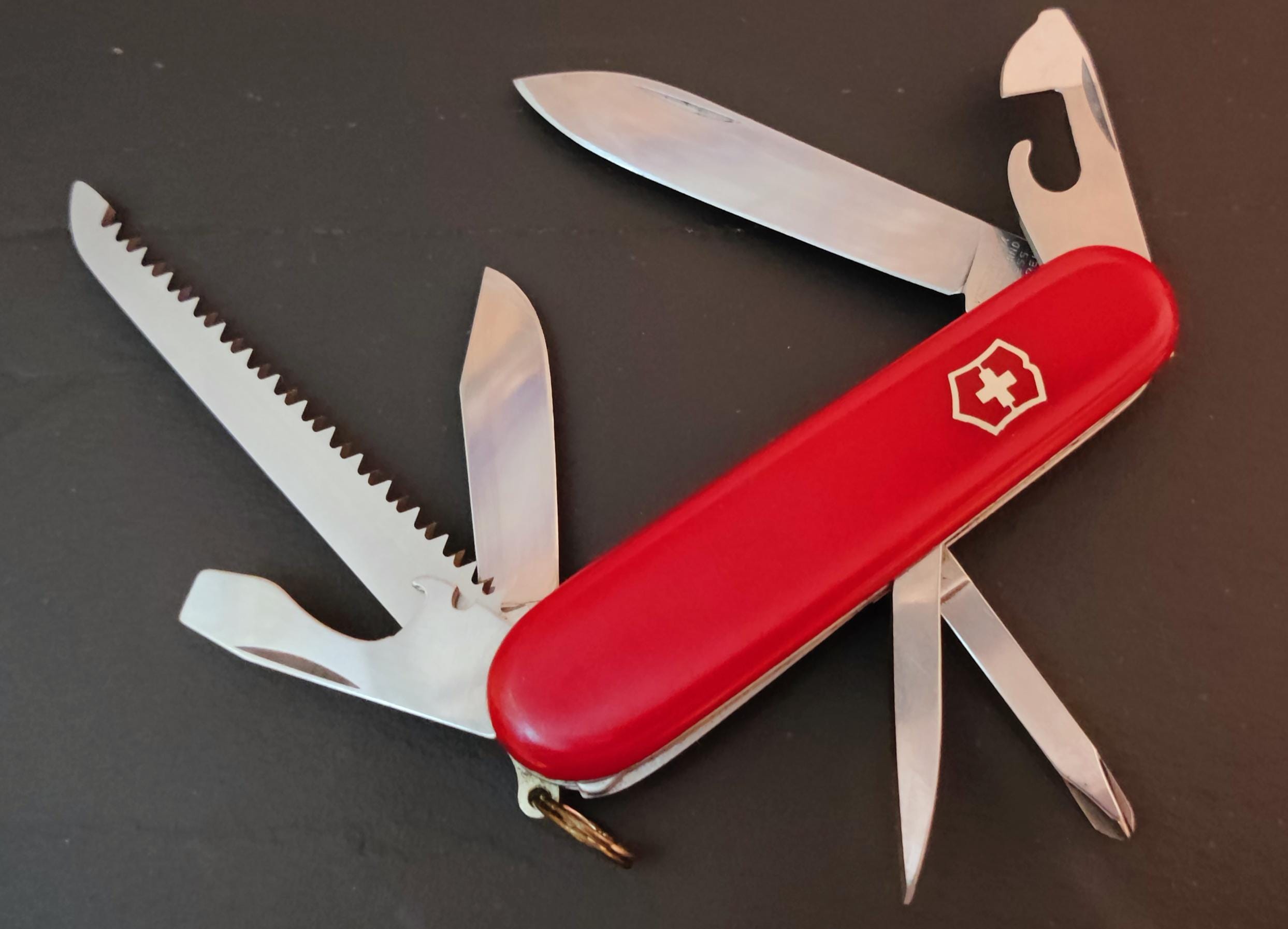
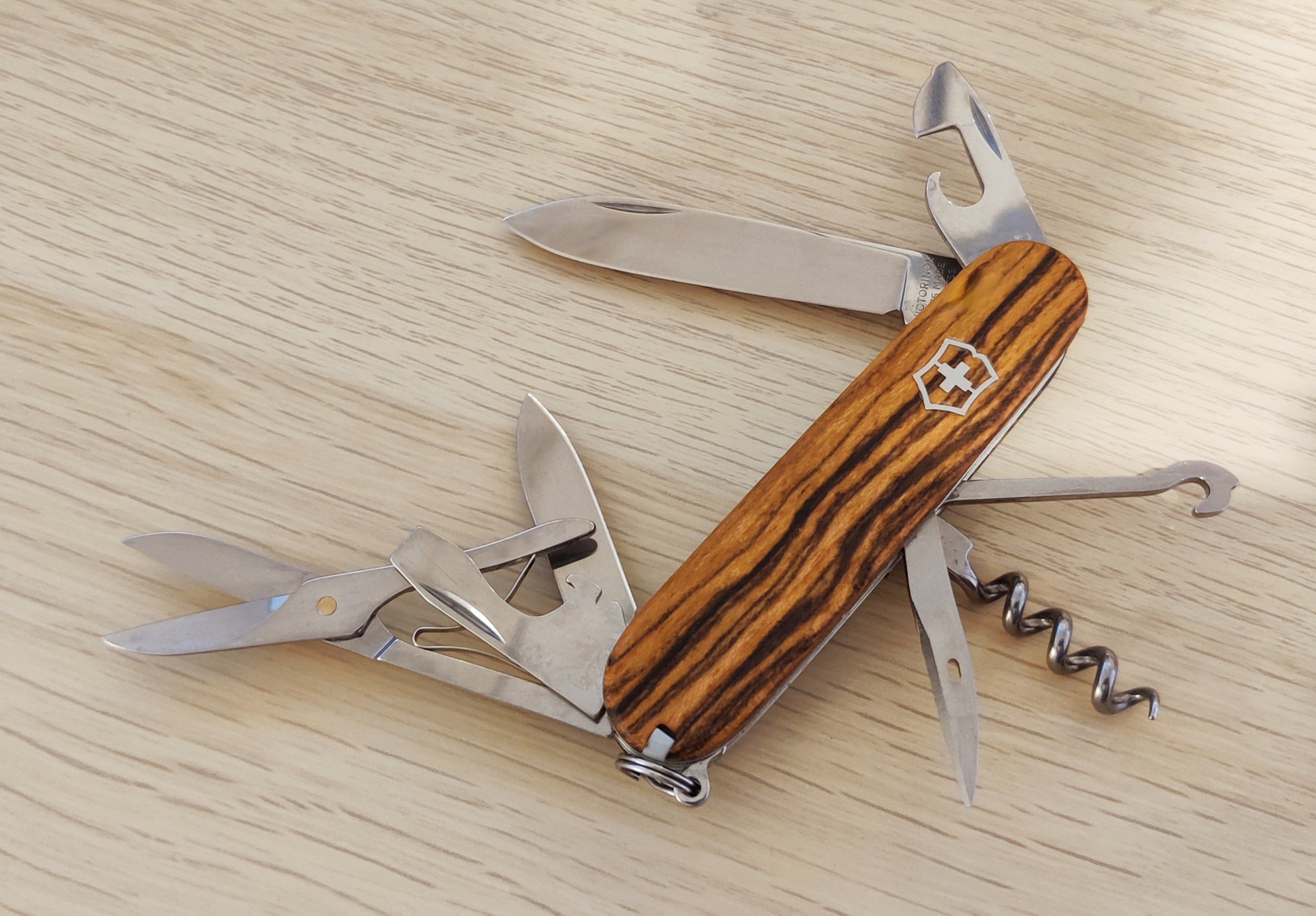
The corkscrew counterpart of the Master Craftsman
Introduction
The Victorinox Ranger (236m) appeared in the early 1950s as the corkscrew counterpart to the Master Craftsman.
Sharing the same five-layer architecture — wood saw, metal file, and scissors — it represents one of the most complete outdoor configurations of the early 91 mm Officer range.
While the Master Craftsman would eventually disappear, the Ranger endured.
I. Technical overview — A five-layer outdoor configuration

Ranger 1990's
Core configuration
- Closed length: 91 mm
- Category: Officer Knife
- Architecture: 5 layers
- Old reference: 236m
- Introduction: early 1950s
Tool configuration
Large blade
Small blade
Can opener + small screwdriver
Bottle opener + large screwdriver + wire stripper
Wood saw
Metal saw / file
Scissors
Back Layer Tools
Corkscrew
Reamer / awl
Scale Tools
Toothpick
Tweezers
The suffix “m” denotes the presence of the metal file / saw, distinguishing it from simpler saw-based outdoor models.
II. Historical evolution — From counterpart to enduring identity
1950s–1960s: the corkscrew Master Craftsman
During the 1950s and 1960s, the 236m exists alongside the Master Craftsman.

1954 Catalogue
Both knives share identical architecture, differing only in the back tool:
- Phillips for the Master Craftsman
- Corkscrew for the 236m

236maU 1957-1961
At this stage, the Ranger is not yet positioned as a separate concept — it is simply the corkscrew expression of the same high-function five-layer platform.

236ma 1961-1966

236ma 1968-1971
1970s: the Ranger name and Camping identity
It is in the 1970s that the model appears clearly under the name Ranger in catalogues for the first time.

1970's Catalogue
This period mirrors the evolution seen on the Camper:
- the model inherits the Camping metal inlay from the Outdoorsman 8236m, reinforcing its outdoor orientation
👉Victorinox Metal Inlays 1973 – A Defining Transitional Year
👉Victorinox Catalogue Metal Inlay Models of the 1970s — From Nickel-Silver to Stainless Steel
- branding shifts toward usage identity rather than pure tool description
- structural refinements stabilise the post-1973 configuration

Ranger 1973 - new tool on the back: flat screwdriver
The Ranger thus becomes explicitly positioned as an outdoor knife — no longer merely the corkscrew counterpart of another model, but a named tool with its own identity.
Retailer-specific editions, including Hoffritz examples, are also known from this era, reflecting the broader golden age of metal inlays and distributor variations.


Ranger Hoffritz 1973

Ranger Hoffritz metal inlay 1973-1976
1980s–1990s: continuity through simplification
While many multi-layer Officer knives were renamed, restructured, or discontinued, the Ranger continued steadily.

Catalogue 1984
Metal inlays gradually disappeared in the 1990s:
- embedded emblems gave way to hot stamping
- later replaced by printed scale logos
Yet the internal structure remained unchanged.

Ranger 1985-1991 - Note the new design of back flat screwdriver and the appearance of chisel
Unlike the Master Craftsman, which vanished from the range, the Ranger maintained its configuration and survived the rationalisation of the 91 mm line.
Modern era
The Ranger persists in the modern Victorinox catalogue with its defining elements intacts, although refined in finishing and branding, its structural logic remains faithful to the early 1950s design.

Ranger 2010's Camping logo hot printed
The Ranger is today the only remaining representative in the once abundant five-layer Officer range.
Collector perspective and significance
The surviving five-layer outdoor platform
 The Ranger represents the longest continuous expression of the early five-layer outdoor configuration.
Its combination of:
- wood saw
- metal file
- scissors
places it at the intersection of craft, repair, and outdoor use — a balance few models achieved so cleanly.
Metal inlays and 1970s identity
Examples featuring:
- Camping metal inlays
- Hoffritz retailer inlays
- 1950's / 1960's early configurations
are especially appreciated among collectors.
They mark the moment when the Ranger ceased to be a counterpart and became a clearly named outdoor model.


Surprising 1973-1976 Ranger with totally missing tang stamp
Bonus collector — Ranger 236maU “Norrek” (1961–1966)

A particularly attractive Ranger 236maU (1961–1966) featuring a blue Norrek corporate metal inlay.
Related models
-
👉Master Craftsman — Phillips counterpart (discontinued)
- 👉Camper — 3 layers saw configuration
- 👉Outdoorsman 8236m — transitional five-layer variant
Conclusion
The Victorinox Ranger (236m) began as the corkscrew counterpart of the Master Craftsman and outlived it.
Emerging in the early 1950s and gaining its own identity in the 1970s, it inherited the Camping orientation and survived the gradual simplification of the 91 mm range.
Where many five-layer configurations disappeared, the Ranger endured — becoming the last living trace of a once extensive family of multi-layer Officer knives.
This article is part of the SAKnife Archives, an independent collector-driven project dedicated to documenting Victorinox Swiss Army Knives. All photographs shown come from the SAKnife private collection unless otherwise noted. The historical and technical information presented here is based on period catalogues and expert collector databases. Additional material will be added as new information emerges.
Identify every Victorinox 91 mm configuration using the structural identification tree:
👉 🔎 Victorinox 91mm Identification Tree – Identify Your Swiss Army Knife by Toolset
Identify the production period of your Swiss Army Knife using the interactive visual tool based on tang stamps and tool evolution:
👉 ⌛ Swiss Army Knife Production Period Guide – Victorinox Interactive Tool Evolution
Explore the evolution of Victorinox 91 mm Swiss Army Knives and discover related model sheets in the historical timeline:
👉 📘 Swiss Army Knife History & 91 mm Model Evolution