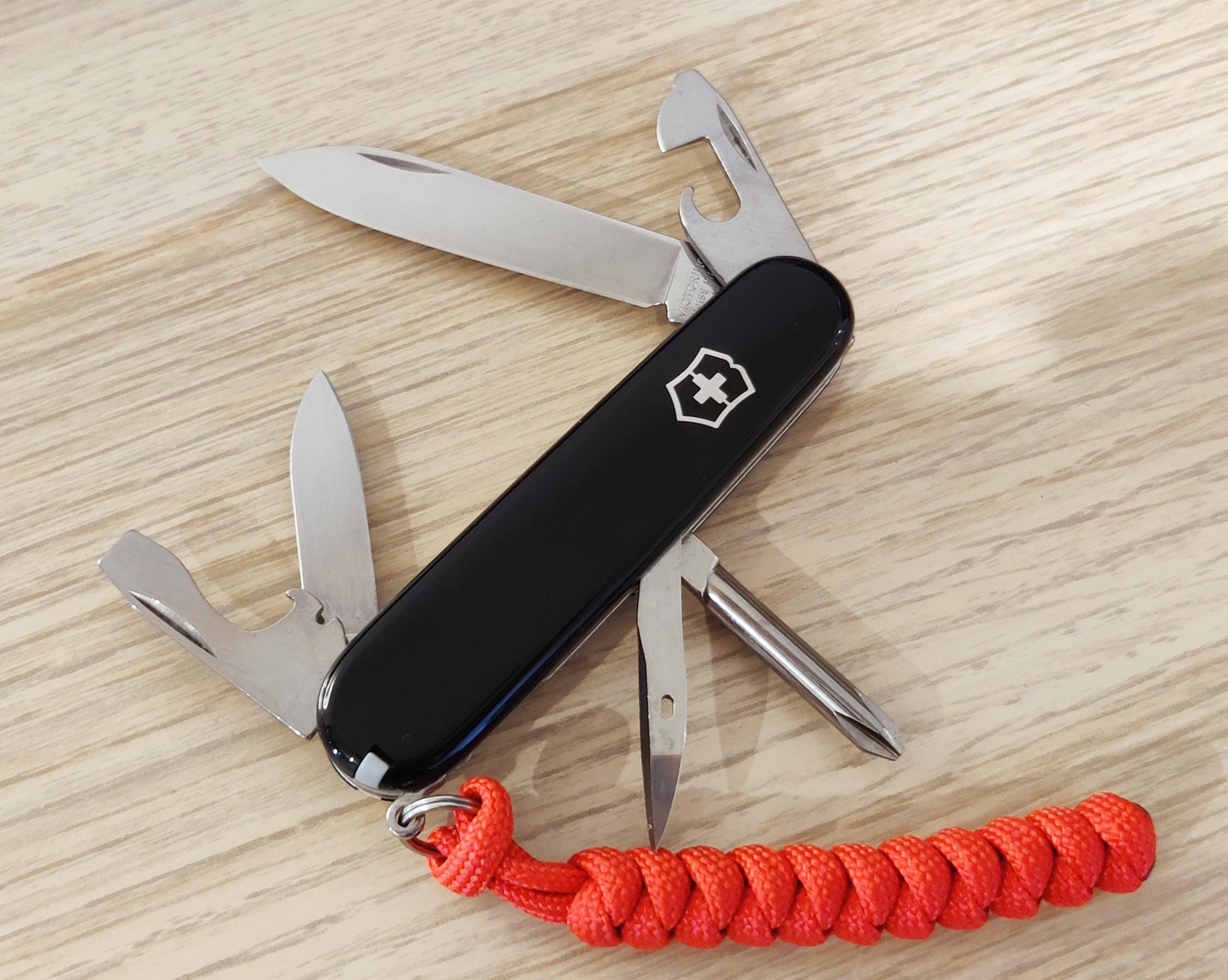
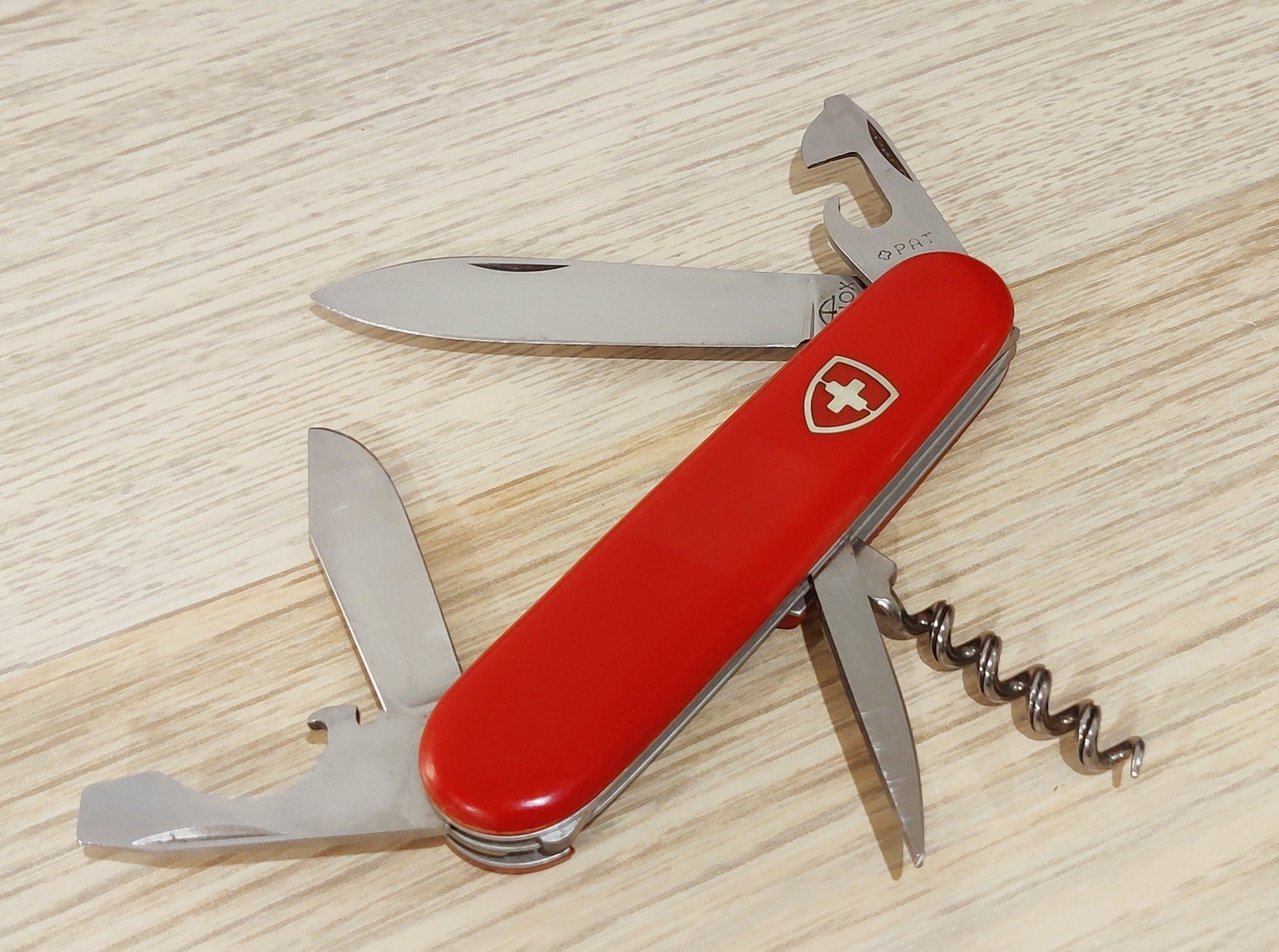
The 5-layer camping bearer of the Elinox era
Introduction
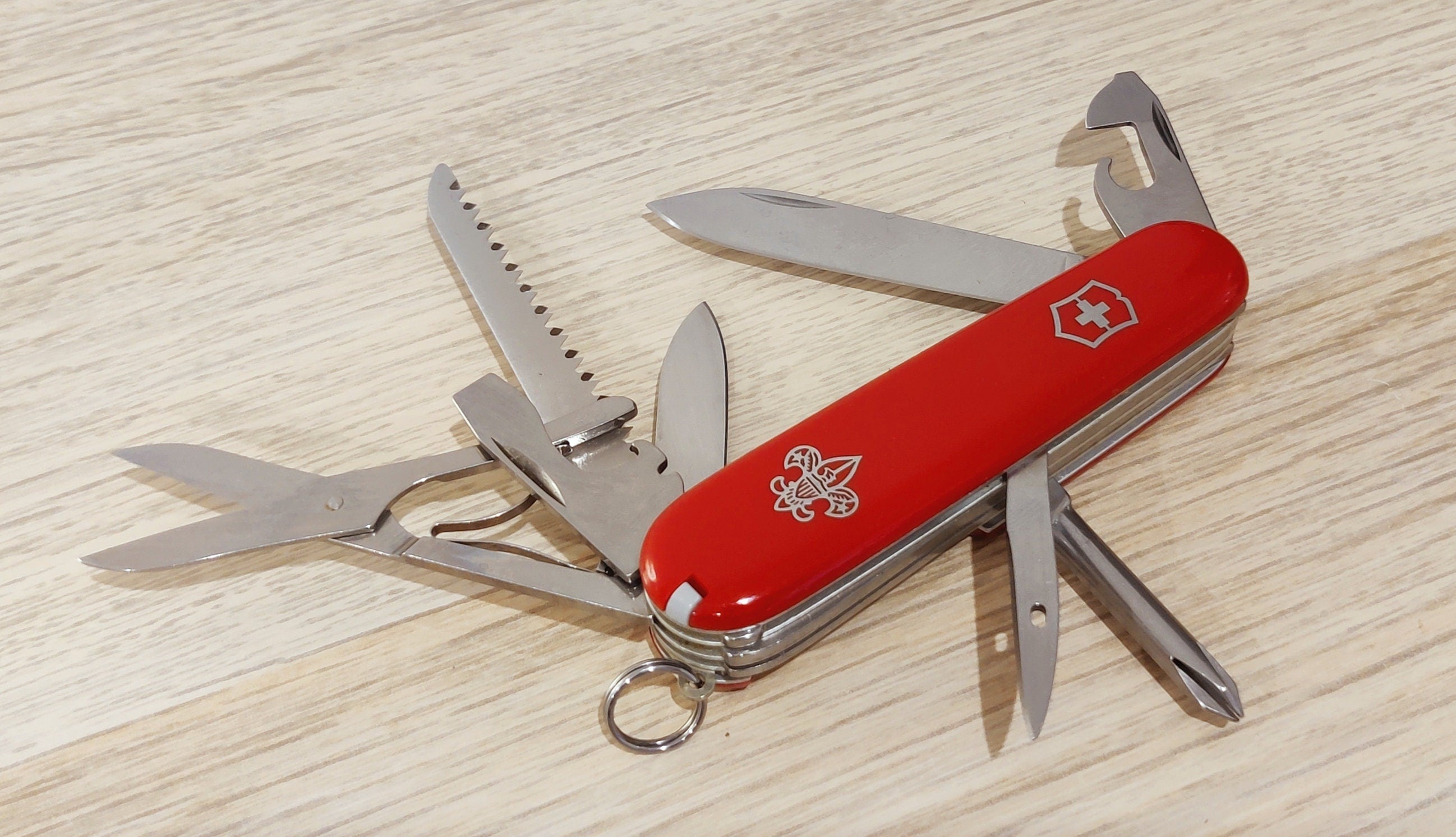
The Victorinox Outdoorsman 8236m is the 5-layer counterpart to the Elinox Picnicker.
Appearing in 1961, it embodies Victorinox’s mid-century outdoor philosophy — a clearly structured camping configuration built within the Elinox line.
More elaborate than the 3-layer Picnicker, it combines saw and metal file into a robust 5-layer architecture.
It disappears in the 1970s during the major catalogue reorganization that reshaped the 91 mm range.
I. Technical Overview — A 5-layer outdoor configuration

Outdoorsman 8236maU 1963-1966
- Closed length: 91 mm
- Old reference: 8236m
- Architecture: 5 layers
- Production period: 1961 – 1970s
Tool configuration
〰️Fully serrated large blade
Small Pruner blade
Wood saw
Metal file
Scissors
Can opener + small screwdriver
Bottle opener + large screwdriver + wire stripper
Back Layer Tools
Reamer / awl
Corkscrew
Scale Tools
Toothpick
Tweezers
A defined camping toolset
The Outdoorsman follows the same thematic logic as the Picnicker:
- Outdoor-oriented configuration
- Exclusive Serrated blade and small Pruner

Picnicker 8237 & Outdoorsman 8236m in the 1970's Hoffritz Catalogue
Where the Picnicker expresses camping in 3 layers, the Outdoorsman represents the fully equipped 5-layer interpretation.

II. 1960's — Elinox outdoor identity
The Outdoorsman appears close to 1961, during a period when Victorinox developed clearly structured outdoor configurations.

This era is marked by:
- Purpose-oriented tool combinations
- Thematic metal inlays
- Pairing logic: a 3-layer and a 5-layer sharing the same identity

👉Victorinox Metal Inlays of the 1960s — Nickel-Silver Models History
The Camping metal inlay follows this pattern, appearing on both the Picnicker (3 layers) and the Outdoorsman (5 layers).
III. 1973 — Transfer of the Camping identity
With the catalogue reorganization of 1973, Elinox-specific configurations begin to disappear.


Surprising late Outdoorsman 8236m, end of the 1970's, NIKON hot printed advertising
The Outdoorsman 8236m is phased out during this transition.
At the same moment, the Camping metal inlay identity passes to the Ranger, which becomes the standardized bearer of the camping theme in the modern 91 mm lineup.
👉1973 — A Turning Point for Victorinox Metal Inlays
This marks a structural shift:
- From purpose-built Elinox outdoor models
- To standardized configurations carrying thematic identity
The Outdoorsman does not receive a direct successor with identical architecture.
Position within the 91 mm range
The Outdoorsman occupies a precise historical position:
- 5-layer camping configuration
- Metal file + wood saw combination
- Thematic twin to the Picnicker
- Predecessor in spirit to the Ranger’s Camping identity
It represents a moment when Victorinox deliberately structured models around defined outdoor use.
Collector Perspective and Significance
Rare and often well-used
The Outdoorsman 8236m is considerably rarer than mainstream 5-layer models such as the Ranger.
Examples in excellent condition are uncommon. Like the Picnicker, most surviving Outdoorsman knives show significant wear — clear evidence that they were genuinely used in the field during their time.
Well-preserved examples are therefore particularly desirable among collectors.

Outdoorsman 8236 1970
Related models
- 👉Camper — later and permanent bearer of the Camping identity
- 👉Ranger — later 5 layer Camping Metal inlay bearer
- 👉Picnicker 8237 — adds Woodsaw and Metal file
Conclusion
The Victorinox Outdoorsman 8236m captures a distinct chapter in Victorinox history.
Appearing in 1961 and disappearing during the 1973 transition, it served as the 5-layer bearer of the Camping identity before that role passed to the Ranger.
Often encountered in heavily used condition and rarely in pristine state, it remains today a compelling and underappreciated piece of the Elinox outdoor era.
Explore how ELINOX evolved from early economy models to a platform for innovation and experimentation within Victorinox:
👉 📜 ELINOX Era (1957–1990s) — Victorinox Product Line Evolution
This article is part of the SAKnife Archives, an independent collector-driven project dedicated to documenting Victorinox Swiss Army Knives. All photographs shown come from the SAKnife private collection unless otherwise noted. The historical and technical information presented here is based on period catalogues and expert collector databases. Additional material will be added as new information emerges.
Identify every Victorinox 91 mm configuration using the structural identification tree:
👉 🔎 Victorinox 91mm Identification Tree – Identify Your Swiss Army Knife by Toolset
Identify the production period of your Swiss Army Knife using the interactive visual tool based on tang stamps and tool evolution:
👉 ⌛ Swiss Army Knife Production Period Guide – Victorinox Interactive Tool Evolution
Explore the evolution of Victorinox 91 mm Swiss Army Knives and discover related model sheets in the historical timeline:
👉 📘 Swiss Army Knife History & 91 mm Model Evolution