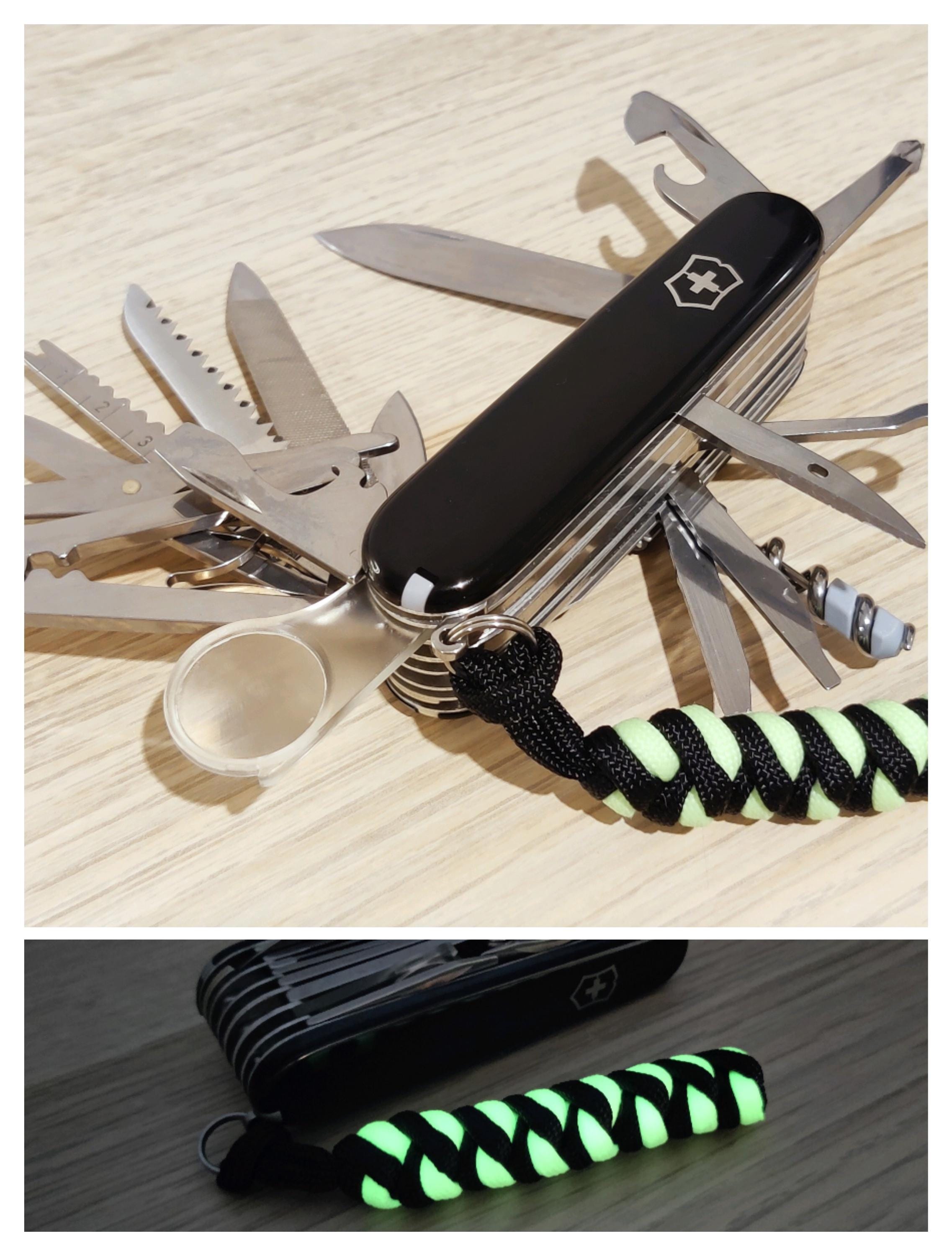
The Compact CyberTool Configuration
Introduction
The Victorinox CyberTool 29, renamed CyberTool S after 2015, is the most compact model in the CyberTool series.
It first appears in the 2000 catalogue with the mention “available this summer”, suggesting a slightly delayed release compared to the CyberTool 34, which is already available at the beginning of 2000.
Designed as a lighter alternative, it offers the essential CyberTool functionality in a reduced format, focusing on electronics capability and minimal everyday tools.
I. Technical Overview


The CyberTool 29 / S follows a 91 mm 3-layer architecture, built around the integration of the bit driver.
Main Tools
Large blade
Small blade
Can opener + small screwdriver
Bottle opener + large screwdriver + wire stripper
CyberTool Layer
Inline bit driver
4 mm double-ended bits
Bit storage
Back Layer Tools
Corkscrew
Reamer / awl
Scale Tools (Plus Scales)
Toothpick
Tweezers
Ballpoint pen
Straight pin
Mini screwdriver
II. The “29” Configuration
Originally designated CyberTool 29, the number refers to its 29 functions using Victorinox’s historical counting method.
After 2015, the model was renamed CyberTool S, aligning it with the simplified S / M / L naming system.
As with the CyberTool 34, the configuration itself remains unchanged.

Catalogue 2001
The model was available in translucent Ruby (red) and Sapphire (blue) scales.
III. Tool Logic: Minimal CyberTool Concept
The CyberTool 29 / S represents the minimal expression of the CyberTool concept.
Compared to the CyberTool 34 / M:
- no scissors
- no pliers
- reduced layer count
It retains only:
- the core Officer Knife toolset (Spartan base)
- the CyberTool bit driver layer
This results in a configuration focused on: electronics capability + essential tools
IV. Position in the CyberTool Range
Within the CyberTool lineup:
- Cybertool S (29) → minimal and compact
- 👉Cybertool M (34) → balanced and versatile
- 👉Cybertool L (41) → expanded toolset
- 👉Cybertool Lite → adds LED functionality
The CyberTool 29 / S is the most compact entry point into the CyberTool series.
It prioritizes:
- reduced thickness
- lower weight
- essential functionality
For a complete understanding of the range, see the CyberTool series overview:
👉 💻 Victorinox CyberTool Series – Bit Driver System & Model Structure
Collector Perspective and Significance
The CyberTool 29 / S is often overlooked, but it holds a clear role:
- lightest CyberTool
- simplest configuration
- closest to the original Officer Knife philosophy
It was also frequently used as a base for advertising and corporate models, thanks to its compact format and accessible positioning.


Its discontinuation in 2024 marks the end of the most minimal CyberTool configuration in the Victorinox lineup.
Conclusion
The Victorinox CyberTool 29 / S is the most streamlined version of the CyberTool concept.
By combining a classic Officer Knife base with the bit driver system, it delivers a compact and efficient tool for modern electronics, without the added bulk of larger models.
It stands as the entry point of the CyberTool range — where specialization meets simplicity.
This article is part of the SAKnife Archives, an independent collector-driven project dedicated to documenting Victorinox Swiss Army Knives. All photographs shown come from the SAKnife private collection unless otherwise noted. The historical and technical information presented here is based on period catalogues and expert collector databases. Additional material will be added as new information emerges.
Identify every Victorinox 91 mm configuration using the structural identification tree:
👉 🔎 Victorinox 91mm Identification Tree – Identify Your Swiss Army Knife by Toolset
Identify the production period of your Swiss Army Knife using the interactive visual tool based on tang stamps and tool evolution:
👉 ⌛ Swiss Army Knife Production Period Guide – Victorinox Interactive Tool Evolution
Explore the evolution of Victorinox 91 mm Swiss Army Knives and discover related model sheets in the historical timeline:
👉 📘 Swiss Army Knife History & 91 mm Model Evolution