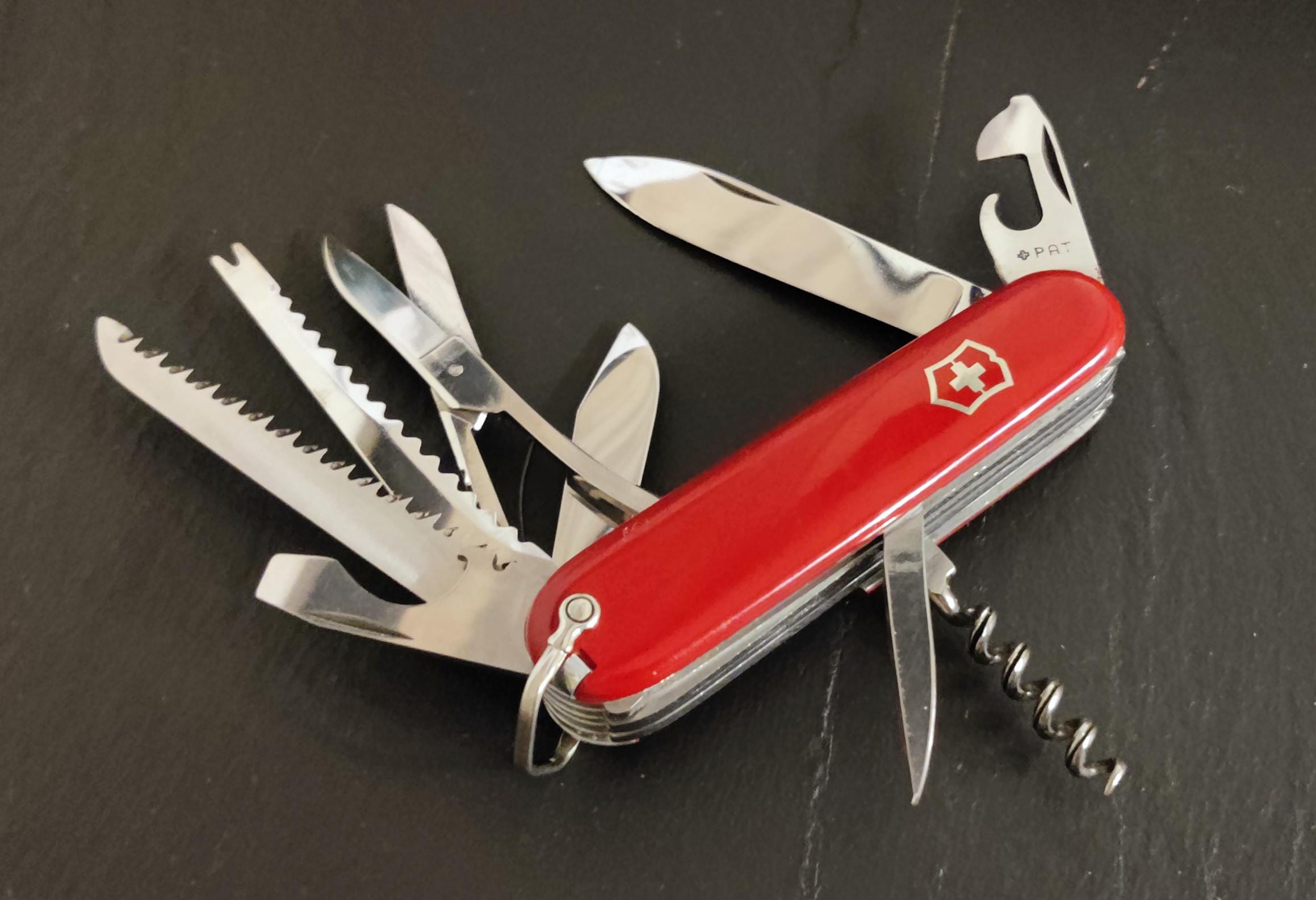
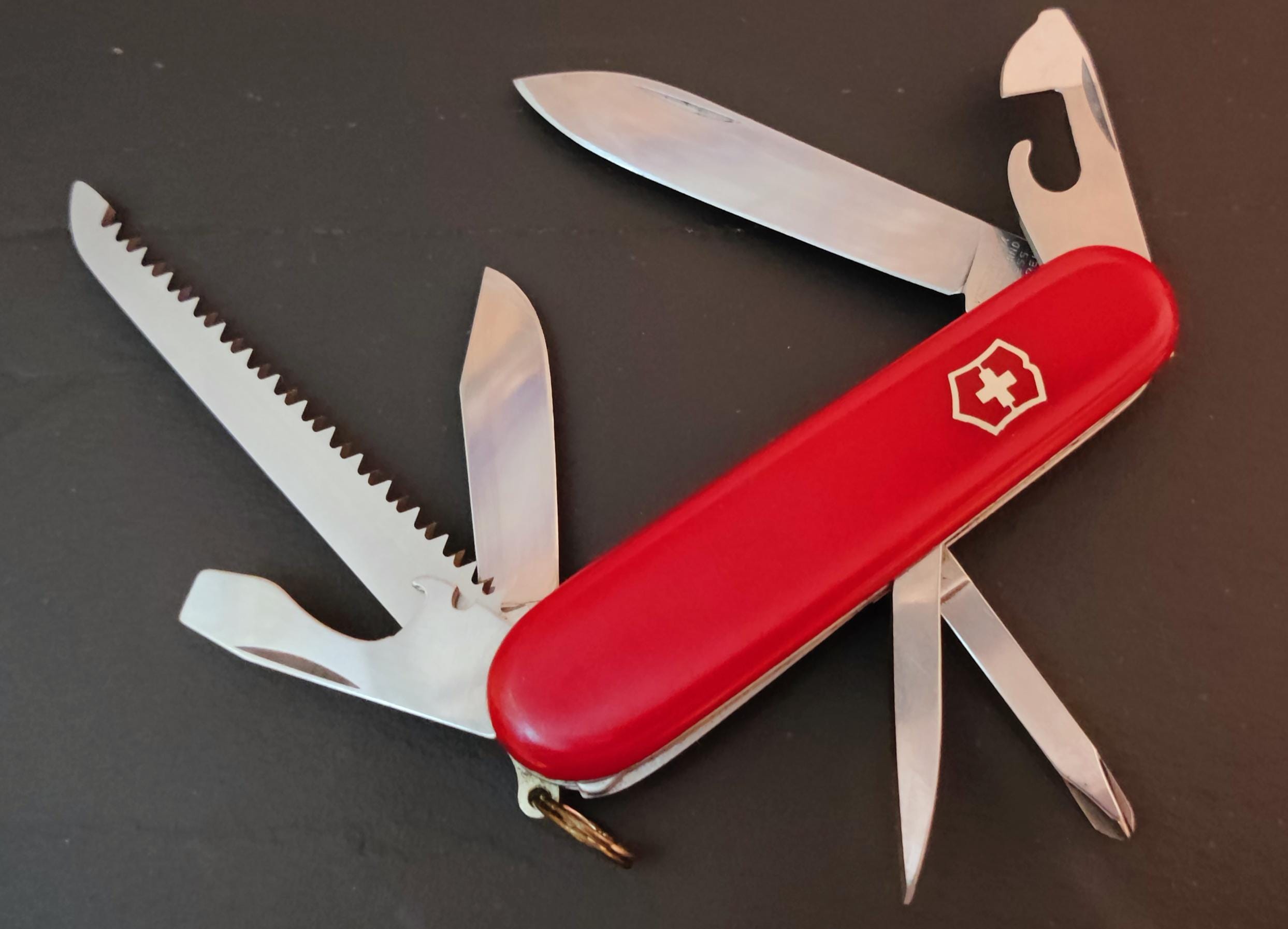
The Reference CyberTool Configuration
Introduction
The Victorinox CyberTool 34, renamed CyberTool M after 2015, is the most balanced and widely recognized model in the CyberTool series.
Introduced around 2000, it combines the bit driver system with a versatile multi-layer toolset, making it the reference configuration for both electronics work and everyday use.
I. Technical Overview


The CyberTool 34 / M follows a 91 mm 5-layer architecture, built around the integration of the bit driver.
Main Tools
Large blade
Small blade
Can opener + small screwdriver
Bottle opener + large screwdriver + wire stripper
Scissors
CyberTool Layer
Inline bit driver
4 mm double-ended bits
Bit storage
Back Layer Tools
Corkscrew
Reamer / awl
Hook
Scale Tools (Plus Scales)
Toothpick
Tweezers
Ballpoint pen
Straight pin
Mini screwdriver
II. The “34” Configuration
Originally designated CyberTool 34, the number refers to its 34 functions using Victorinox’s historical counting method.
In modern specifications, the same model is listed as having 32 functions, reflecting an updated counting system.
After 2015, Victorinox simplified the naming structure, and the model became known as the CyberTool M, aligning it with the S / M / L classification.
Despite these changes, the configuration itself remains unchanged.
Between 2000 and 2006, the CyberTool 34 was available in three translucent scale colors:

Catalogue 2002
- Ruby (red)

- Sapphire (blue)

- Onyx (definitely not black anymore)

The Onyx version disappears after 2006 and does not appear on later CyberTool models, making it a distinctive early variant.
On catalogue a transparent black, the Onyx scales are often observed today with a brownish tint, most probably due to UV exposure.

III. Tool Logic: From Deluxe Climber to CyberTool
The CyberTool 34 / M is best understood as an evolution of the Deluxe Climber.
It retains:
- the Climber base (blades, openers, scissors)
- the pliers layer of the Deluxe Climber
and add a dedicated CyberTool bit driver layer
The catalogue timeline reinforces this interpretation:
- the 👉Deluxe Climber appears for the last time in 1999 catalogue
- the CyberTool 34 appears in 2000

Catalogue 2000, Cybertool 34 is first available in Cybertool Family
This results in a clear structural transition:
👉Deluxe Climber → CyberTool 34
Rather than simply adding tools, Victorinox redefines the functional core, adapting the knife to modern screw standards used in electronics and computing.
IV. Position in the CyberTool Range
Within the CyberTool lineup:
- 👉Cybertool S (29)→ minimal and compact
- Cybertool M (34) → balanced and versatile
- 👉Cybertool L (41)→ expanded toolset
- 👉Cybertool Lite → adds LED functionality
The CyberTool 34 / M sits at the center, offering the best compromise between:
- size
- weight
- capability
It is widely considered the reference CyberTool.

Cybertool M on 2001 Catalogue Cover
For a complete understanding of the range, see the CyberTool series overview:
👉 💻 Victorinox CyberTool Series – Bit Driver System & Model Structure
Collector Perspective and Significance
The CyberTool 34 / M is the most important model in the CyberTool series:
- most commonly encountered
- most widely used
- best representation of the concept
It embodies Victorinox’s transition toward modern, precision-oriented toolsets, adapted to evolving user needs.
The persistence of the “34” designation among collectors also highlights its strong identity within the community.
Conclusion
The Victorinox CyberTool 34 / M represents the perfect balance between innovation and tradition.
Derived from the Deluxe Climber and restructured around the CyberTool layer, it transforms the Swiss Army Knife into a precision tool adapted to the digital era.
Whether referred to as the CyberTool 34 or CyberTool M, it remains the central model of the CyberTool series — where the concept reaches its most practical and complete form.
This article is part of the SAKnife Archives, an independent collector-driven project dedicated to documenting Victorinox Swiss Army Knives. All photographs shown come from the SAKnife private collection unless otherwise noted. The historical and technical information presented here is based on period catalogues and expert collector databases. Additional material will be added as new information emerges.
Identify every Victorinox 91 mm configuration using the structural identification tree:
👉 🔎 Victorinox 91mm Identification Tree – Identify Your Swiss Army Knife by Toolset
Identify the production period of your Swiss Army Knife using the interactive visual tool based on tang stamps and tool evolution:
👉 ⌛ Swiss Army Knife Production Period Guide – Victorinox Interactive Tool Evolution
Explore the evolution of Victorinox 91 mm Swiss Army Knives and discover related model sheets in the historical timeline:
👉 📘 Swiss Army Knife History & 91 mm Model Evolution