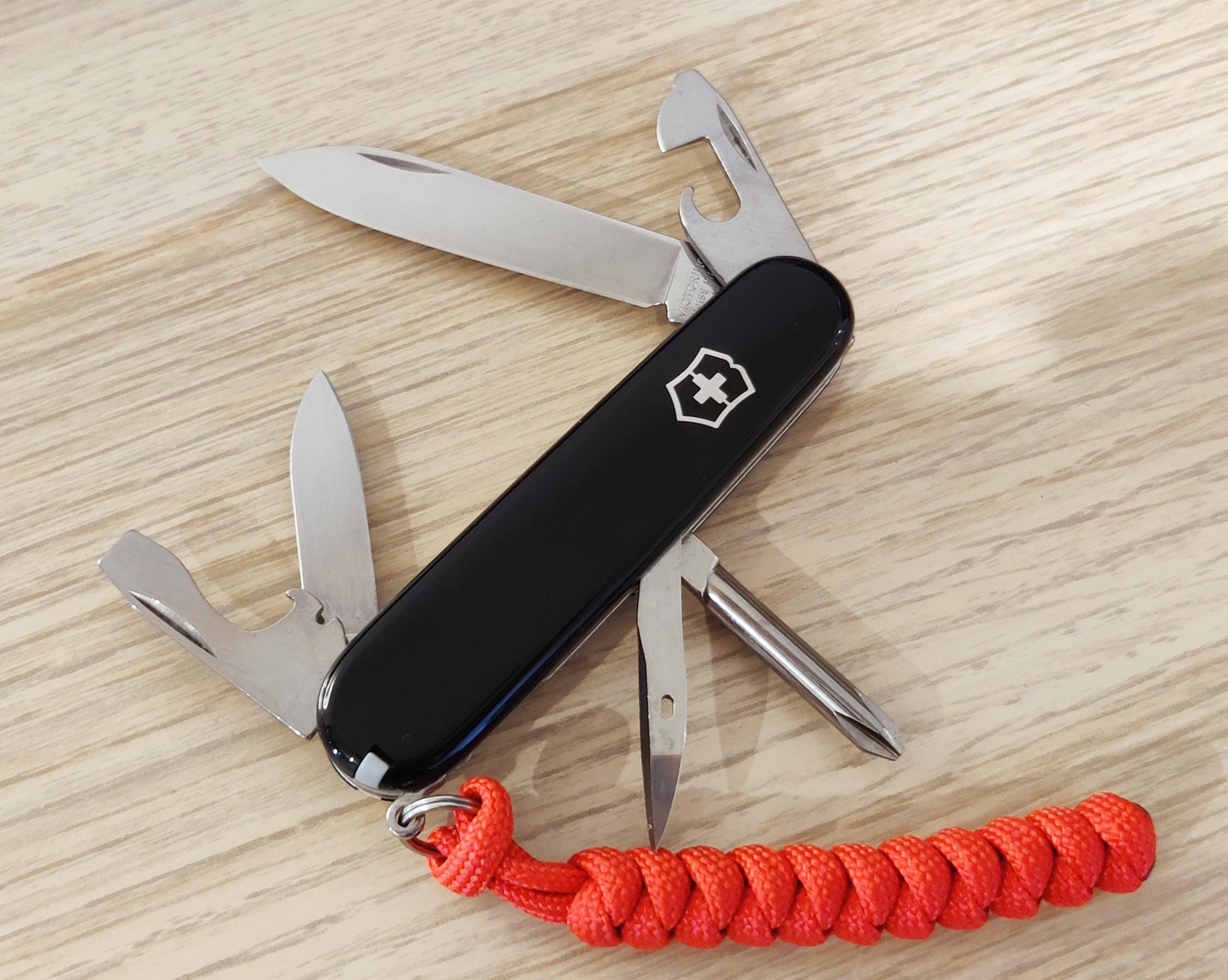
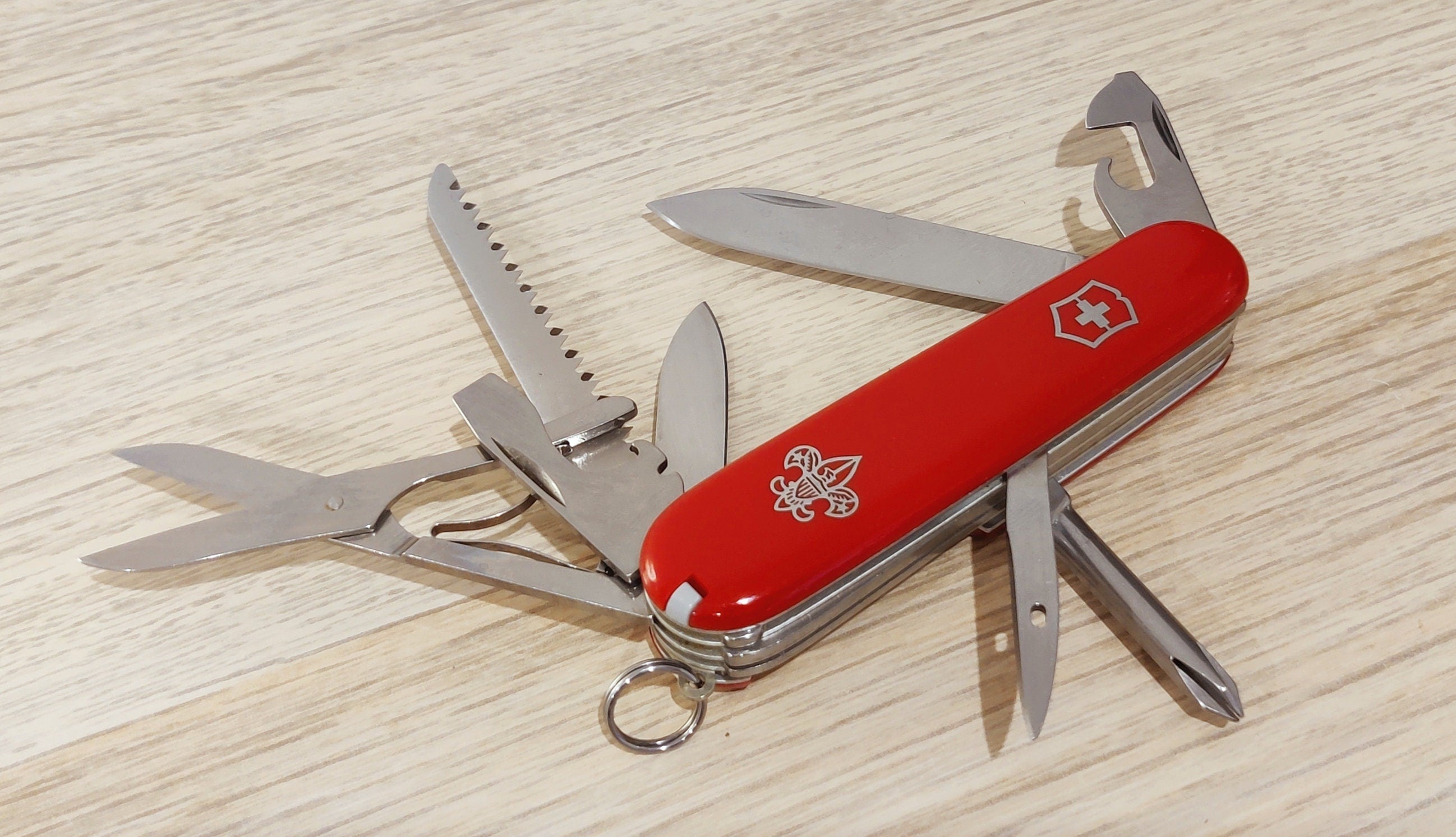
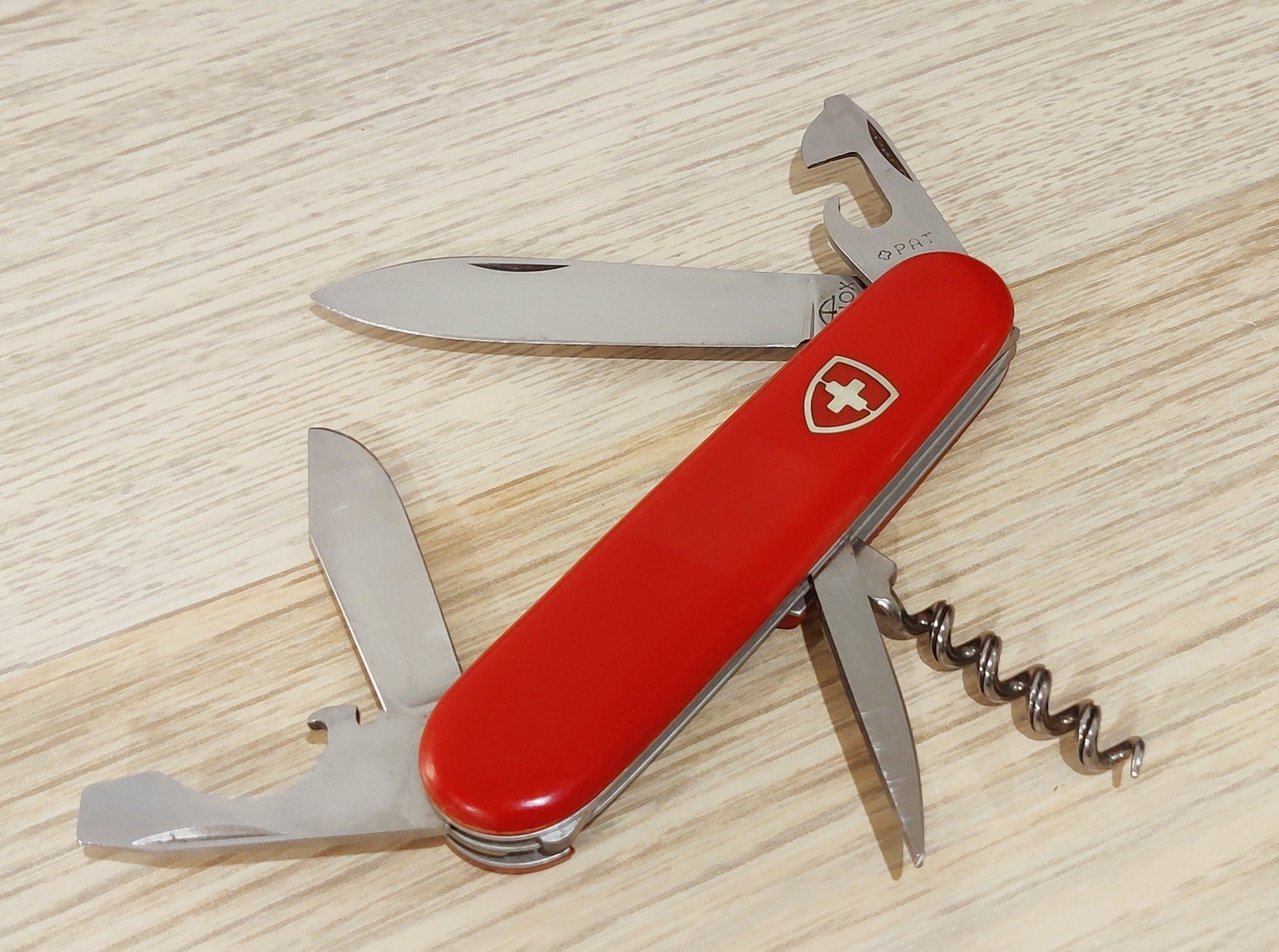
A scissor-equipped Officer Knife, older than its name
Introduction
The Victorinox Climber (model 235) is today a well-known 91 mm Officer Knife, defined by a balanced everyday toolset built around blades, scissors, and openers.
Historically, however, the Climber presents a paradox: its configuration appears very early, yet the Climber as a clearly identified 91 mm model remains relatively uncommon before the 1970s.
For much of the mid-20th century, users appear to have favored the 84 mm Climber Small, a slimmer alternative well suited to everyday carry. This preference helps explain why early full-size Climbers are less frequently encountered by collectors.
I. Technical overview — A classic scissor-based toolset

Core configuration (Climber)
-
Closed length: 91 mm
-
Category: Officer Knife
-
Architecture: three main tool layers
Main tools (by functional groups)
-
Large blade and small blade
-
Scissors
-
Openers (can opener and bottle opener with flat screwdriver and wire stripper)
Back tools
-
Corkscrew
-
Reamer / awl
- Multipurpose hook
Toothpick and tweezers
-
Present on versions equipped with scale tools
-
Absent on earlier or economy-positioned examples
Model references
-
Old Victorinox reference: 235
-
Common historical variants: 235a (toothpick & tweezers), 235U (bail / keyring), 235aU
-
Modern Victorinox reference: 1.3703
Depending on equipment and market, the same base knife could be sold under different commercial names.
II. Historical evolution — Early roots, late recognition
1. A configuration older than the name

Model 235 (Climber forefather) 1931-1942
The Climber’s essential configuration — blades, scissors, openers, and corkscrew — exists very early in Victorinox production, long before “Climber” becomes a stable commercial name.

Model 235U 1946-1951
In the first half of the 20th century, Victorinox structured its range primarily around tool combinations, not fixed model identities. As a result, knives matching the Climber layout predate the Climber name by decades.

Model 235U 1957-1961
2. The dominance of the 84 mm Climber Small
Throughout the mid-20th century, many users appear to have preferred the 84 mm Climber Small.

1950's catalogue advertising the 84mm 235k as a 'natural size'
91mm models exist at that period but is not enlightened in that catalogue
Likely reasons include:
-
slimmer profile
-
lighter carry
-
sufficient functionality for everyday use
This long-standing preference explains why 91 mm Climbers remain relatively scarce before the 1970s, despite the maturity of the configuration itself.
3. Traveller, President, and commercial naming (1960/1970's)
Before full catalogue standardization, the Climber platform appeared under several commercial names, depending on market and equipment, without tweezers/toothpick.
-
President
In the United States, the Climber configuration was also marketed under the name President, a commercial designation rather than a structural difference.
Hoffritz 235U (President)
- Traveller
A version without keyring (no bail), documented starting in the late 1960s, using the same core toolset as the Climber. Traveller pre-1970
-
Backpacker
In some regions, the same toolset appeared under the name Backpacker.
These names reflect a recurring Victorinox strategy:
one technical platform, multiple commercial identities.
4. Stabilization and modern Climber identity (1970s onward)
From the 1970s, Victorinox increasingly standardizes its 91 mm Officer Knife range.

Early 1970's Climber, with ring and tweezers/toothpick
During this period:
-
the Climber name becomes firmly established
-
toothpick and tweezers become more common
-
the 91 mm Climber gains visibility alongside models such as the Spartan, Camper, and Huntsman
From this point onward, the Climber becomes a core catalogue model, continuing into modern production aside the Traveller that finally disappear from catalogue in the 1990's

1980's catalogue showing both Climber and Traveller

Advertising Climber without Keyring (Traveller) 1980's
Collector perspective and significance
An early urban EDC
The Climber is fundamentally a scissor-based Officer Knife.
Its identity is distinct from saw-equipped models such as the Camper and Huntsman, positioning it closer to urban and everyday use.

Model 235U 1946-1951 with Horn handles
Collector interest
-
245 variants with Long Nail File
👉Climber LNF (245) -
Pre-1970 examples of the 91 mm Climber
-
Traveller versions without keyring
-
US-market President examples
- Promotional or commemorative Metal Inlays
Position within the 91 mm range
The Climber sits naturally between:
-
👉Spartan / Standard (no scissors)
-
👉Super Tinker (scissors without Phillips)
-
👉Huntsman (scissors plus saw)
It represents one of the most balanced everyday Officer Knife configurations.
Conclusion
The Victorinox Climber (235) is a knife whose history is older than its name.
While its configuration appears early, the 91 mm Climber only becomes a clearly identified, widely distributed model from the 1970s onward. Earlier decades favored the slimmer 84 mm Climber Small, leaving early full-size examples comparatively uncommon today.
Commercial names such as Traveller and President illustrate Victorinox’s gradual shift from tool-based configurations to standardized model identities. For collectors, the Climber is not about rarity, but about understanding how one of the most enduring Officer Knife layouts quietly took its place in the modern range.

1990's Climber with Swiss Air Force commemorative metal inlay
Explore:
👉Commemoratives Metal Inlays
This article is part of the SAKnife Archives, an independent collector-driven project dedicated to documenting Victorinox Swiss Army Knives. All photographs shown come from the SAKnife private collection unless otherwise noted. The historical and technical information presented here is based on existing data shared by recognized collector communities, forums, and expert collector databases. Additional period examples and variants will be added over time as the archive continues to grow.
Identify every Victorinox 91 mm configuration using the structural identification tree:
👉 🔎 Victorinox 91mm Identification Tree – Identify Your Swiss Army Knife by Toolset
Identify the production period of your Swiss Army Knife using the interactive visual tool based on tang stamps and tool evolution:
👉 ⌛ Swiss Army Knife Production Period Guide – Victorinox Interactive Tool Evolution
Explore the evolution of Victorinox 91 mm Swiss Army Knives and discover related model sheets in the historical timeline:
👉 📘 Swiss Army Knife History & 91 mm Model Evolution