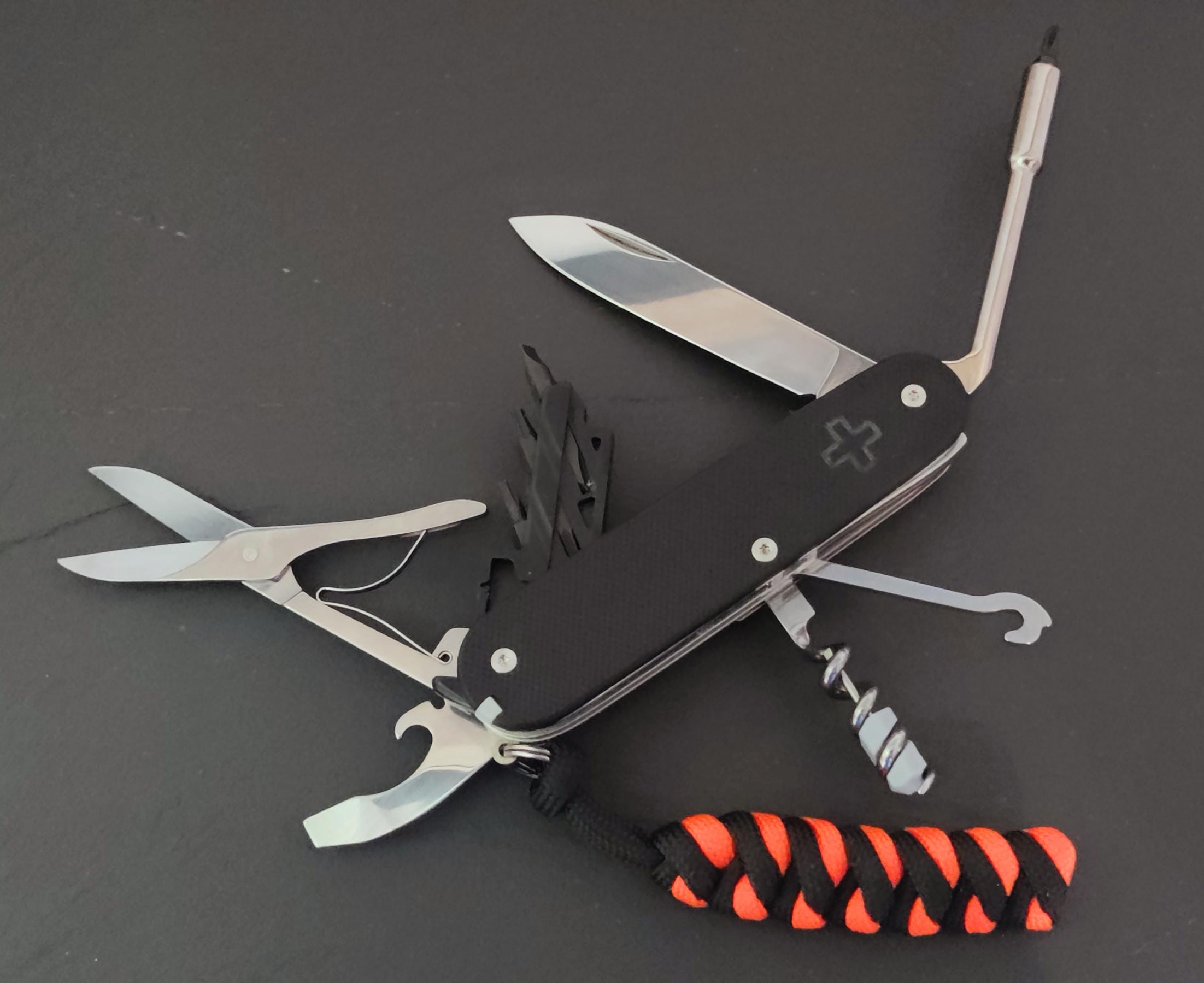
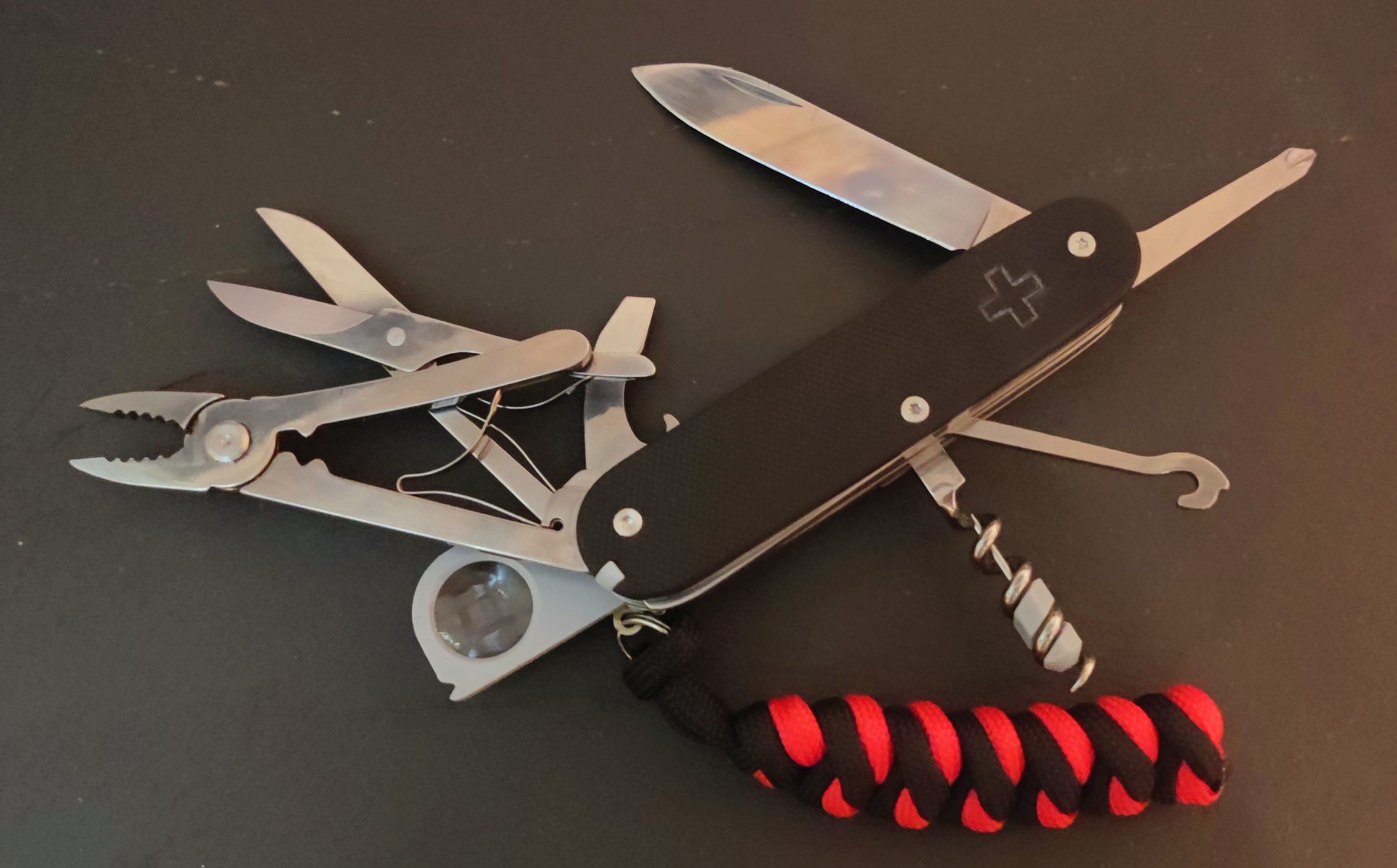
This page explores how Victorinox 91 mm toolsets evolved over time, and how tools shape the structure, purpose, and genealogy of Swiss Army Knife models.
It is designed as a functional and structural counterpart to the historical catalogue pillar:
👉 📘 Victorinox History & Catalogue — 91 mm Models Evolution
Where the catalogue pillar follows chronology and model availability, this page focuses on tools, tool combinations, and the internal logic behind Victorinox 91 mm knife construction.
What is meant by “tools”

Champion C Tools from 1984 Catalogue
On a Victorinox 91 mm Swiss Army Knife, the term tools refers to the functional elements that define a knife’s structure, thickness, and intended use.
This includes blades, openers, saws, files, scissors, screwdrivers, and specialised implements that occupy full layers or shape the internal architecture of a model.
This page deliberately focuses on tools that drive structural evolution.
Scales, hidden accessories (toothpick, tweezers), cosmetic variations, and branding differences certainly matter to collectors, but they do not determine how a model is built internally, nor how toolsets evolve across decades.
This distinction is intuitive for most users — yet essential when reading Victorinox genealogy, layer logic, and historical development.
📝 How to read the Victorinox 91 mm toolset family tree
The interactive tree below is a structural and historical map of Victorinox 91 mm models, organised by tool combinations rather than by marketing names.
Each box represents a specific toolset configuration.
Its position reflects:
-
when the toolset appears,
-
how many layers it contains,
-
and how it relates structurally to other models.
Every model shown in the tree links directly to its dedicated model sheet., where specifications, variants, and production history are documented in detail.
The tree is not a marketing genealogy.
Models are connected by tool evolution, not by naming conventions or modern product lines.
How to use the tool & period legend
The legend above allows you to interact with the tree and explore the Victorinox 91 mm range dynamically.
You can filter models by:
-
Tools
Select one or several tools to highlight only the models that contain all selected tools. -
Historical periods
Select a period to highlight all models available during that phase of the catalogue.
Only one period can be active at a time.
Tool and period filters work together:
for example, selecting Wood saw + 1951–1957 will highlight only the models that combine both.
Use the reset button to clear all filters and return to the full tree.
Together, the tree, the legend, and the model sheets form a single reading system, allowing any Victorinox 91 mm knife to be placed precisely within its:
-
toolset evolution,
-
structural complexity,
-
and historical context.
Toolset evolution: a functional logic
The evolution of Victorinox toolsets follows use, context, and habit, rather than arbitrary design.
Tools appear when they become relevant in everyday life — not before.
As social habits, leisure activities, and domestic environments change, the Swiss Army Knife adapts by integrating tools that reflect those realities.
This page focuses on why tools appear, not on catalogue sequencing.
For a complete model-by-model timeline, see the companion article:
👉 📘 Victorinox History & Catalogue — 91 mm Models Evolution
Tools details
Each tool listed below is briefly described with its function, use, and historical context.
When an individual tool presents significant variants or generational changes, it links to a dedicated article.

Handyman Tools, Liners & Rivets
Foundational tools
Blades
The core cutting tools of every Swiss Army Knife. Present from the earliest military models, blades define the knife’s primary function and structural baseline.
Can opener
Originally essential for military rations, the can opener became a permanent civilian tool. Its hooked geometry reflects a purely functional origin.
Bottle opener
Introduced alongside bottled beverages, often integrating a flat screwdriver and wire-stripper into a single multifunction tool.
Awl / reamer
A legacy field tool used for leather, canvas, and light repair, rooted in military and rural maintenance needs.
Corkscrew
A civilian-oriented tool that became emblematic of Officer knives, reflecting the Swiss Army Knife’s dual identity as tool and companion.
Outdoor and leisure tools
Wood saw
Developed with the rise of camping and outdoor leisure. Efficient tooth geometry allows cutting small branches and firewood.
Scissors
A precision tool reflecting the transition from survival utility to everyday carry, well suited to grooming and textile tasks.
Fish scaler
Directly linked to recreational fishing, which expanded with post-war prosperity and paid holidays.
Pruning blade
A curved blade dedicated to gardening and plant maintenance, reflecting domestic outdoor activities.
Refinement and precision tools
Long Nail File (LNF)
A comfort and grooming tool rather than a survival necessity, marking the refinement of the Swiss Army Knife toward personal everyday use.
Metal file / metal saw
Introduced as domestic repair and DIY activities became common, useful for shaping, smoothing, and light technical work.
Phillips screwdriver
Appears once cross-head screws become standard in consumer products, mirroring changes in manufacturing norms.
Magnifying glass
A precision and leisure tool associated with reading, inspection, map work, and outdoor activities.
Combo tool
A multifunction implement combining several actions into a single thin layer, reflecting rationalisation and compact design strategies.
Domestic and specialised tools
Chisel
A woodworking and shaping tool used for scraping and fine adjustments.
Pliers
Introduced as home repair culture expands, designed for gripping, bending, and light mechanical tasks.
Multipurpose hook
A discreet but practical tool for carrying, pulling, and handling loads.
Spatula
A niche convenience tool used for lifting or spreading soft materials, mainly found in large multi-layer models.
Golf divot tool
A leisure-specific tool reflecting sport-oriented and themed editions.
Electronic and modern tools
Clock / timer module
An experimental module combining timekeeping and alarm functions.
LED light
A modern everyday convenience, appearing once compact and reliable LED technology became available.
Electronic scale
A portable precision tool reflecting late-era experimentation with electronics.
CyberTool / bit holder
A response to computers, electronics, and modern screw standards, enabling modular precision screwdriving.
Contemporary convenience tools
Lighter
An integrated fire-starting solution appearing on specialised models, limited by safety and regulatory constraints.
Box opener
A recent addition reflecting modern parcel-opening habits — a quiet indicator of changing everyday use.
After Wenger: toolsets without an “ideal” model
For much of the twentieth century, Victorinox refined tool combinations toward balanced and coherent models.
After the acquisition of Wenger, this dynamic gradually shifted.
Without direct competition, toolsets increasingly follow market segmentation strategies rather than the pursuit of a single “ideal” configuration.
Some tools become redundant, others intentionally absent, encouraging complementary ownership rather than definitive solutions.
This shift also explains the rise of modern custom builds, where users reconstruct the coherence once embodied by historical models.
Conclusion
The Swiss Army Knife toolset is not random.
It is a functional record of everyday life, shaped by history, habits, and use.
From military utility to cardboard warfare.
This analysis is based on original Victorinox catalogues, factory documentation, and cross-referenced collector sources.
The interactive tree reflects structural toolset logic rather than marketing naming conventions.
Explore the evolution of Victorinox 91 mm Swiss Army Knives and discover related model sheets in the companion pillar below:
👉 📘 Victorinox History & Catalogue — 91 mm Models Evolution