Late appearance of the inline technician screwdriver
Introduction
The Victorinox Engineer is not a catalogue model.
It is a corporate special run, produced for , and derived from the Victorinox Scientist platform.
At first glance, it appears close to the Scientist.
In reality, one crucial detail sets it apart: the inline technician screwdriver, a tool already disappearing from the Victorinox range at the time.
This makes the Engineer not only a corporate knife, but also a technical endpoint in Victorinox tool evolution.
I. Technical overview — A Scientist platform with a legacy tool


Core configuration
- Closed length: 91 mm
- Category: Officer Knife
- Architecture: two main tool layers
- Base platform: Victorinox Scientist
- Status: Corporate Special Run (Telemecanique)
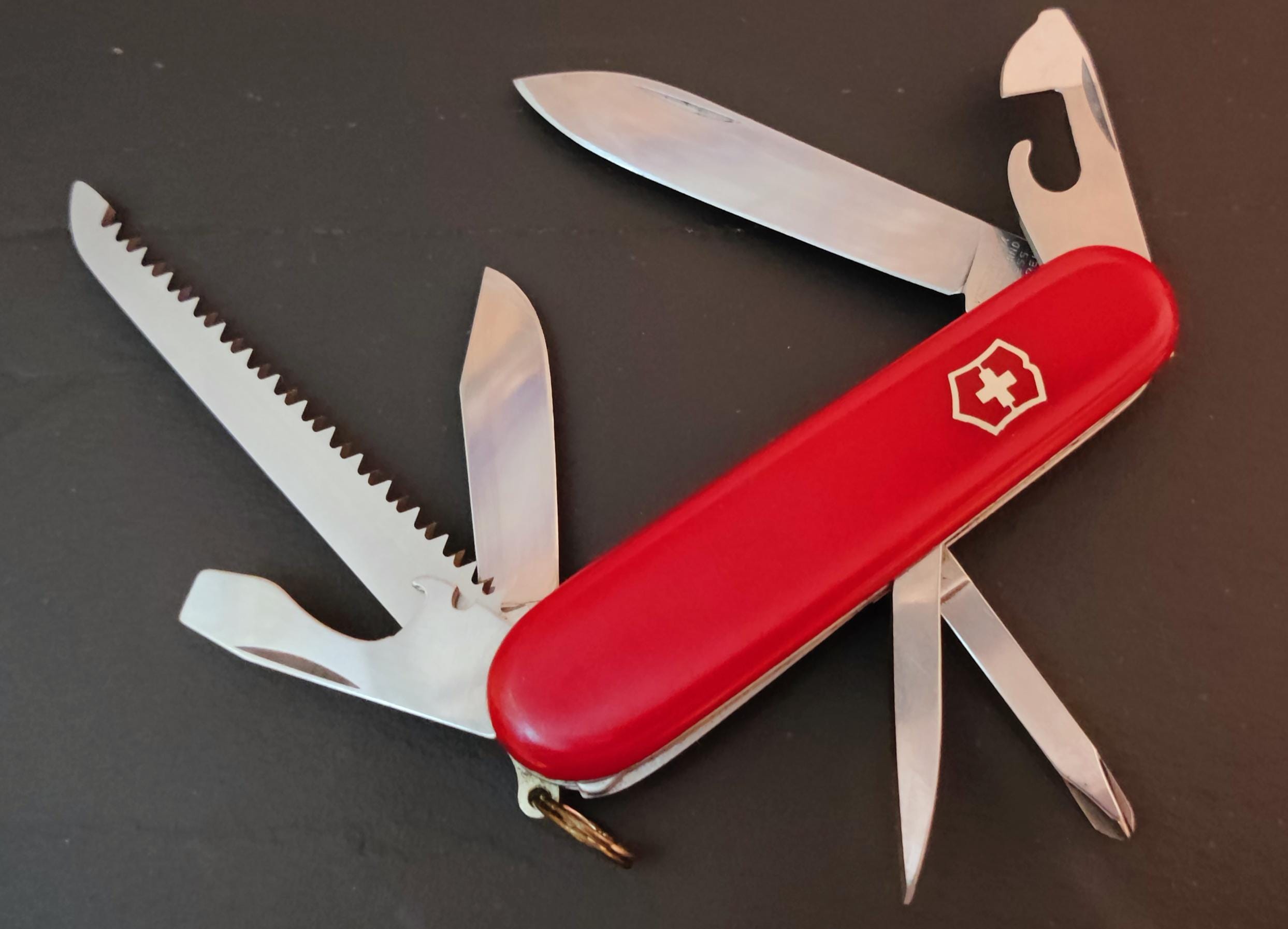
Main tools
Main blade
Inline technician screwdriver
Magnifying glass
Back Layer Tools
Corkscrew
Mini screwdriver
Scale Tools
Toothpick
Tweezers
Unlike the standard Scientist, the Engineer does not use a combo tool.
Instead, it retains a true inline technician screwdriver, most likely sourced from remaining stock of 1970s-era components.
II. A disappearing tool — Historical context

Explore the rare inline technician screwdriver and its dedicated Victorinox models:
👉🪛Victorinox Technician Screwdriver — Inline Tool, Catalogue Models & Special Runs
The inline technician screwdriver
The inline technician screwdriver is a distinctive Victorinox tool, designed for precise mechanical and electrical adjustments, rather than general-purpose fastening.
By the late 1970s and early 1980s, it is already being phased out in favour of:
- Phillips drivers
- combo tools
- modular bit systems
Before the Engineer, this tool appears notably on official Catalogue models:
With the Engineer, it makes a late appearance in a Victorinox knife.
III. Industrial context — Telemecanique and Schneider
Telemecanique in the 1980s
By the 1980s, Telemecanique is a major European player in:
- industrial automation
- control systems
- variable speed drives
Its engineers and technicians operate at the intersection of mechanics and electronics, a context that perfectly explains the inclusion of:
- a magnifying glass
- a precision inline screwdriver
👉🔍Magnifying Glass — Models & Evolution
The Schneider merger (1988)
In 1988, acquires Telemecanique.
This merger marks:
- the integration of automation into a broader electrical ecosystem
- the rise of electronics-heavy industrial equipment
- a shift toward compact, field-service-oriented tools
The Victorinox Engineer fits precisely into this transitional moment.
Altivar 5 — A symbol of the era
Among Telemecanique’s emblematic products of the period is the Altivar 5, an early and widely deployed variable speed drive.

The Altivar 5 represents:
- compact electronic control
- fine calibration and adjustment
- on-site diagnostics rather than workshop repair
The Engineer’s toolset directly mirrors this reality:
inspect, adjust, verify — not dismantle.
Collector perspective and significance
A true Corporate Gift Knife
The Engineer is a textbook example of a Corporate Gift Knife:
- produced for a single industrial group
- never intended for retail
- tightly linked to professional identity

Its restrained configuration reflects Telemecanique’s own values: precision, reliability, and technical seriousness.
The last of its kind
For collectors, the Engineer holds a unique status:
- Late Victorinox model with an inline technician screwdriver
- bridge between 1970s mechanical tradition and 1980s electronic industry
- material proof of Victorinox’s pragmatic use of legacy tooling
This alone makes it historically significant.
Relationship to the Scientist

The Scientist provided the structural base.
The Engineer provided the historical closure.
Where the Scientist looks forward — compact, modern, minimal —
the Engineer looks backward just enough to carry a disappearing tool into a new industrial context.
Explore the Scientist model:
👉Scientist
Conclusion
Compact, discreet, and technically precise, the Engineer captures a moment when electronics overtook mechanics, yet still required skilled hands — and the right tool in a pocket.
For broader context on limited editions and factory outliers, see:
👉Victorinox Special Runs — SAKnife Archives
This article is part of the SAKnife Archives, an independent collector-driven project dedicated to documenting Victorinox Swiss Army Knives. All photographs shown come from the SAKnife private collection unless otherwise noted. The historical and technical information presented here is based on period catalogues and data shared by recognized collector communities, forums, and expert collector databases. Additional examples and contextual material may be added over time as the archive continues to grow.
Identify every Victorinox 91 mm configuration using the structural identification tree:
👉 🔎 Victorinox 91mm Identification Tree – Identify Your Swiss Army Knife by Toolset
Identify the production period of your Swiss Army Knife using the interactive visual tool based on tang stamps and tool evolution:
👉 ⌛ Swiss Army Knife Production Period Guide – Victorinox Interactive Tool Evolution
Explore the evolution of Victorinox 91 mm Swiss Army Knives and discover related model sheets in the historical timeline:
👉 📘 Swiss Army Knife History & 91 mm Model Evolution