The Mid-1980s Evolution of the Woodsman Name
Introduction
In the mid-1980s, the name Woodsman was reassigned to a new configuration within the 91 mm range.
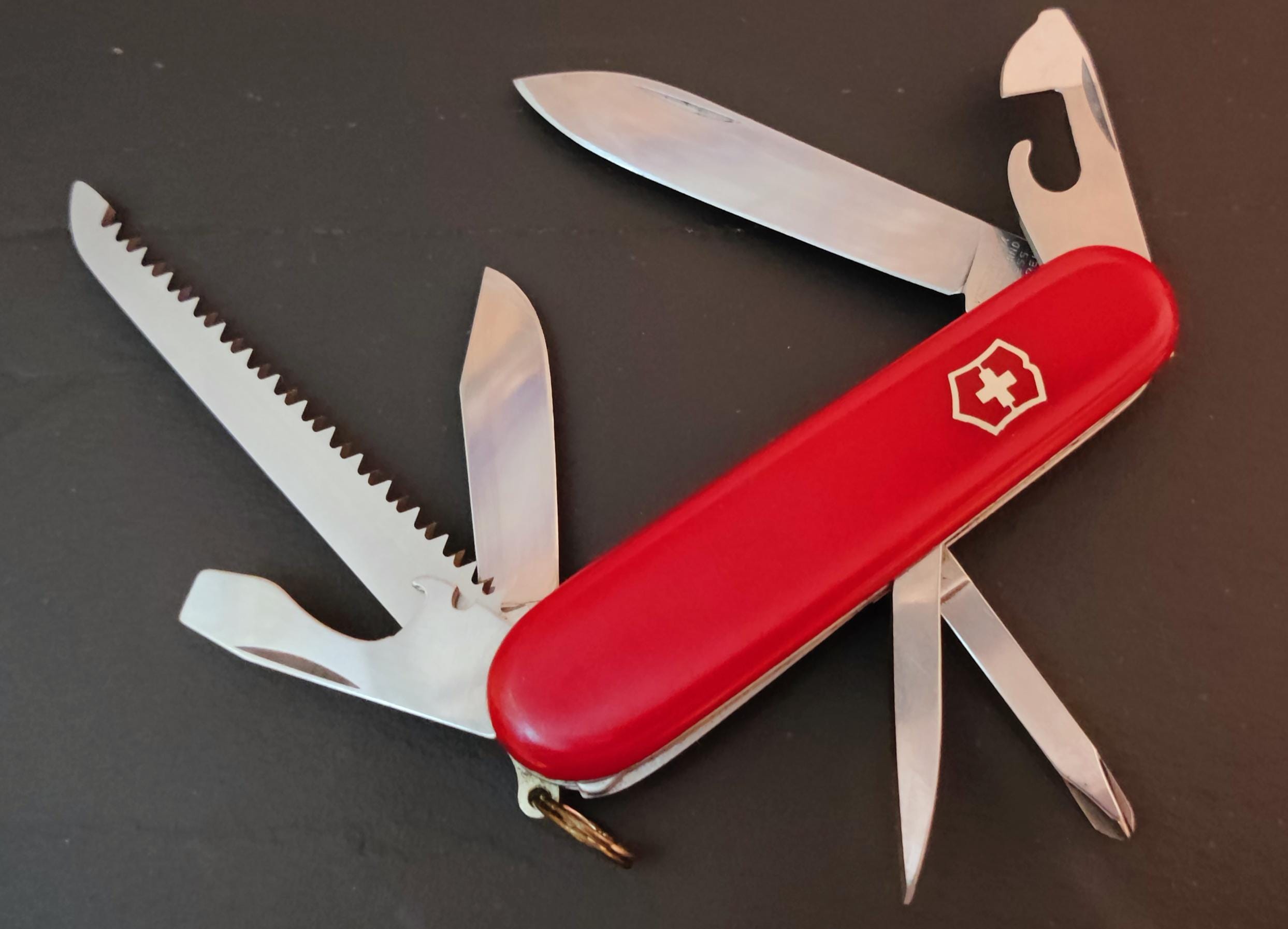
While earlier Woodsman models of the 1950s–70s were 4-layer knives without Toothpick and Tweezers, the new Woodsman adopted the modernized structure of the 1980s — including the magnifying glass and inline Phillips screwdriver.
This version effectively combines the outdoor identity of the Woodsman with the precision layer introduced in 1973.
I. Technical Overview
- Closed length: 91 mm
- Introduced: Mid-1980s
- Architecture: 5 layers
- Status: Discontinued
Tool configuration

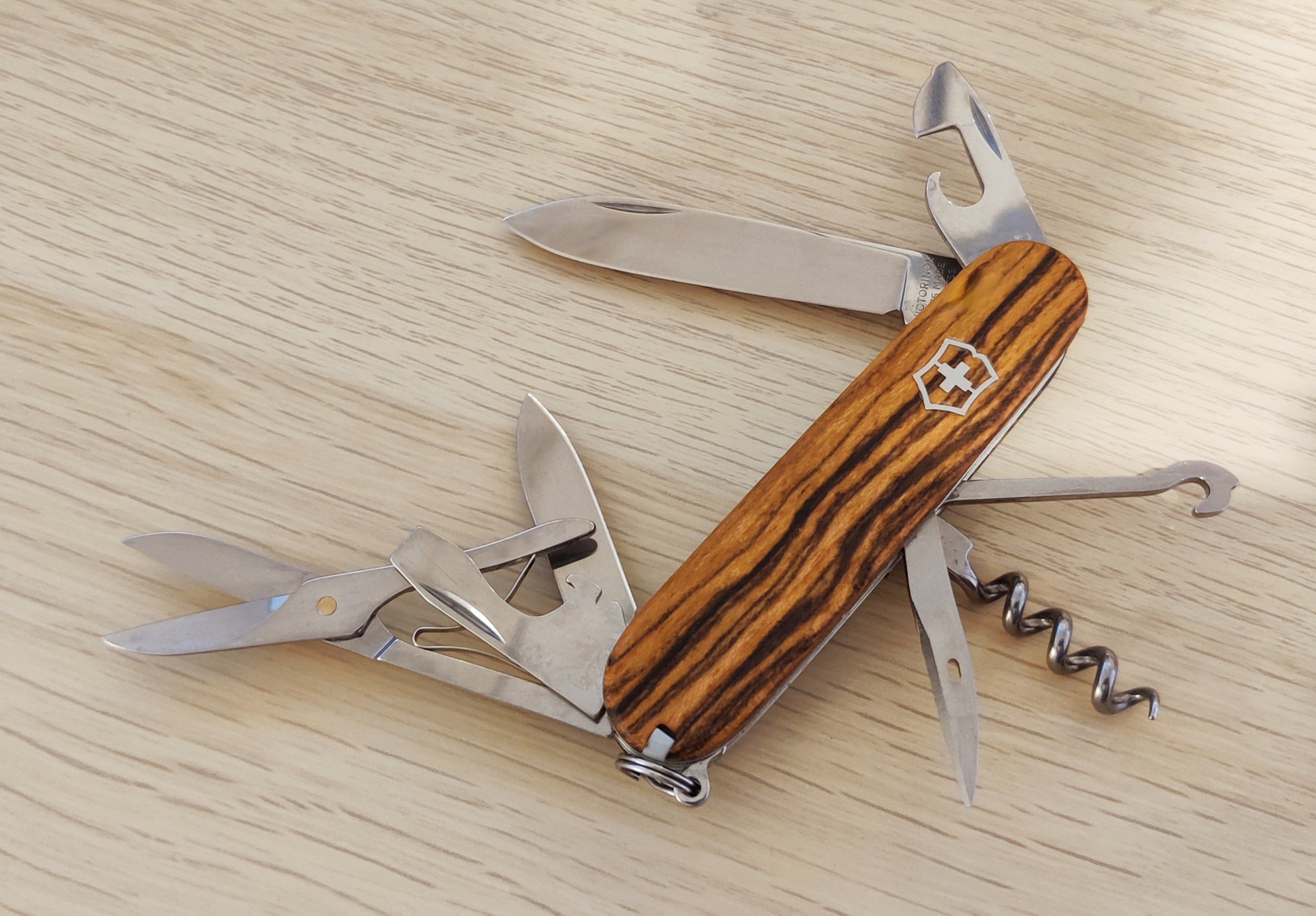
Late Woodsman 1990's
Large blade
Small blade
Scissors
Wood saw
Can opener + small screwdriver
Bottle opener + large screwdriver + wire stripper
Magnifying glass
Inline Phillips screwdriver
Back Layer Tools
Corkscrew
Reamer / awl
Fine screwdriver for latest models 1990's
Scale Tools
Toothpick
Tweezers
II. The Transfer of the Woodsman Name
Originally, the name Woodsman applied to a 4-layer configuration similar to the modern Huntsman without scale tools.

Catalogue 1982
By the mid-1980s, that Economy/Ecoline Huntsman is not anymore named Woodsman in catalogues, the name is reassigned to this new magnifier-equipped model.

Early Woodsman 1983-1985


Catalogue 1986

Woodsman 1986-1991
This reassignment reflects a broader marketing simplification within the 91 mm range.
III. Structural Identity
The Woodsman (magnifier version) can be understood structurally as:
Explorer + Wood Saw + Corkscrew
Compared to related models:
- Explorer → no saw
- Huntsman → no magnifier
- Modeler → earlier similar model with metal file in place of the woodsaw
This places the Woodsman in a precise niche: a balanced outdoor-capable magnifier configuration.

Woodsman White 1991
👉🔍Magnifying Glass — Models & Evolution
IV. A Notable Retail Edition — The Rabbit Inlay
One of the most attractive versions of the magnifier Woodsman appeared in a black scale variant with a rabbit metal inlay, produced for The Nature Company, a retail chain focused on science, nature, and educational products.

The rabbit emblem reinforced the outdoor identity of the model and aligned with the store’s naturalist branding.


The Nature Company was later acquired by Discovery Channel, which adds an interesting retail-historical context to this edition.
These black rabbit-inlay Woodsman examples are particularly appreciated by collectors today for their distinct aesthetic and niche distribution.
V. Production and Disappearance
The magnifier Woodsman remains in the range for a limited period during the late 1980s and early 1990s.

Woodsman 1991
It disappears as Victorinox gradually streamlines overlapping 5-layer configurations.
The Explorer and Huntsman remain the dominant mid-range references.
Position within the 91 mm Range
The Woodsman (magnifier) represents:
- The modernization of a historic name
- A transitional mid-1980s configuration
- A structurally coherent but short-lived model
It is one of the clearest examples of Victorinox reassigning a legacy name to a new toolset.
Collector Perspective and Significance
This version is interesting because:
- It demonstrates the reassignment of a historic model name
- It combines saw + magnifier + corkscrew and is by many considered as a perfect EDC
- It existed for a relatively short period
It remains far less common than the Explorer or Huntsman.
Related Models
Conclusion
The Woodsman (magnifier version) illustrates how Victorinox adapted historic model names to modern toolsets.
By merging outdoor functionality with the magnifier layer, it created a coherent but short-lived configuration — a transitional piece within the late-1980s evolution of the 91 mm range.
The black rabbit inlay edition adds a distinctive collector dimension, tying the model to a specific retail culture of science and nature-oriented stores of the era.
This article is part of the SAKnife Archives, an independent collector-driven project dedicated to documenting Victorinox Swiss Army Knives. All photographs shown come from the SAKnife private collection unless otherwise noted. The historical and technical information presented here is based on period catalogues and expert collector databases. Additional material will be added as new information emerges.
Identify every Victorinox 91 mm configuration using the structural identification tree:
👉 🔎 Victorinox 91mm Identification Tree – Identify Your Swiss Army Knife by Toolset
Identify the production period of your Swiss Army Knife using the interactive visual tool based on tang stamps and tool evolution:
👉 ⌛ Swiss Army Knife Production Period Guide – Victorinox Interactive Tool Evolution
Explore the evolution of Victorinox 91 mm Swiss Army Knives and discover related model sheets in the historical timeline:
👉 📘 Swiss Army Knife History & 91 mm Model Evolution