The Magnifier Icon — A Timeless Everyday Carry Since 1973
Introduction
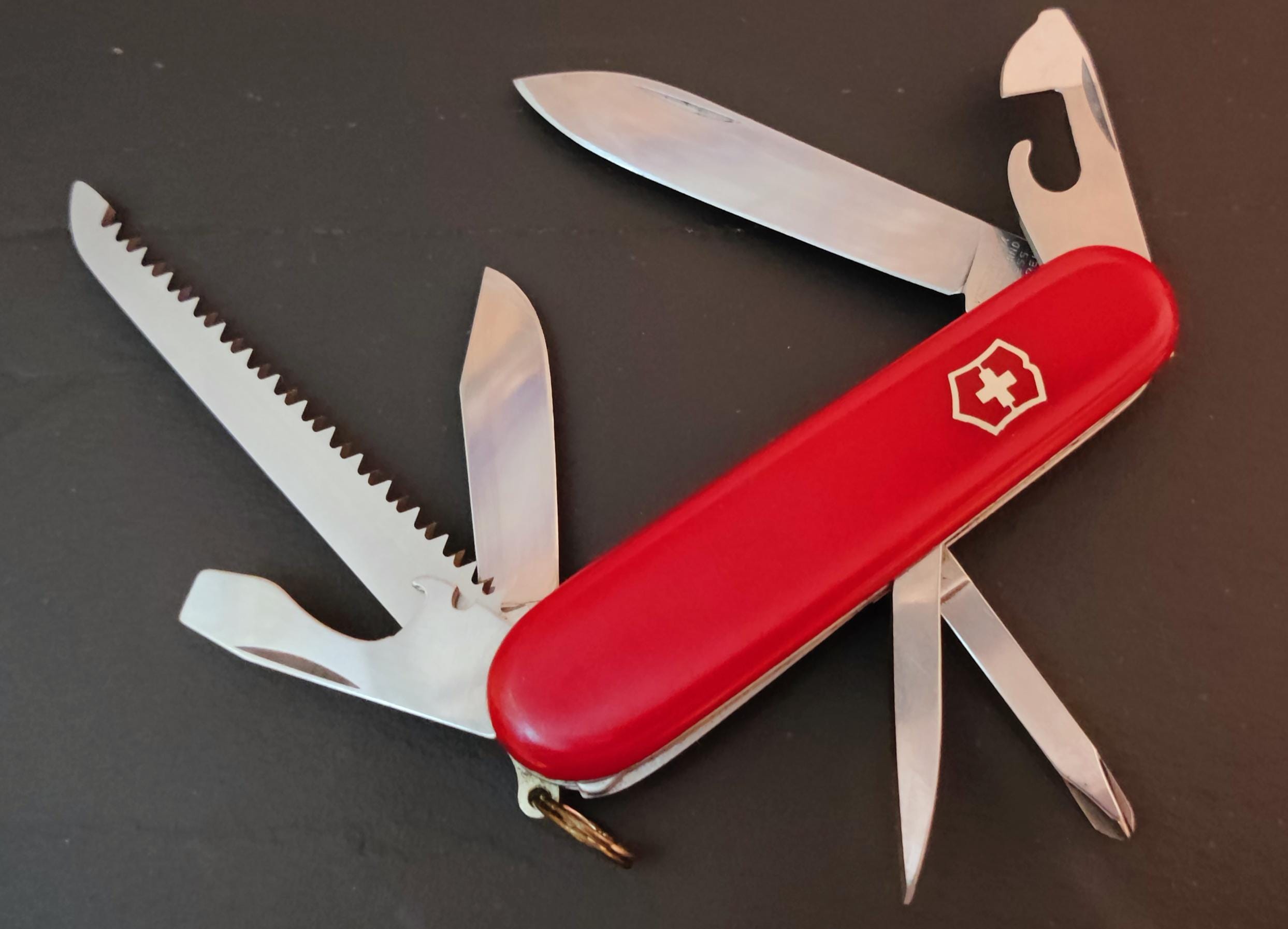
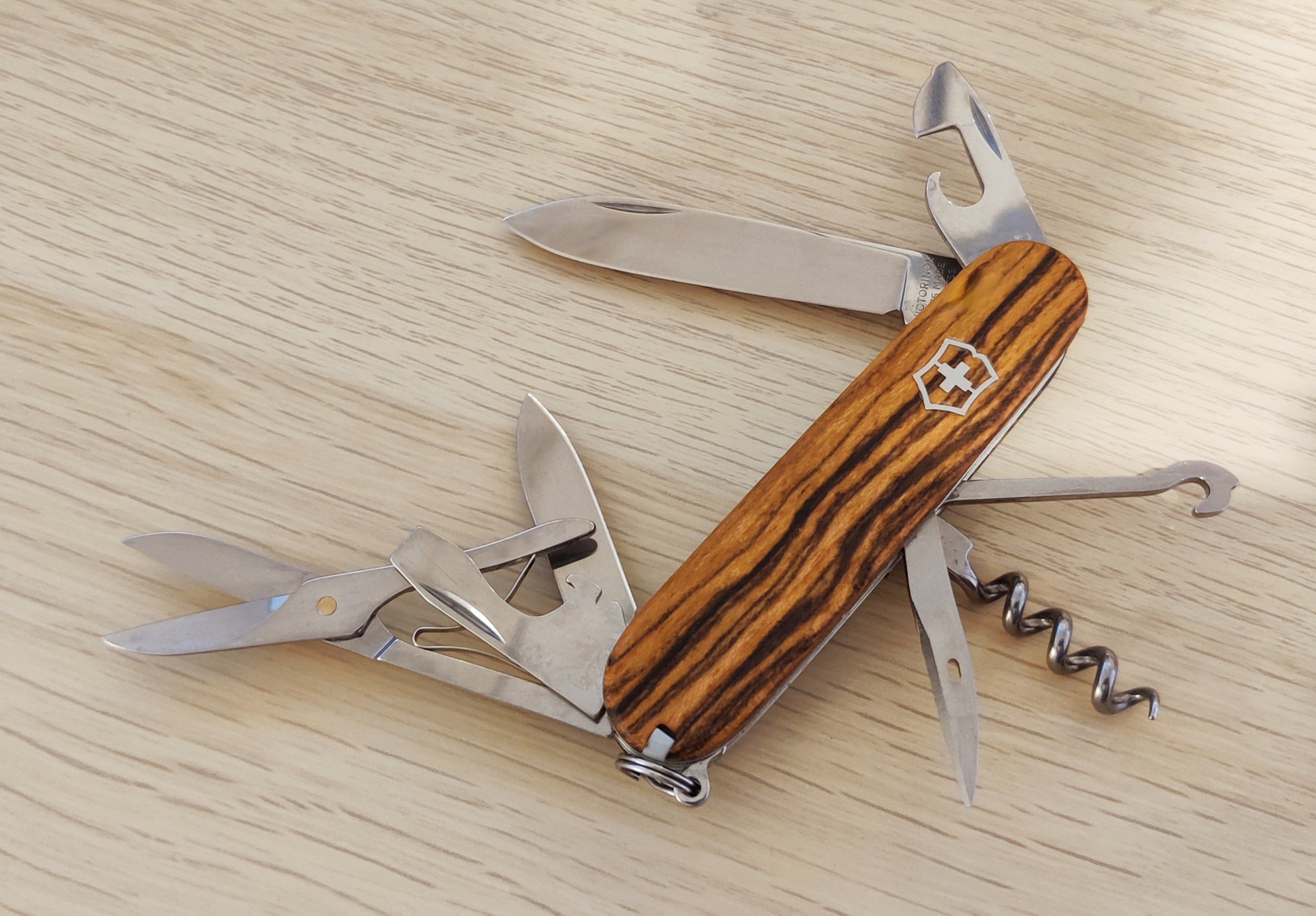
Introduced in 1973, the Victorinox Explorer quickly became one of the most appreciated everyday carry models in the 91 mm range.
Its defining feature is the magnifying glass paired with an inline Phillips screwdriver, a layer that marked a turning point in Victorinox’s evolution during the post-1973 restructuring.
Unlike many complex models of that era, the Explorer never disappeared.
It remains in production today — one of the longest-running magnifier-equipped configurations in the lineup.
I. Technical Overview — A Balanced 4-Layer EDC
- Closed length: 91 mm
- Introduced: 1973
- Architecture: 4 layers
- Modern reference: 1.6703
- Status: Still in production
Tool configuration

Explorer 1983-1985
Large blade
Small blade
Scissors
Can opener + small screwdriver
Bottle opener + large screwdriver + wire stripper
Magnifying glass
Inline Phillips screwdriver
Back Layer Tools
Reamer / awl
Corkscrew
Scale Tools
Toothpick
Tweezers
II. The 1973 Magnifier Generation

Explorer 1973
The Explorer belongs to the first wave of magnifier-equipped models introduced in 1973, alongside:
- Champion C
- 👉Modeler
- Passenger

Within this group, the Explorer offered the most practical everyday balance: classic openers, scissors, and the new magnifier layer — without excessive bulk.

Catalogue 1973
It quickly established itself as a versatile urban and light outdoor tool.
III. The Magnifying Glass — Utility and Identity
The Explorer’s magnifier is not decorative — it is functional.
It allows:
- Inspection of small mechanical components
- Reading fine print
- Fire-starting by focusing sunlight
Many collectors prefer the early grey housing with the 8× glass lens, widely regarded as optically superior and mechanically more robust than later revisions.

1970s–1980s examples with this grey magnifier are particularly appreciated.
👉🔍Magnifying Glass — Models & Evolution
IV. Hoffritz Era and Export Success
Throughout the 1970s and 1980s, the Explorer appeared in Hoffritz USA catalogues, with Hoffritz metal inlay helping solidify its presence in the American market.
👉Victorinox Non-Regular Metal Inlays

Hoffritz Catalogue 1970's
Its balanced configuration made it one of the most recommended mid-range Officer knives — versatile without being overly dense.

Explorer Hoffritz 1970's
The strong Hoffritz exposure significantly contributed to its export success.
V. BSA Anecdote — When “Yeoman” Became an Explorer
Both the Explorer and the original Yeoman appeared with Boy Scouts of America inlay.

Explorer BSA mid 1980's
However, after the true Yeoman configuration (with combo tool layout) was stopped, BSA continued using the name “Yeoman” — while the knife supplied under that designation was in fact an Explorer configuration with plus scales.


Explorer Plus BSA late 1990's
In practice:
- The original Yeoman disappeared.
- The Explorer replaced it structurally.
- The Yeoman name remained in BSA documentation.
This historical naming transition explains much of the confusion surrounding “BSA Yeoman” examples today.
👉Victorinox BSA Metal Inlays — SAKnife Archives
Position within the 91 mm Range
The Explorer occupies a precise structural niche:
- Slim magnifier + inline Phillips configuration
- More versatile than the Spartan
- Less dense than the Champion C
- More practical for daily carry than heavier 5- and 6-layer models

Catalogue 1980's

Interesting Explorer end of the 1980's with old white ivory color scale, note the Phillips and Scissors layers are reversed

Explorer 1985 from Zurich, reversed Phillips and Scissors layers
For many enthusiasts, it represents the ideal magnifier-based everyday carry.
Collector Perspective and Significance
The Explorer stands out because:
- It democratized the magnifier layer
- It has enjoyed uninterrupted production since 1973
- Early grey 8× magnifier versions are especially desirable
- It played a subtle role in the BSA naming transition
Unlike many 1970s introductions, it was never rationalized out of existence during later range simplifications.

Catalogue 1990's

Explorer 2020's with Ruby Scales
It endured — and still does.
Related Models
- 👉Champion C – Flagship magnifier model of 1973
- 👉Yeoman – Combo tool magnifier variant
-
👉Passenger – Slim magnifier configuration
Conclusion
The Victorinox Explorer is one of the clearest examples of sustainable design in the 91 mm lineage.
Introduced during a pivotal restructuring in 1973, it combined innovation (magnifier + inline Phillips) with everyday practicality.
More than fifty years later, it remains in production — proof that some tool combinations simply get it right the first time.
This article is part of the SAKnife Archives, an independent collector-driven project dedicated to documenting Victorinox Swiss Army Knives. All photographs shown come from the SAKnife private collection unless otherwise noted. The historical and technical information presented here is based on period catalogues and expert collector databases. Additional material will be added as new information emerges.
Identify every Victorinox 91 mm configuration using the structural identification tree:
👉 🔎 Victorinox 91mm Identification Tree – Identify Your Swiss Army Knife by Toolset
Identify the production period of your Swiss Army Knife using the interactive visual tool based on tang stamps and tool evolution:
👉 ⌛ Swiss Army Knife Production Period Guide – Victorinox Interactive Tool Evolution
Explore the evolution of Victorinox 91 mm Swiss Army Knives and discover related model sheets in the historical timeline:
👉 📘 Swiss Army Knife History & 91 mm Model Evolution