The Rare Huntsman with Pliers
Introduction
The Victorinox Motorist is one of the most unusual models of the 1990s 91 mm range.
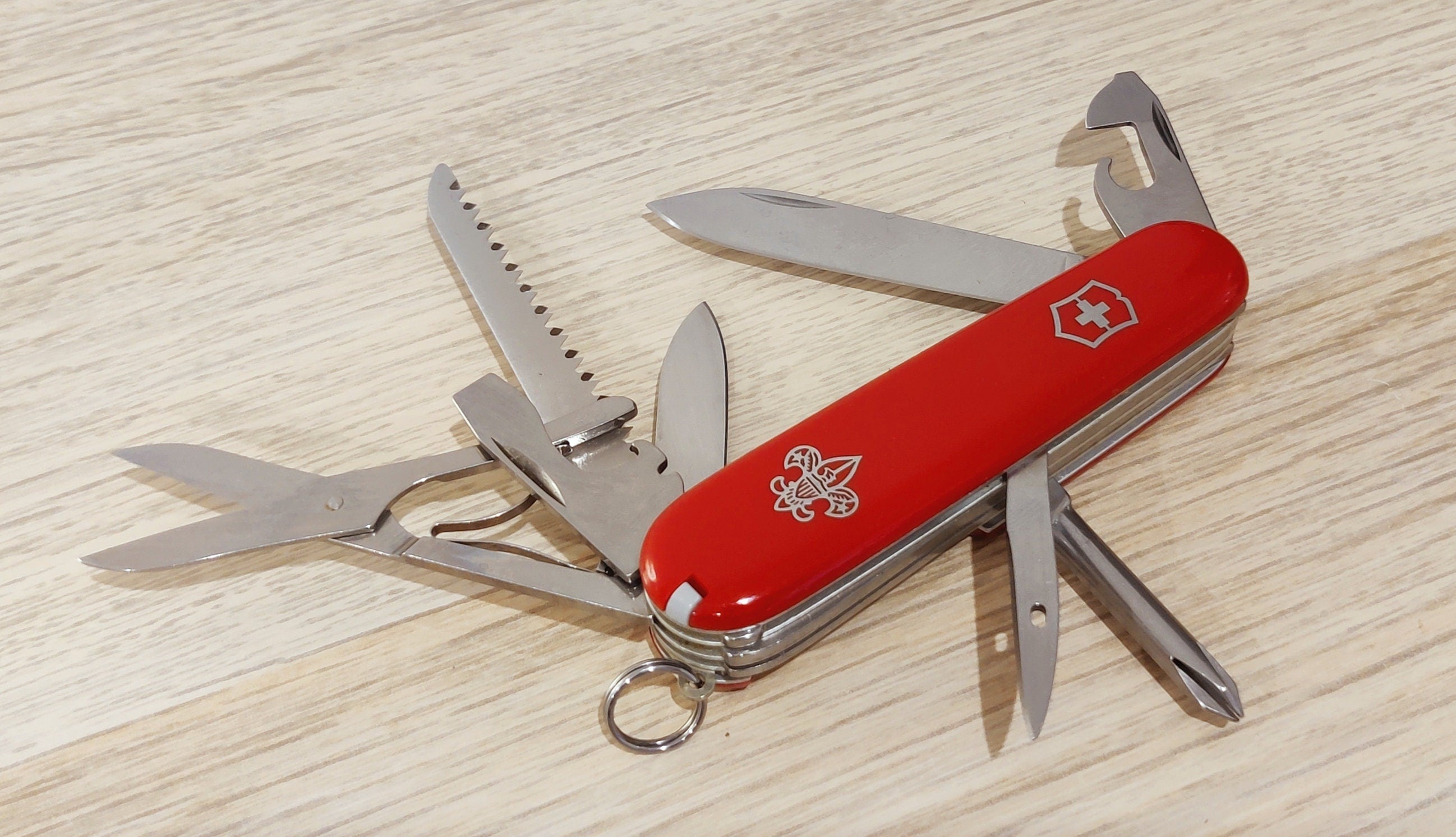
Produced with economy nylon scales, it combines an uncommon toolset rarely seen in the standard lineup: scissors, wood saw and 🗜️Pliers in the same knife.
Although it never appeared prominently in catalogues, surviving examples suggest production during the early to late 1990s, making it a relatively short-lived and uncommon configuration today.
Because of this unusual architecture and limited visibility in official documentation, the Motorist remains a little-known but fascinating model for collectors.
I. Technical Overview

Late 1990's Motorist
The Motorist is built on a 5-layer architecture and features economy nylon scales, a configuration rarely used for such a complete toolset.
Main Tools
Large blade
Small blade
Scissors
Wood saw
🗜️Pliers with wire cutters
Can opener + small screwdriver
Bottle opener + large screwdriver + wire stripper
Back Layer Tools
Corkscrew
Fine screwdriver
Reamer / awl
Scale Tools
Toothpick
Tweezers
II. A 1990s Economy Experiment
Evidence from surviving examples suggests the Motorist appeared during the early 1990s and continued through the decade.
Interestingly, early examples show transitional tool features, including:
- screw-pivot scissors
- second-generation pliers without the spring groove


Motorist Early 1990's with scissors pivot screw and 2nd gen plier - note that one doesn't have the back fine screwdriver
These characteristics indicate that the model likely appeared earlier than often assumed, probably at the beginning of the 1990s, during a period of ongoing tool evolution within the Victorinox lineup.
Unlike most complex 91 mm knives, the Motorist was produced with nylon economy scales, a material normally reserved for simpler or cost-focused models. This positioning suggests the knife may have been intended as a robust working tool rather than a premium catalogue model.
IV. A Discreet and Poorly Documented Model
One of the most intriguing aspects of the Motorist is its absence from most Victorinox catalogues.
The model appears to have circulated mainly through specific distributors or limited markets, which may explain why documentation remains scarce today.

Unusual Motorist with Turquoise Scales, end of 1999's
Interestingly, the Motorist name itself is not entirely new in Victorinox history.
In certain 1960s catalogues, the term Motorist was occasionally used to describe the Automobile model (8134m) — a technical knife equipped with the inline technician screwdriver and the St. Christoph automotive inlay.

👉Automobile 8134m, named ''Motorist''
The reuse of the name in the 1990s therefore fits a long-standing Victorinox tradition of recycling descriptive model names across different generations of knives.
Position within the 91 mm Range
The Motorist occupies an unusual position within the Victorinox lineup.
It sits somewhere between:
- the Huntsman (scissors + wood saw)
- and the Handyman (scissors + pliers + saw + file)
The Motorist effectively delivers much of the capability of these larger knives while remaining more compact and lighter.
Collector Perspective and Significance
Several factors contribute to the Motorist’s collector appeal:
- uncommon tool combination
- economy nylon scales on a relatively complex toolset
- evidence of early-1990s transitional tool versions
- very limited documentation in official catalogues
Because of these characteristics, the Motorist is often considered a curious and somewhat overlooked configuration within the evolution of the Victorinox 91 mm range.
Related Models
👉Huntsman
👉Handyman
👉Mechanic
👉Deluxe Climber
Conclusion
The Victorinox Motorist illustrates how the Swiss Army Knife lineup occasionally produced unexpected configurations outside the standard catalogue structure.
By combining the practical outdoor toolset of the Huntsman with the added capability of pliers, the Motorist created a compact yet versatile knife.
Although never widely documented, it remains an intriguing piece of Victorinox history — and a reminder that some of the most interesting Swiss Army Knives are the ones that appeared quietly and disappeared just as discreetly.
This article is part of the SAKnife Archives, an independent collector-driven project dedicated to documenting Victorinox Swiss Army Knives. All photographs shown come from the SAKnife private collection unless otherwise noted. The historical and technical information presented here is based on period catalogues and expert collector databases. Additional material will be added as new information emerges.
Identify every Victorinox 91 mm configuration using the structural identification tree:
👉 🔎 Victorinox 91mm Identification Tree – Identify Your Swiss Army Knife by Toolset
Identify the production period of your Swiss Army Knife using the interactive visual tool based on tang stamps and tool evolution:
👉 ⌛ Swiss Army Knife Production Period Guide – Victorinox Interactive Tool Evolution
Explore the evolution of Victorinox 91 mm Swiss Army Knives and discover related model sheets in the historical timeline:
👉 📘 Swiss Army Knife History & 91 mm Model Evolution