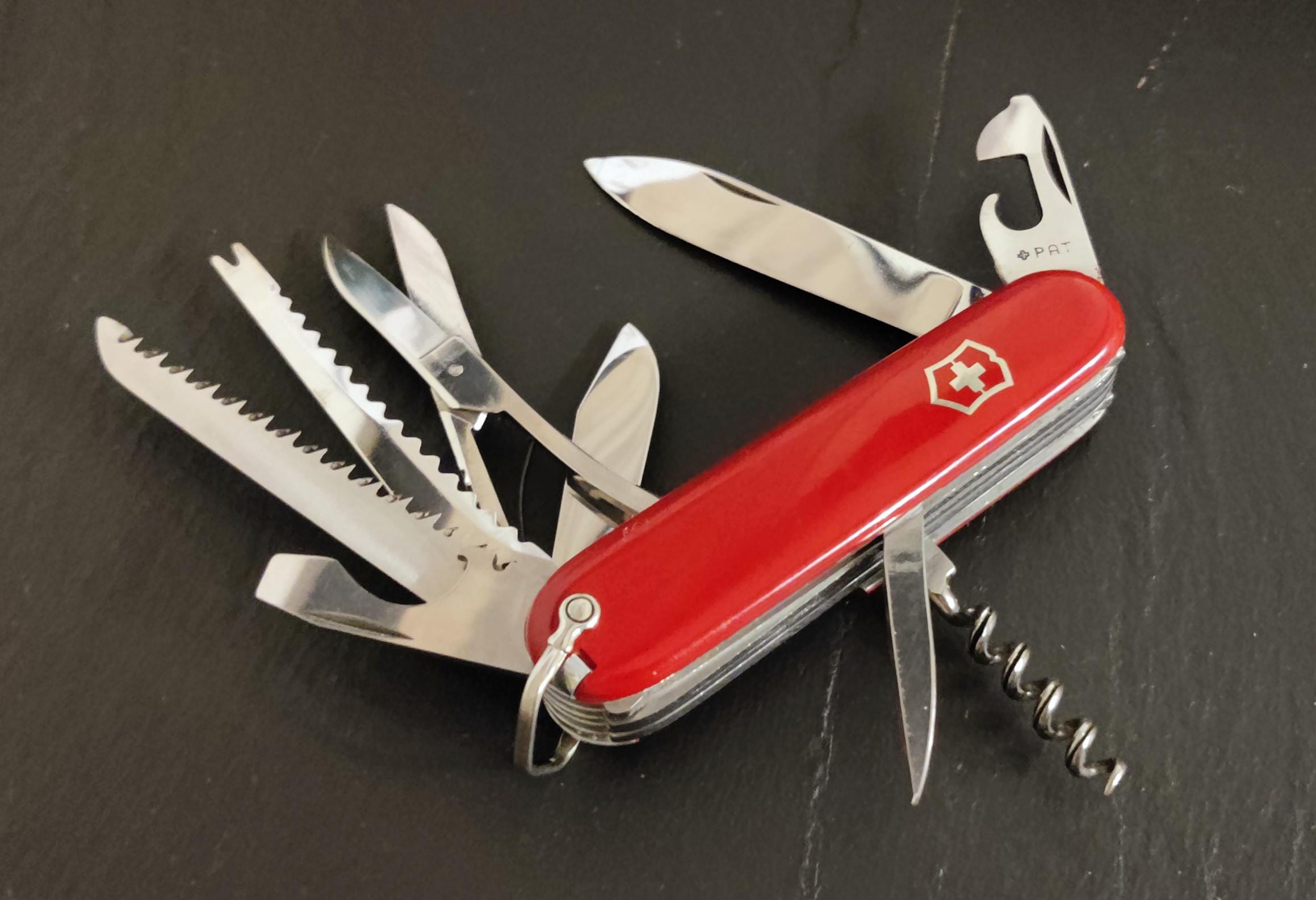
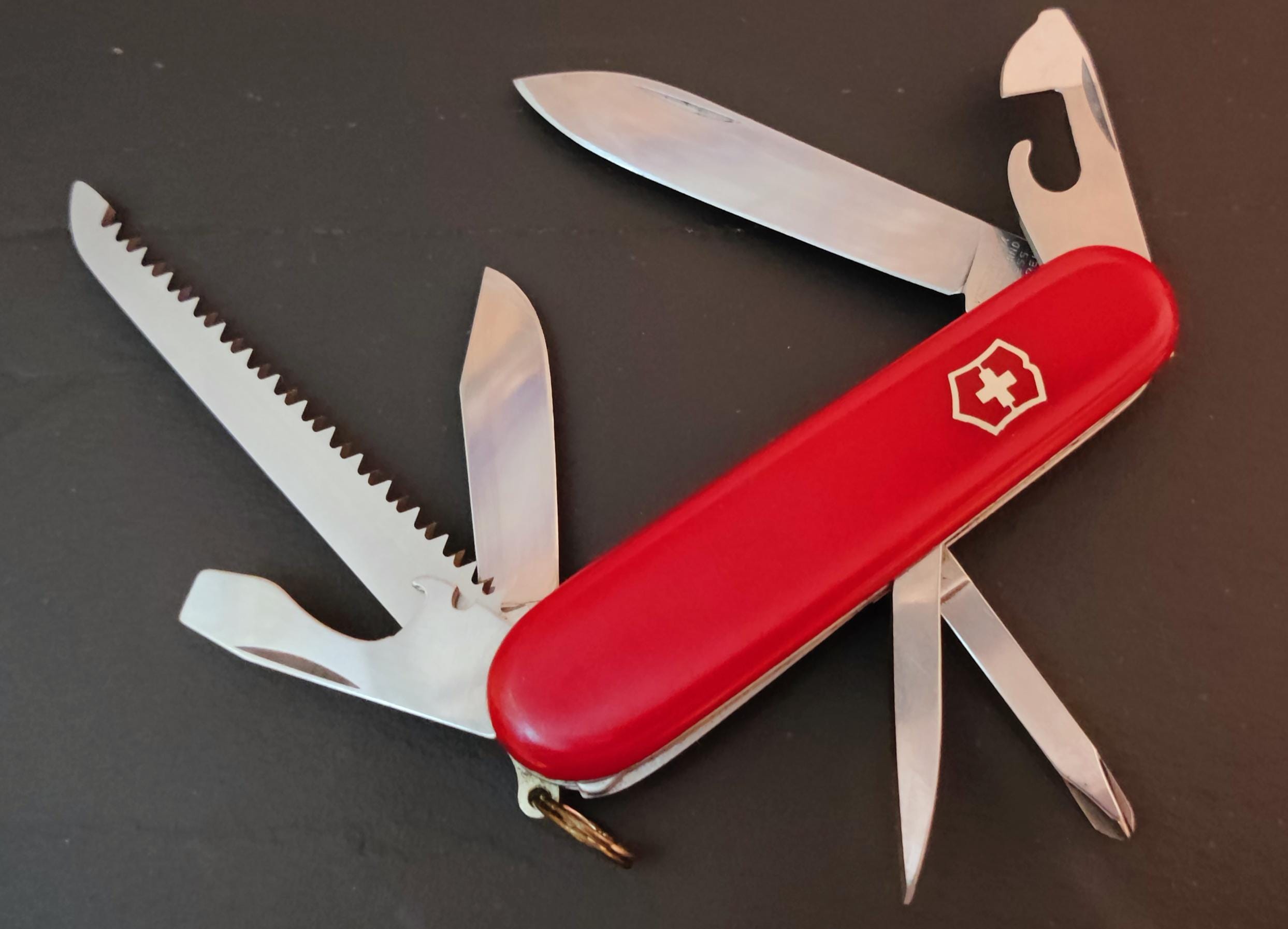
The Enduring Corkscrew Heir of the Champion A
Introduction
Introduced in 1973, the Victorinox Handyman 236fm emerges during the major restructuring of the 91 mm Officer range.
👉📜Victorinox Transitional Year 1973 – a pivotal moment in Swiss Army Knife history
It directly continues the architecture of the Champion A 246fm of the 1960s — minus the Long Nail File (LNF).
The Champion had already existed in two variants:
- Champion A (corkscrew)
- Champion B (Phillips)

Champions from the early 1960's
In 1973, these configurations were no longer presented as options under a single flagship name. They became distinct catalog models.
The corkscrew branch became the Handyman — and, unlike many of its contemporaries, it never disappeared.
I. Technical Overview — A 6-layer Champion Legacy
- Closed length: 91 mm
- Old reference: 236fm
- Introduced: 1973
- Architecture: 6 layers
Tool configuration

Handyman 236fm late 1970's
Large blade
Small blade
Wood saw
Metal file
Scissors
Can opener + small screwdriver
Bottle opener + large screwdriver + wire stripper
Fish scaler / 🗜️Pliers after 1986

Modern Handyman
Back Layer Tools
Reamer / awl
Corkscrew
Scale Tools
Toothpick
Tweezers
II. From Champion A to Handyman
Structurally, the Handyman 236fm is the Champion A without the LNF layer.

Late 1971/1972 Champion A 246fm
The 1973 restructuring did not create a new concept — it formalized existing architectures under clearer identities.

Early Handyman 236fm 1973
As with the Craftsman (Phillips branch), the Handyman preserved the dense multi-layer format of the 1960s Champion generation — streamlined, but still structurally imposing.

Victorinox Catalogue early 1980's
III. The 1980s Transition — Pliers Replace the Fish Scaler
In the late 1980s, the Handyman undergoes its defining evolution.

1986 Catalogue picturing Handyman with first thin 2.5mm Plier

Handyman 1985-1988 with first Plier
Like the Craftsman, it replaces the fish scaler with the new fine 2.5 mm plier layer, and shortly thereafter (c. 1988), the pliers are reinforced.

Handyman 1988-1991
From that point onward, the Handyman adopts the configuration that continues into modern production.

1991 Catalogue
This marks the shift from a primarily outdoor-oriented architecture toward a more mechanical multi-tool identity — without sacrificing its layered density.
IV. A Frequent Corporate Platform
Throughout its production life, the Handyman proved especially attractive as a corporate and commemorative base model.
👉Victorinox Non-Regular Metal Inlays
Examples exist from both the 1970s and post-1985 period, confirming its consistent appeal as a prestigious 6-layer platform.

Beautiful mid-1980's Handyman Dupont Centari

Brown Boveri Handyman

Handyman World Food Programme with Nylon blue scales

Handyman United Nations with Nylon Scales

Beautiful Handyman Swiss Cheese
Its balance — neither flagship nor entry-level — made it ideal for customized scales and metal inlays.
V. Astronaut Tribute — A Lineage Honored
In 2017, the Handyman lineage received a symbolic tribute.
As part of the I.N.O.X. Sky High Limited Edition, a white-scale Handyman was released featuring the iconic Astronaut metal inlay, echoing the historic Apollo-era commemorations associated with the Champion lineage.

It was a subtle but powerful reminder:
The corkscrew branch of the original Champion never vanished.
It simply evolved.
Position within the 91 mm Range
The Handyman occupies a unique and enduring position:
- Direct heir to the Champion A
- Corkscrew counterpart to the Craftsman
- One of the very few 6-layer Champion-era architectures still alive
- A model that successfully transitioned from fish scaler to pliers
While many dense configurations disappeared as Victorinox streamlined its range — particularly after the Wenger acquisition — the Handyman endured.
It remains today as a living continuation of the early 1950s Champion platform.
Collector Perspective and Significance
The Handyman 236fm matters because:
- It preserves the corkscrew lineage of the original Champion
- It bridges the fish-scaler era and the plier era
- It served extensively as a corporate base
- It received a modern Astronaut homage
- It remains in production — a rarity among legacy-heavy models
Few 91 mm knives can claim such continuity.
The Handyman is not merely inspired by the Champion A.
It is its evolution.
Related Models
- 👉Champion A 246fm – The direct ancestor
- 👉Craftsman 136fm – The Phillips counterpart
- 👉Champion C – The post-1973 flagship
-
👉Handyman 7236m – A earlier Elinox cousin with inline technician screwdriver
Conclusion
The Victorinox Handyman 236fm stands as one of the most enduring architectures in the 91 mm lineage.
Born from the 1973 restructuring, refined in the late 1980s with the plier transition, and still present today, it embodies the continuity of the Champion tradition.
Where many heavyweights disappeared, the Handyman adapted — ensuring that the spirit of the corkscrew Champion remains alive in the modern range.
This article is part of the SAKnife Archives, an independent collector-driven project dedicated to documenting Victorinox Swiss Army Knives. All photographs shown come from the SAKnife private collection unless otherwise noted. The historical and technical information presented here is based on period catalogues and expert collector databases. Additional material will be added as new information emerges.
Identify every Victorinox 91 mm configuration using the structural identification tree:
👉 🔎 Victorinox 91mm Identification Tree – Identify Your Swiss Army Knife by Toolset
Identify the production period of your Swiss Army Knife using the interactive visual tool based on tang stamps and tool evolution:
👉 ⌛ Swiss Army Knife Production Period Guide – Victorinox Interactive Tool Evolution
Explore the evolution of Victorinox 91 mm Swiss Army Knives and discover related model sheets in the historical timeline:
👉 📘 Swiss Army Knife History & 91 mm Model Evolution