Introduction
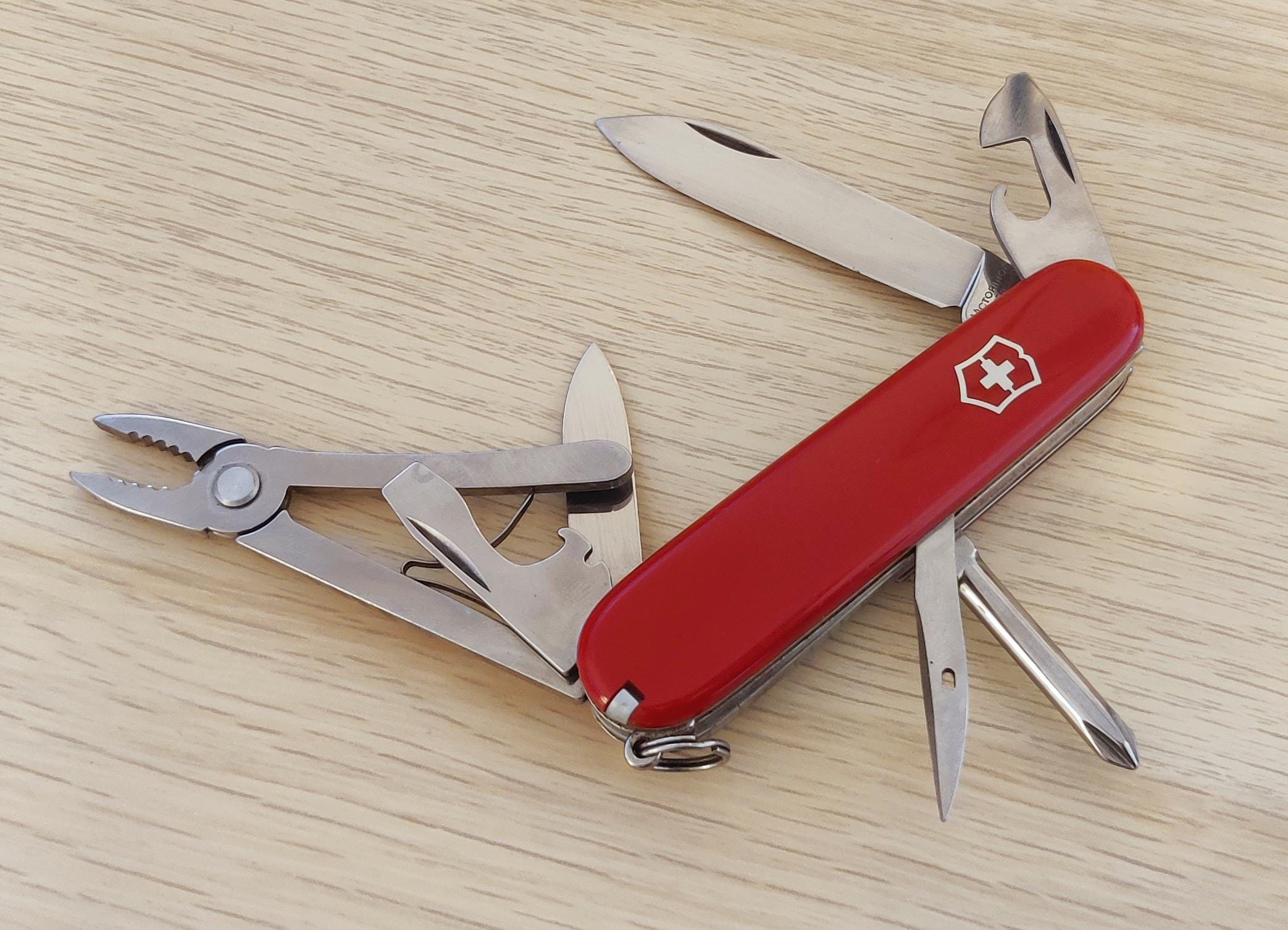
The Victorinox “Rainier” is a late 1990s limited edition built on the Huntsman platform and associated with a small series of mountain-themed Victorinox models.
Named after Mount Rainier in the United States, it combines the classic outdoor-oriented Huntsman configuration with a partially serrated main blade, creating a more aggressive cutting profile while retaining the versatility of the original model.
I. Technical Overview

Model: Rainier
Length: 91 mm
Layers: 4
Tools
- Partially serrated large blade
- Small blade
- Wood saw
- Scissors
- Can opener (with small screwdriver)
- Cap lifter (with screwdriver / wire stripper)
Back tools
- Corkscrew
- Reamer / awl
- Multipurpose hook
Scale tools
- Toothpick
- Tweezers
II. A Modified Huntsman Platform
The Rainier is directly derived from the Huntsman, one of the most iconic outdoor-oriented Victorinox configurations.
The key difference lies in the main blade:
- standard plain edge replaced by a partially serrated blade


This modification improves:
- cutting performance on fibrous materials
- grip during pull cuts
- efficiency on rope and outdoor materials
while preserving the overall versatility of the Huntsman platform.
For the standard configuration history and evolution, see:
👉Victorinox Huntsman
III. The Mountain Series
The Rainier belongs to a small late-1990s “Mountain Series” including:
- Rainier
- McKinley
- Matterhorn
These models shared:
- mountain-inspired identities
- partially serrated blades
- classic 91 mm outdoor-oriented configurations

Catalogue US 1999
These configurations are based on different standard platforms:
- Rainier → Huntsman
- Matterhorn → Deluxe Tinker variant
- McKinley → smaller Tinker configuration
Related Models
- 👉Huntsman
- McKinley
- 👉Matterhorn
- 👉Weekender
Conclusion
The Victorinox Rainier represents a rare late-1990s evolution of the classic Huntsman platform.
As part of the Mountain Series alongside the McKinley and Matterhorn, it reflects Victorinox’s exploration of more aggressive outdoor-oriented variations while retaining the proven versatility of the traditional 91 mm toolset.
Explore the history of Victorinox's fully serrated blade and every model that featured it:
👉 〰️ Victorinox Serrated Blade Models — The History of the Fully Serrated Blade
This article is part of the SAKnife Archives, an independent collector-driven project dedicated to documenting Victorinox Swiss Army Knives. All photographs shown come from the SAKnife private collection unless otherwise noted. The historical and technical information presented here is based on existing data shared by recognized collector communities, forums, and expert collector databases. Additional period examples and variants will be added over time as the archive continues to grow.
Identify every Victorinox 91 mm configuration using the structural identification tree:
👉 🔎 Victorinox 91mm Identification Tree – Identify Your Swiss Army Knife by Toolset
Identify the production period of your Swiss Army Knife using the interactive visual tool based on tang stamps and tool evolution:
👉 ⌛ Swiss Army Knife Production Period Guide – Victorinox Interactive Tool Evolution
Explore the evolution of Victorinox 91 mm Swiss Army Knives and discover related model sheets in the historical timeline:
👉 📘 Swiss Army Knife History & 91 mm Model Evolution